
How to Play
Blackjack Switch is a modern casino Blackjack variant where you play 2 hands at once and may swap a card between them to build stronger totals, in exchange for a dealer-22 push rule and an even-money natural payout.
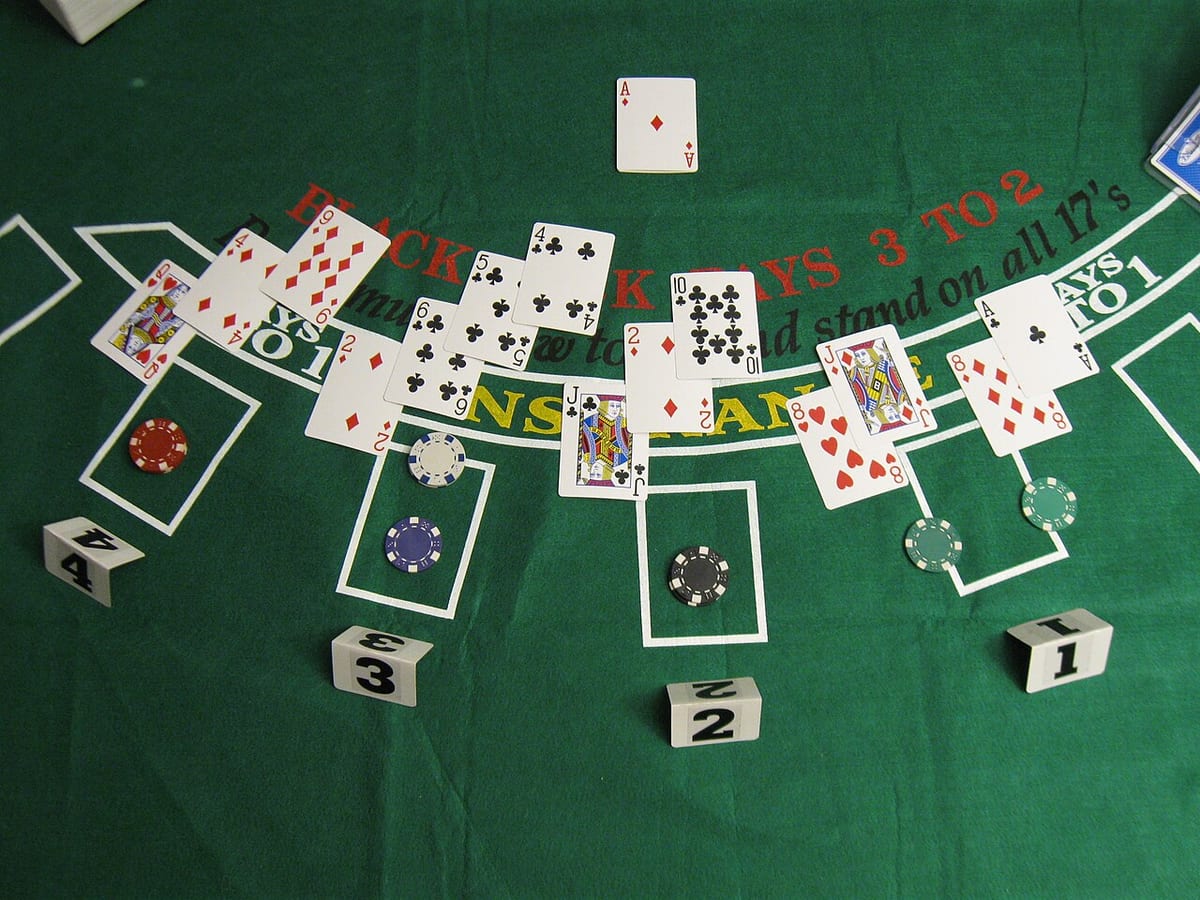
Blackjack Switch is a casino variant of Blackjack in which each player is dealt 2 hands instead of 1 and may swap the second card dealt to each hand to build stronger totals out of the same 4 cards. Invented by casino executive Geoff Hall and introduced on the Las Vegas Strip in 2009, it keeps Blackjack's familiar hit, stand, double, and split structure but adds a single, once-per-round SWITCH decision right after the deal. That extra option comes at a cost: a dealer total of exactly 22 pushes instead of busting, and a natural blackjack typically pays even money instead of 3:2. Players who learn switch-specific basic strategy can bring the house edge close to that of a standard 3:2 Blackjack game, making Switch one of the more player-friendly widely spread proprietary casino table games.
Quick Reference
- Place 2 equal bets and receive 2 hands of 2 cards each, all dealt face-up.
- Optionally swap the second card of Hand A with the second card of Hand B, once, before playing either hand.
- Dealer receives 1 upcard and 1 hole card, exactly as in standard Blackjack.
- Play Hand A fully, hit, stand, double, or split, before moving to Hand B.
- Dealer reveals the hole card, then hits below 17 and stands on 17 or higher.
- A dealer total of exactly 22 pushes instead of busting.
- Each hand wins, loses, or pushes independently against the dealer.
- An unswitched natural blackjack typically pays even money (1:1), not the standard 3:2.
- A regular win pays 1:1 per hand; a dealer bust above 22 pays out normally.
Players
1 to 7 players per table, each playing SOLO against the dealer using 2 separate hands; players do not compete with each other. Because every player controls 2 hands per round, the table moves somewhat slower than standard Blackjack. A single round, betting, the switch decision, playing both hands, and the dealer's turn, takes about 2 to 3 minutes; a session is bounded by bankroll or time rather than a fixed number of rounds.
Card Deck
- Played with 6 or 8 standard 52-card decks shuffled together in a shoe, matching the multi-deck format used at most Blackjack tables; smaller casinos sometimes deal from 2 decks by hand.
- No jokers; no wild cards.
- Suits are irrelevant; only rank values matter, exactly as in standard Blackjack.
- Card values: number cards 2-10 = face value; face cards (J, Q, K) = 10; Ace = 1 OR 11, whichever benefits the holder.
- A hand containing an Ace counted as 11 is a 'soft hand' (e.g., is 'soft 17'); if counting the Ace as 11 would bust the hand, it reverts to 1 and the hand becomes 'hard'.
Objective
Beat the dealer on EACH of your 2 hands independently by finishing closer to 21 than the dealer without busting; it is entirely possible to win 1 hand and lose the other in the same round. Before playing either hand, you may SWITCH the second card dealt to Hand A with the second card dealt to Hand B, once, to try to turn 4 mediocre starting cards into 2 stronger totals. In exchange for that option, a dealer total of exactly 22 pushes against any player hand that has not busted, instead of losing to the dealer's bust as it would in standard Blackjack, and a natural blackjack usually pays even money (1:1) rather than the customary 3:2.
Setup
- Place 2 equal bets, one for each hand you will play; both bets must fall within the table's posted minimum and maximum.
- Initial deal: each player receives 2 hands of 2 cards each, all dealt face-up; the dealer receives 1 face-up upcard and 1 face-down hole card, exactly as in standard Blackjack.
- Switch decision: immediately after the deal, before any hitting or doubling, you may swap the SECOND card dealt to Hand A with the second card dealt to Hand B. This is optional, free, and can be done only once per round, before either hand is played.
- Natural check: if the dealer's upcard is an Ace or 10-value card, the dealer peeks at the hole card. A dealer natural ends the round immediately; a player hand that is also a natural pushes, all other hands lose.
- Play begins with the player to the dealer's LEFT and proceeds clockwise; each player finishes Hand A completely before moving to Hand B, and the dealer plays last.
Gameplay
- Per-hand options: HIT (take another card), STAND (keep the hand's current total), DOUBLE DOWN (double that hand's bet, take exactly 1 more card, then stand), or SPLIT (if that hand's 2 cards share a rank, separate them into 2 hands with a matching bet; most houses cap re-splits at 3 or 4 total hands and give split Aces only 1 further card each).
- Playing 2 hands: resolve Hand A completely, through busting, standing, or doubling, before starting Hand B. A bust on 1 hand does not end the other; each hand is settled independently against the dealer.
- Illustrating the switch: starting with Hand A (soft 16) and Hand B (16), swapping the second cards produces Hand A (a comfortable soft 17 to stand on) and Hand B (15, an easier total to improve with 1 more card than the original 16). Switching cannot change the combined value of your 4 cards, only how that value is split between your 2 hands, so it pays off when it turns 2 awkward totals into 1 strong hand plus 1 more playable one, or when it completes a 21.
- Dealer's turn: after every player has acted on both hands, the dealer reveals the hole card and must HIT on totals below 17 and STAND on 17 or higher; most Blackjack Switch tables stand on soft 17, though rule cards vary by casino.
- Dealer 22 rule: if the dealer's final total is exactly 22, every remaining player hand that has NOT busted PUSHES instead of winning. This single rule is what funds the switching advantage and is the defining feature of the variant.
Scoring
- Regular win: pays 1:1 on that hand's bet.
- Natural blackjack (unswitched): an Ace plus a 10-value card as a hand's original 2 cards, before any switch, typically pays even money (1:1) at Blackjack Switch tables instead of the 3:2 paid by standard Blackjack; always check the posted payout before sitting down.
- Push: including the special dealer-22 push, returns that hand's bet with no win or loss.
- Loss: the dealer collects that hand's bet.
- Super Match side bet (where offered): an optional side wager, separate from the main hands, that pays out when 2 or more of your original 4 cards, before switching, share a rank; its paytable is posted at the table.
Variations
- Dealer hits soft 17: some tables have the dealer hit rather than stand on soft 17 , raising the house edge slightly, exactly as in standard Blackjack.
- Reduced push-22 scope: a few rule sheets limit the push-on-22 rule to hands at or above a minimum total rather than every unbusted hand, or trade it away for a better natural payout; the table's printed rule card always states which version is in play.
- Double after switch: most tables allow doubling down and splitting normally on both hands after switching, but some restrict doubling on a hand that was just switched.
- Related variant, Zappit Blackjack: a different single-hand game that lets a player redraw ('zap') a bad total instead of swapping cards between 2 hands; the 2 are often confused because both trade a rule concession for an extra player option.
Winning
Each of your 2 hands is settled independently. You WIN a hand if its final total beats the dealer's without busting, or if the dealer busts past 22 while your hand did not; a dealer total of exactly 22 pushes rather than paying out. You LOSE a hand if it busts first, or if the dealer's total is closer to 21. A natural blackjack on a hand's original 2 cards, before any switch, is normally paid at even money rather than 3:2, since the switch option already hands players a choice the dealer does not have. Across a full session, your result is the sum of both hands every round; winning 1 hand and losing the other in the same round nets close to even for that round.
Tips & Strategy
Learn switch-specific basic strategy rather than standard Blackjack strategy, since the correct switch decision depends on both of your hands together, not on either hand in isolation. As a rule of thumb, switch whenever doing so converts 2 stiff totals (12-16) into 1 strong stand (17 or higher) plus 1 more comfortable hand, or completes a 21 in either hand; never switch when your 2 hands are already strong, for example 2 totals of 18 or more, since switching cannot add combined value there. Because the dealer's 22 pushes instead of busting, hands are worth keeping alive a little longer than in standard Blackjack, so hit marginal stiff totals of 12 or 13 against a strong dealer upcard slightly more often than basic Blackjack strategy suggests. Always check whether the table pays even money or 3:2 on an unswitched natural before sitting down, since the switching edge only closes the house's gap when the natural payout is at the lower rate the published strategy tables assume.
The core strategic skill in Blackjack Switch is evaluating your 4 starting cards as a single unit before deciding whether to switch, since the 2 resulting hands determine both your win probability and how the dealer-22 push rule affects your expected return. Because that push rule keeps more hands alive longer, correct play also means standing on marginal stiff totals a little less readily than in standard Blackjack, since a dealer bust at 22 no longer guarantees you a win.
Trivia & Fun Facts
The dealer-total-22 push is the only widely spread Blackjack variant rule where a dealer bust does not automatically pay every remaining player; it exists purely to fund the value players gain from switching cards between their 2 hands. With perfect switch-strategy play, Blackjack Switch can carry a house edge below many single-deck 3:2 Blackjack games, which is unusually player-friendly for a modern proprietary casino table game.
-
01What happens when the dealer's final total is exactly 22 in Blackjack Switch, and how does that differ from standard Blackjack?Answer In Blackjack Switch, a dealer total of 22 pushes against every player hand that has not busted, instead of losing to the dealer's bust as it would in standard Blackjack; this rule offsets the advantage players gain from switching cards between their 2 hands.
History & Culture
Blackjack Switch was invented by casino executive Geoff Hall and introduced to Las Vegas casinos in 2009 through Shuffle Master, later SHFL entertainment and now part of Scientific Games and Light & Wonder, which licensed the format to casino floors for a fee. It spread quickly to casinos in the United Kingdom, continental Europe, and Australia during the early 2010s as operators looked for a Blackjack variant that felt familiar to players while offering a fresh decision point. Unlike centuries-old traditional card games, Switch belongs to a modern wave of patented, proprietary casino table games engineered and mathematically tested for a specific house edge before release, alongside titles such as Spanish 21 and Free Bet Blackjack.
Blackjack Switch represents the modern, patent-driven side of casino card game design: rather than evolving informally over centuries like Poker or Rummy, it was engineered, tested for house edge, trademarked, and licensed to casino floors as a complete package. It reflects how 21st-century casinos compete for player attention with mathematically tuned proprietary tables that sit alongside the traditional games that inspired them.
Variations & House Rules
Rule sheets vary mainly in 3 places: whether the dealer hits or stands on soft 17, whether an unswitched natural pays even money or the full 3:2, and whether the push-on-22 rule applies to every remaining player hand or only to hands at or above a minimum total. Some casinos also spread the Super Match side bet, which pays out when 2 or more of a player's original 4 cards share a rank, entirely independent of how the main hands play out.
Home players can agree on a fixed payout structure before dealing, even money versus 3:2 on naturals, and decide as a group whether to use the dealer-22 push rule at all, since it is the trickiest rule to track without a printed table card. A simplified home version can also skip the Super Match side bet and the multi-deck shoe, using just 2 standard decks shuffled together for faster dealing.


