
How to Play
The oldest of the three casino baccarat variants: a single banker holding an auctioned, semi-permanent bank deals two separate hands (tableaux) at once from a three-deck shoe, using personal judgment on marginal draws instead of Punto Banco's fixed table.
Baccarat Banque, also called Baccarat a Deux Tableaux ('two tableaux') or Baccarat en Banque, is the oldest of the three casino baccarat variants and the direct ancestor of both Chemin de Fer and the fully automated Punto Banco played worldwide today. Its defining feature is that a single banker deals two separate hands at once, the Left and Right tableaux, and covers both simultaneously from one bank instead of facing a single rotating opponent. The right to bank a shoe is auctioned at the start of a session to whichever punter stakes the largest bank fund, and that banker then keeps dealing coup after coup until they choose to retire or the fund is exhausted, rather than passing automatically after every loss as in Chemin de Fer. Three standard 52-card decks are shuffled together and dealt from a shoe, fewer than the six to eight decks used in Chemin de Fer and Punto Banco, and hand totals use the same modulo-10 value system found in every baccarat variant: the tableau closer to 9 beats the bank. Because both the punters' representative on each tableau and the banker retain discretion over drawing a third card at a two-card total of 5, Baccarat Banque rewards a banker's reading of the game in a way the mechanical Punto Banco never does.
Quick Reference
- Punters auction for the banker's seat; the winner stakes the bank fund.
- Punters bet on the Left or Right tableau; the largest bettor on each side plays that hand.
- Deal two cards each to the Left tableau, the Right tableau, and the bank from a three-deck shoe.
- Each tableau's point stands on 6 or 7, draws on 0 to 4, and chooses freely on 5.
- The banker then decides their own draw at marginal totals after seeing both tableaux's actions.
- Naturals of 8 or 9 win immediately without further draws.
- Winning bets against the bank pay even money (1:1); the bank keeps the stakes it beats.
- A tie between the bank and a tableau pushes that bet, with no commission taken on either side.
- Winners may let their stake ride onto the next coup instead of collecting it.
Players
The banker plus as many punters as the table seats, commonly ten or more, split between the Left and Right tableaux. Before each shoe, punters bid for the right to deal; the highest bidder stakes the bank fund and becomes banker for as long as they keep dealing that shoe. On each tableau, the punter with the largest individual wager against the bank, called the point, plays that hand's cards and draw decisions on behalf of everyone backing that side.
Card Deck
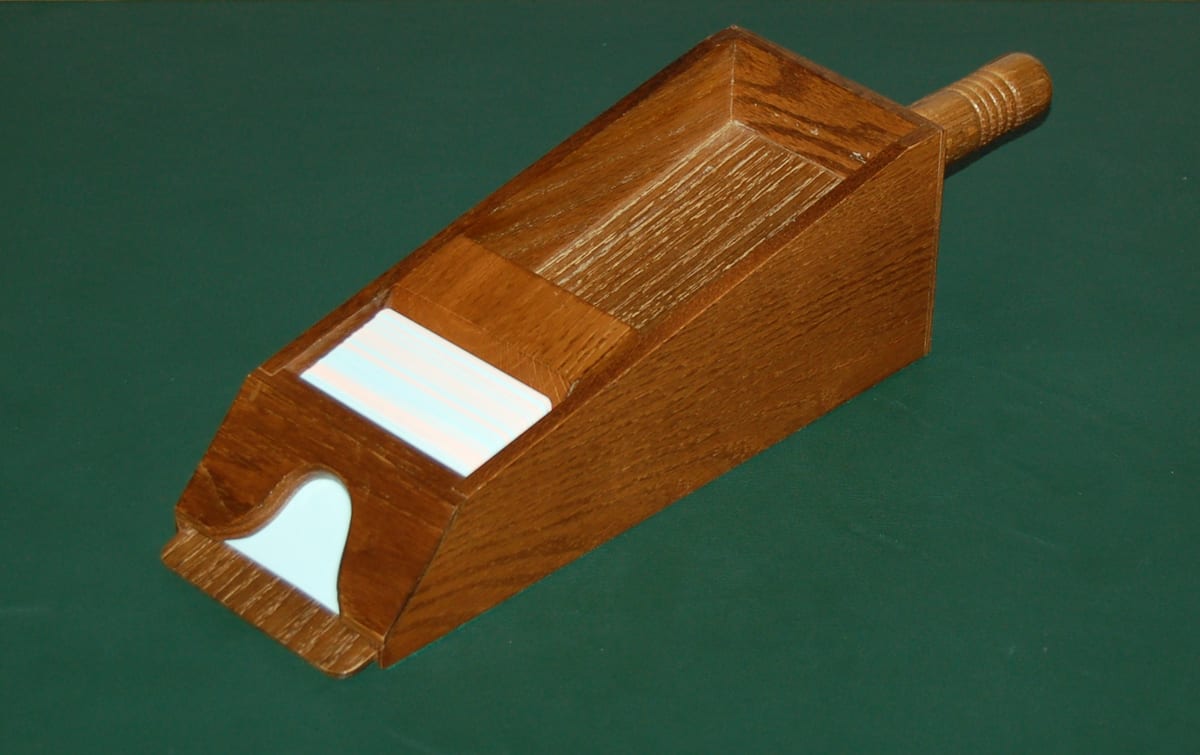
- Three standard 52-card decks (156 cards total) shuffled together and dealt from a shoe (sabot); this is fewer decks than the six to eight used in Chemin de Fer and Punto Banco.
- Card values: Ace = 1; 2 through 9 = pip value; 10, Jack, Queen, King = 0. Suits carry no value and never break a tie.
- Hand totals use modulo-10 arithmetic: add the card values and keep only the last digit, so 9 is the highest possible total. Example: sums to 17, which counts as 7.
- A two-card total of 8 or 9 is a natural and wins immediately with no further draws, unless the bank and a tableau are both tied naturals, which pushes that bet.
Objective
Beat the bank's hand with a tableau total closer to 9, or, if you hold the bank, beat one or both tableaux with your own hand. Punters backing a tableau win their stake at even money against the bank when that tableau's final total is higher; the bank collects the stakes of any tableau its own hand beats. A tie between a tableau and the bank pushes that bet, returning the stake with no win or loss on that side.
Setup and Deal
- At the start of a shoe, punters bid for the right to bank; the highest bidder stakes the bank fund, the amount the bank is prepared to lose, and takes the dealing position for the rest of the shoe.
- Punters place their bets against the bank on either the Left or the Right tableau before any cards are dealt; on each side, whoever stakes the most becomes that tableau's point and plays its cards.
- The banker deals two cards face down to the Left tableau, two to the Right tableau, and two to themselves, one card at a time in that order.
- Each hand's total is announced. A natural 8 or 9 in either tableau or the bank ends that comparison immediately; otherwise play moves to the draw.
Gameplay
- Each tableau's point plays first: a two-card total of 0 to 4 must draw a third card, a total of 6 or 7 must stand, and a total of exactly 5 is a discretionary draw left to the point's own judgment.
- The banker then decides their own draw only after seeing what each tableau did, which is the game's central skill element: with a marginal total of 3 to 6, an experienced banker weighs a tableau's stand-or-draw decision and its exposed third card, if one was drawn, before choosing, rather than following the fixed table Punto Banco's automated banker uses.
- A banker total of 0 to 2 always draws and a banker total of 7 always stands, matching the boundary rules used in every baccarat variant, even though the middle totals stay discretionary here.
- Because the bank plays a single hand against two independent tableaux, the banker can end up drawing a card that helps one side and hurts the other; there is no way to tailor the same third card differently for the Left and the Right.
Scoring and Payouts
- The bank's final total is compared separately against the Left tableau and the Right tableau. Winning bets against the bank pay even money (1:1); the bank keeps the stakes of any tableau it beats.
- A punter who wins may let their stake ride for the next coup instead of collecting, a traditional practice sometimes called following one's luck; a loss on the following coup then costs the full parlayed amount.
- A tie between a tableau and the bank, called an egalite, pushes that tableau's bets; the stake is returned and the bank continues to play its result against the other tableau normally.
- The bank absorbs every loss from its own fund and keeps every stake it wins outright. Unlike Punto Banco, where the house deducts a 5 percent commission from winning Banker bets, Baccarat Banque charges the bank no commission at all, since the banker is a fellow player risking personal capital rather than the house.
Winning
There is no fixed final score. The bank keeps dealing coup after coup until the banker voluntarily retires, loses the entire bank fund to the tableaux, or the three-deck shoe runs out, at which point a new auction sets the next banker. A punter's session win is simply walking away with more than they staked; the bank's session win is finishing with a larger fund than it started with, or selling the remaining bank to another punter at a profit before stepping down.
Common Variations
- Chemin de Fer: Only one tableau is dealt, and the bank passes automatically to the next punter after a loss instead of a single banker holding a semi-permanent bank against two tableaux.
- Punto Banco: The house itself banks every hand using a fully automated drawing table, removing both the auction for the bank and any discretionary third-card decisions.
- Baccarat Banque a Un Tableau: A rarer single-tableau form of Baccarat Banque that keeps the auctioned, semi-permanent bank but drops the second hand, sitting between this game and Chemin de Fer.
- Mini Baccarat Banque: A lower-stakes home and club version dealt from a single 52-card deck by a rotating banker seat rather than an auctioned fund, shortening the game for casual play.
Tips and Strategy
- As the point on a tableau, draw on a two-card total of 5 more often than not; the extra card improves the total more often than it ruins it, the same logic that makes 5 a profitable stand-or-draw decision in every baccarat variant.
- As banker, use each tableau's exposed third card, when one is drawn, to judge your own draw at totals of 3 to 6; a tableau that drew a small card (2 to 6) hints at an improved total, so lean toward drawing yourself, while a tableau that drew an 8, 9, or a 10-value card is less likely to have improved.
- Bid conservatively for the bank. It pays no commission and keeps every stake it wins, but it is also on the hook for both tableaux at once, so a short losing streak against two hands simultaneously can exhaust a bank fund far faster than in a single-tableau game.
- Avoid letting a stake ride more than once or twice in a row; a single loss erases several coups of accumulated winnings at once.
Glossary
- Tableau: One of the two hands, Left or Right, dealt to the punters each coup.
- Point: The punter with the largest stake on a given tableau, who makes that hand's draw decisions.
- Bank fund: The pool of money the banker stakes after winning the auction to deal; the bank's losses are paid from this fund.
- Natural: A two-card total of 8 or 9, which wins immediately unless matched by an equally high natural.
- Egalite: A tie between the bank and a tableau; that side's bets push.
- Sabot: The dealing shoe holding the shuffled decks.
- Following one's luck: Leaving winnings on the table to carry over onto the next coup instead of collecting them.
Tips & Strategy
Draw on a tableau total of 5 more often than not, since an extra card improves the hand more often than it hurts it. As banker, read each tableau's exposed third card before making your own marginal draw at totals of 3 to 6; that single piece of information is the entire skill of the position. Bid for the bank conservatively, since it is exposed to two tableaux at once rather than one.
Because both a tableau's point and the banker retain discretion at a two-card total of 5, and because the banker acts last with full knowledge of both tableaux's drawn or undrawn third cards, Baccarat Banque rewards attentive, experienced bankers far more than the fully automated Punto Banco does. The banker's edge comes primarily from this informational advantage of acting last against two hands, not from any fixed statistical edge built into a commission.
Trivia & Fun Facts
Because the banker in Baccarat Banque risks personal capital rather than the house's money, French casinos historically required the incoming banker to display the bank fund in cash or chips on the table before dealing began, so every punter could see exactly how much the bank could afford to lose. Baccarat Banque is one of only three baccarat variants individually named in French gambling regulations, alongside Chemin de Fer and Punto Banco. Because a single banker's hand is compared against two separate tableaux at once, an unlucky banker can lose to both sides on the same coup, doubling the payout the bank must cover in a single deal.
-
01How many standard decks are traditionally shuffled together for Baccarat Banque, and how does that compare to Punto Banco?Answer Three standard 52-card decks, fewer than the six to eight decks typically used in Punto Banco and Chemin de Fer.
-
02How is the banker's seat determined at the start of a Baccarat Banque session?Answer Punters bid for it in an auction, and the highest bidder stakes the bank fund and deals every coup until they retire or the fund runs out.
History & Culture
Baccarat Banque is generally regarded as the ancestor of the other two casino baccarat forms, predating Chemin de Fer in French gambling houses of the 19th century and surviving today mainly in a handful of French casinos, where French gambling regulations still recognize it as a distinct authorized game alongside Chemin de Fer, and in some private European clubs. Its auctioned, semi-permanent bank reflects an older tradition of banking games in which a wealthy patron effectively bought the right to play the house, a structure Chemin de Fer later softened by rotating the bank automatically and that Punto Banco removed entirely by having the casino bank every hand.
Baccarat Banque represents the game's original form as a genuine contest between a risk-taking banker and the rest of the table, before 20th-century casinos standardized baccarat into the highly automated, commission-based Punto Banco now found worldwide. It survives today largely as a heritage game in French casinos and private clubs, prized by baccarat purists specifically because the banker's judgment still matters, in contrast to the fully mechanical modern game most players know from Macau and Las Vegas.
Variations & House Rules
Chemin de Fer strips the game down to one tableau and rotates the bank automatically after each loss. Punto Banco removes the auction and all discretion, having the house bank every hand by a fixed table. Baccarat Banque a Un Tableau keeps the auctioned bank but drops the second hand. Mini Baccarat Banque shrinks the game to a single 52-card deck and a rotating banker seat for casual play.
For a home game, replace the cash auction with players simply taking turns as banker for a fixed number of coups, and shuffle two 52-card decks together instead of three; the modulo-10 math stays identical while the smaller pack deals more comfortably for a small group. Beginners can drop the discretionary draw on a total of 5 and use Punto Banco's fixed rule instead until they are comfortable reading the table.


