
How to Play
Blackjack, also known as 21, is a popular casino game. The goal is to reach a hand value of 21 without exceeding it. Learn basic strategy, counting cards, and master the art of decision-making in this fast-paced game.
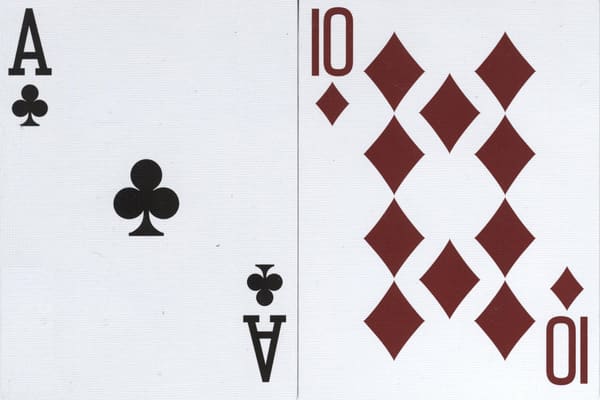
Blackjack (also called 21) is the most played casino card game in the world. Each player plays SOLO against the dealer; other players at the table do not compete with each other. Every hand starts with 2 cards; you repeatedly hit (take another card) or stand (keep your total) to get as close to 21 as possible without exceeding it (busting). A natural 'blackjack' (an Ace + any 10-valued card on the first 2 cards) pays 3:2; a win by having a higher total than the dealer (without busting) pays 1:1; a loss hands your bet to the dealer. Optional actions (split pairs, double down, insurance, surrender) add strategic depth. Long-run expected value is decided almost entirely by following 'basic strategy'.
Quick Reference
- Use one or more standard 52-card decks shuffled together.
- Each player and the dealer receive two cards.
- Dealer gets one card face-up and one face-down.
- Hit (draw a card) or stand (keep current hand).
- Optionally split pairs or double down.
- Dealer reveals hole card and hits until reaching 17 or higher.
- Number cards are face value, face cards are 10, Ace is 1 or 11.
- Blackjack (Ace + 10-value card) is the best hand.
- Busting (exceeding 21) means an automatic loss.
Players
1 to 7 players per table, each playing SOLO against the dealer; you do NOT compete with other players. A standalone home game also works with one banker plus any number of bettors. A single hand takes about 1-2 minutes; a session is typically bounded by bankroll or time rather than by a fixed number of hands.
Card Deck
- Played with 1 to 8 standard 52-card decks shuffled together, depending on the casino. Home games commonly use 1 or 2 decks; Las Vegas Strip tables typically use 6 or 8.
- No jokers; no wild cards.
- Suits are irrelevant; only rank values matter.
- Card values: number cards 2-10 = face value; face cards (J, Q, K) = 10; Ace = 1 OR 11, whichever benefits the holder.
- A hand containing an Ace counted as 11 is called a 'soft hand' (e.g., A-6 is 'soft 17'); if counting the Ace as 11 would bust, it reverts to 1 and the hand is 'hard'.
- Each hand example: = 30 (bust); = 21 (natural blackjack).
Objective
Beat the DEALER, not the other players, by having a final hand total closer to 21 than the dealer WITHOUT going over 21. A 'natural' (Ace + 10-value card as the first 2 cards) wins automatically and pays 3:2; any other win pays 1:1. A tie ('push') returns your bet. Busting (going over 21) is an automatic loss regardless of what the dealer does later.
Setup
- Use 1 to 8 standard 52-card decks shuffled together (multi-deck sets usually come from a 'shoe').
- Each player places a bet in their betting circle BEFORE any cards are dealt; bets must fall within the table minimum and maximum.
- Initial deal: each player receives 2 cards face-up; the dealer receives 1 card face-up (the 'upcard') and 1 card face-down (the 'hole card'). In European rules, the dealer takes the hole card only after players have acted.
- Natural check: if the dealer's upcard is an Ace or 10-value, the dealer peeks at the hole card; if the dealer has a natural blackjack, the hand ends immediately. Players with their own natural push; all others lose (except in certain European no-hole-card rules).
- Play begins with the player on the dealer's LEFT and proceeds clockwise; the dealer plays LAST.
Gameplay
- Your turn options: HIT (take another card), STAND (end your turn with your current total), DOUBLE DOWN (double your bet, take exactly one more card, then stand), SPLIT (if your first 2 cards are the same rank, separate them into 2 hands with an additional matching bet), SURRENDER (optional; forfeit half your bet and end the hand on your first action, where permitted).
- Hitting: you may keep hitting as many times as you wish; your turn ends when you stand or bust.
- Busting: the moment your total exceeds 21, your hand loses immediately (the dealer collects your bet) regardless of what the dealer does next.
- Splitting pairs: after a split, each new hand is played one at a time. Most houses allow re-splits up to 3 or 4 total hands; splitting Aces usually gives you only ONE additional card per hand and no further hits.
- Doubling down: allowed on your first 2 cards in most rules; some houses restrict doubling to totals of 9, 10, or 11. After the extra card, the hand stands automatically.
- Insurance: offered only when the dealer's upcard is an Ace. You may wager up to half your original bet as a side bet that the dealer has a natural blackjack; pays 2:1 if so, loses otherwise. Generally a poor-expected-value bet for most strategies.
- Surrender: where offered, on your first action you may surrender your hand, losing only half your bet. Useful for very bad starting totals (e.g., 16 versus dealer 10).
- Dealer's turn: after all players have acted, the dealer reveals the hole card. The dealer must HIT on all totals below 17 and STAND on 17 or higher. In 'Hit on soft 17' rule sets, the dealer also HITS on soft 17 (A-6); in 'Stand on soft 17' rule sets they stand. The house-edge difference is about 0.2%.
Settlement and Winning
- Natural blackjack (Ace + 10-value on first 2 cards, no split): you win 3:2 immediately unless the dealer also has a natural (push).
- Regular win: if your final total is closer to 21 than the dealer's WITHOUT busting, you win 1:1. If the dealer busts, all remaining players win 1:1.
- Push: if your total equals the dealer's (both below 22), your bet is returned; no one wins or loses.
- Loss: if the dealer's total is closer to 21 than yours, or if YOU busted earlier, you lose your bet. A dealer natural beats any non-natural player 21.
- Session winning: a session is typically bounded by a bankroll limit, time limit, or target profit. The 'winner' is any player who leaves the table with more chips than they started with.
- Match play (home games): in a friendly home game, agree on a number of rounds or a stop-time; the player with the most chips at the end wins the night.
Winning
You WIN a single hand if your final total is higher than the dealer's (both <=21), or if the dealer busts while you did not. A natural blackjack (Ace + 10-value on first 2 cards) wins immediately at 3:2 unless the dealer also has a natural (push). You LOSE if you bust first, or the dealer's total is closer to 21 without busting. You PUSH when your total equals the dealer's. Over a long session, your expected value is determined almost entirely by how closely you follow basic strategy and the table rules; a perfect basic-strategy player faces only about a 0.5% house edge in most multi-deck games.
Advanced Moves
- Splitting Pairs: if your first 2 cards share rank, you can separate them into 2 hands with an additional matching bet. Each hand is played independently. A matching split pair (e.g., two 8s) gives you 2 chances to beat the dealer and is often mandatory against weak dealer upcards (2-7).
- Doubling Down: double your bet and commit to take exactly 1 more card. Strong on totals of 9, 10, 11 against weak dealer upcards.
- Insurance: a side bet offered when dealer shows Ace; pays 2:1 if dealer has blackjack. Expected value is negative in most multi-deck games unless you are card counting.
- Surrender: where allowed, on your first action give up half your bet and end the hand. Optimal for hard 16 vs. dealer 9/10/A and hard 15 vs. dealer 10.
- Double after split (DAS): in tables allowing this, you may double your bet on a split hand. Improves basic-strategy expected value by about 0.14%.
Betting
- Players place bets before the initial deal; minimum and maximum bets are posted at the table.
- Additional wagers (for splits and doubling down) are placed after the initial cards are dealt and match the original bet.
- Insurance and surrender are sized at half the original bet.
- Progressive betting systems (Martingale, Oscar's grind, 1-3-2-6) do not change expected value against the house edge in the long run; bet flat unless card counting.
Common Variations
- American vs. European: American dealers take hole card immediately and peek for blackjack; European dealers wait until after players act. European rules slightly worsen player EV on doubles and splits.
- Single-deck vs. multi-deck: single-deck games typically pay 6:5 on natural (a player-unfriendly variant); multi-deck usually pays 3:2. Always prefer 3:2.
- Hit vs. stand on soft 17: 'H17' tables (dealer hits soft 17) carry a slightly higher house edge than 'S17' tables.
- Spanish 21: played with a 48-card Spanish deck (no 10s); offers bonus payouts; a separate game (id=203).
- Pontoon (British): British ancestor with slight differences in dealer rules and payouts; a separate game (id=202).
- Double Exposure: both dealer cards are dealt face up; dealer wins ties except on naturals; a trade-off variant.
- Switch: players are dealt 2 hands and may swap the top cards; pays 1:1 on natural instead of 3:2.
- Continuous Shuffle Machines (CSM): eliminate card counting; slightly higher house edge.
Tips and Strategies
- Learn basic strategy chart. A printed basic-strategy card shows the mathematically optimal action for every hand total vs. every dealer upcard. Following it reduces the house edge to about 0.5% in typical multi-deck 3:2 games; deviating from it is the single largest source of losses for new players.
- Never take insurance. Unless you are counting cards, insurance is a -7% expected-value side bet.
- Always split Aces and 8s. Always split these pairs regardless of dealer upcard.
- Never split 10s, 5s, or 4s. 20 is a strong hand; keep it. 10 is a strong doubling total. 4s aren't a good split.
- Double 11 almost always. Against every dealer upcard except Ace, doubling on 11 is the optimal play.
- Stand on hard 17+. Hitting a hard 17 to chase 21 is almost always a losing move because the dealer must stop at 17 too.
- Hard 12 through 16 vs. dealer 7-Ace: HIT. You are in no-man's land; hitting wins slightly more often than standing.
- Manage your bankroll. Set a session loss limit and a win-and-walk target before you sit down; discipline matters more than strategy.
- Prefer 3:2 tables. 6:5 blackjack payouts increase the house edge by ~1.4%; always check the payout sign.
Etiquette
- Use hand signals to indicate hit (tap the table) and stand (wave flat hand over cards) rather than speaking; this is how casino cameras verify actions.
- Do not touch your bet once cards are dealt; change is delivered by the dealer.
- In facedown single-deck games, hold your cards with one hand only.
- Tip the dealer when you are winning (usually a chip pushed forward), never when you are losing; this is not required but customary.
Glossary
- Natural / Blackjack: an Ace + 10-value card dealt as the first 2 cards, unsplit; pays 3:2.
- Hit: take another card; signal with a table tap.
- Stand: end your turn; signal with a flat-hand wave.
- Bust: total exceeds 21; automatic loss.
- Push: tie with dealer; bet returned.
- Hard hand: a hand with no Ace, or an Ace forced to count as 1 to avoid busting.
- Soft hand: a hand containing an Ace counted as 11.
- Double down: double your bet, take exactly 1 more card, stand.
- Split: separate a starting pair into 2 hands with a matching bet.
- Insurance: side bet on dealer's natural when dealer shows Ace; pays 2:1.
- Surrender: forfeit half the bet on your first action; ends the hand.
- Upcard: the dealer's face-up card; the single most important information on the table.
- Hole card: the dealer's face-down card, revealed only after players act.
- Shoe: the multi-deck box from which cards are dealt in most casinos.
- Basic strategy: the mathematically optimal action for each hand vs. upcard; printed on pocket cards.
Tips & Strategy
Master basic strategy to optimize your chances. Knowing when to hit, stand, double down, or split is crucial for success.
Balancing risk and reward is key in Blackjack. Understanding when to take calculated risks can significantly improve your chances of success.
Trivia & Fun Facts
Did you know? The term 'Blackjack' refers to a hand containing an Ace and a 10-value card, originally offering a higher payout.
What is the term for the best possible hand in Blackjack, consisting of an Ace and a 10-value card?
History & Culture
Blackjack traces its origins to French and Spanish card games from the 17th century. It became popular in American casinos during the 20th century.
Blackjack has become synonymous with casino culture and strategic gaming. It has inspired movies, books, and even mathematical strategies.
Variations & House Rules
Common variations include Spanish 21, Pontoon, and Double Exposure. Each variant introduces unique rules and twists to the classic game.
Experiment with different rule variations or side bets to add excitement to your Blackjack games.


