
How to Play
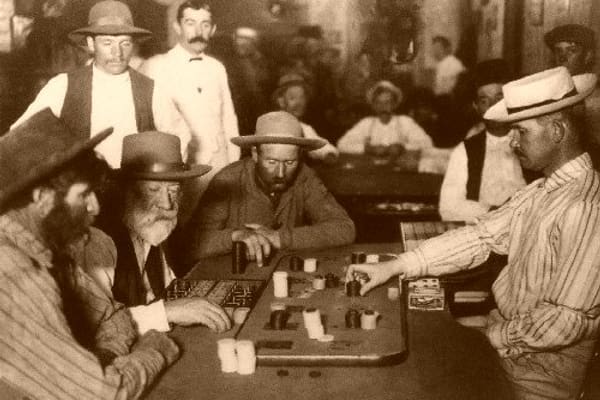
The historic banking card game that ruled American gambling for a century. Bet on ranks of a 52-card deck; two cards dealt per turn resolve winners, losers, and splits. Famous for near-even odds and Old West saloon play.
Faro is the historic banking card game that dominated American gambling from the early 1800s through the 1920s. A full deck of 52 cards is laid out on a painted spade-suit board ('layout') showing the 13 ranks; players place chips on any rank to bet it will win. The dealer burns the top card of the shoe (the soda), then deals two cards per turn: the first out of the box is the 'losing' (banker's) card and takes all bets on its rank; the second is the 'winning' (player's) card and pays all bets on its rank at even money. A 'copper' hexagonal token placed on chips reverses the bet (backs the card to lose). Identical ranks on both cards of a turn are a 'split' and the banker takes half of all bets on that rank. When three cards remain, players may 'call the turn' by betting on their exact order (pays 4:1, or 1:1 if a pair). Faro's math is so close to even that tracking dealt cards on an abacus-like casekeep is the primary skill: late in the deck, knowing which ranks are still live lets players bet essentially against a no-house-edge game. This extreme fairness is both why Faro was beloved and why most parlours cheated.
Quick Reference
- Banker shuffles and deals from a box. Burn the soda (first) card.
- Players place chips on the 13-rank layout.
- A casekeep tracks remaining cards of each rank.
- First card out = losing card; straight bets on that rank lose.
- Second card = winning card; straight bets on that rank pay 1:1.
- Copper (hexagonal token) reverses the bet. Same-rank pair = split (banker takes half).
- Winning bets pay 1:1; splits cost half a stake.
- Calling the turn (last 3 cards) pays 4:1 (or 2:1 with a pair).
- House edge is low; skilled tracking approaches break-even.
Players
One banker (house) and any number of punters (usually up to 10 at a single table). Bettors act simultaneously by placing chips on the layout; they do not take turns. Classical casino Faro was dealt from a single 52-card shoe; a full deck took about 25 turns and 5 to 10 minutes to play out.
Card Deck and Equipment
- One standard 52-card deck, no jokers. Dealt from a dealing box ('shoe') that exposes one card at a time through a spring-loaded slot.
- Layout board: a green baize cloth painted with all 13 ranks of the spade suit in a 2-row grid (Ace, 2, 3, 4, 5, 6 on top; 8, 9, 10, J, Q, K on bottom; 7 at one end as the 'sevens').
- Casekeep: an abacus-like frame with 13 spindles, each holding 4 beads representing the 4 cards of each rank. A dedicated assistant ('casekeeper') slides beads to track which cards have been dealt.
- Copper tokens: hexagonal (or circular) markers placed on a bet to reverse its meaning (from 'win' to 'lose').
- Card rank ordering is not used for outcomes; only the rank of each dealt card matters.
Objective
Predict for each two-card turn which of the 13 ranks will appear as the winning (second) card, which will appear as the losing (first) card (if you copper), or that two cards of the same rank will appear together (a split). You win chips when the rank you backed comes up in the right position and lose when it comes up in the wrong one. Unresolved chips remain on the layout for the next turn.
Setup
- The banker shuffles the 52-card deck thoroughly, placing it face down in the dealing box.
- The layout board is placed in front of the players. Bettors buy chips from the house.
- The soda: The dealer slides the top card out of the box and exposes it face up beside the box. This is the 'soda' card; it is 'dead' (cannot be bet on) and serves only to open the deck. Its rank is recorded on the casekeep.
- Players may now place bets on any rank of the layout.
Placing Bets
- Straight bet: Place chips directly on one rank on the layout. You are betting that the next dealt winning card will be of that rank.
- Copper bet: Place a copper token on top of your chips. You are now betting that the next LOSING (first of the turn) card will be of that rank. This flips the bet direction.
- Multi-rank bet: Place chips between two ranks on the layout to back either one (each rank acts independently on the next turn).
- Heel bet: A bet that stays in place across multiple turns until it is resolved. Default Faro bets are heel bets; you need not remove winning chips each turn unless you want to.
- Hoc card: The last card in the box is called the 'hoc' and plays no active role; bets on the hoc rank are returned.
The Turn
- Step 1 (banker's card): The dealer draws the top face-down card from the box and exposes it. This is the 'losing' or 'banker's' card. All straight bets on this card's rank lose (the banker collects the chips). All coppered bets on this rank win and are paid at even money (1:1).
- Step 2 (player's card): The dealer draws the next card and exposes it. This is the 'winning' or 'player's' card. All straight bets on this card's rank win (paid 1:1). All coppered bets on this rank lose.
- Step 3 (resolution): The dealer pays winning bets, collects losing bets, and updates the casekeep (slides the beads for both ranks dealt). The two dealt cards are placed face up beside the box; they are dead and will not play again.
- Step 4 (bets remain): Any bet on a rank that was not dealt remains in place for the next turn. The dealer resets the box and the next turn begins.
- No bets while dealing: Players may not add to or remove bets during the turn; bets are locked once the dealer reaches for the box.
Splits
- A split occurs when both cards of a single turn are of the same rank.
- On a split, the banker takes HALF of all straight bets on that rank (chips are returned to a half-count). Coppered bets on a split rank also pay the banker half.
- Splits are the primary source of the house edge. A single deck averages about 3 splits per deal; each split is an automatic half-loss on any chips betting that rank.
- Skilled punters use the casekeep to see when only two cards of a rank remain in the box; such ranks have a much higher chance of splitting and are typically avoided.
Calling the Turn
- When only three cards remain in the box (with the hoc already set aside as the final), players may 'call the turn' by naming the exact order the last three will come out.
- A successful call with three different ranks pays 4:1 (the mathematical fair odds are 5:1, so this is the house's second profit source).
- If two of the last three cards are the same rank (a 'cat-hop'), a correct call pays only 2:1 (mathematical fair odds 3:1). Some houses also pay 1:1 for cat-hop calls.
- Players not calling the turn simply resolve their standing straight bets as the final three are dealt in order.
- A missed call costs the full stake.
Scoring and Settlement
- Winning bets pay 1:1 (stake plus equal amount).
- Winning calls of the turn pay 4:1 (three-different) or 2:1 (cat-hop).
- Splits cost half the stake on a rank.
- House edge: from splits only, approximately 1.5 to 2 percent per deck. Calling the turn adds a small extra edge when mis-paid. In a strictly honest game with the full-dealt-deck settlement, Faro is one of the lowest house-edge casino games ever designed.
- Historically many Faro banks cheated with rigged boxes or marked cards, pushing the real edge much higher; this reputation contributed to the game's decline.
Winning
There is no 'winning the game'; Faro is a session game. A session ends when the deck is fully dealt (the hoc card is exposed) or when the player chooses to leave. Long-term profit depends entirely on card tracking through the casekeep and discipline in avoiding split-heavy ranks.
Common Variations
- Stuss (Jewish Faro): Dealer deals from hand rather than a shoe; splits go entirely to the banker rather than half, sharply increasing the house edge.
- Mexican Faro / Monte Bank: Uses a Spanish-suited deck (no 8s, 9s, 10s) for 40 cards; faster hands.
- Dutch Faro / Rouge et Noir: French variant where players bet on red or black majority rather than specific ranks.
- Home Faro: A family game played without the dealing box or casekeep; ranks are tracked on paper. Splits are often counted as a complete loss on both bets (straight and coppered).
- Saratoga Faro: A side-bet variant popular in 19th-century resort casinos adding paroli (parlay) and martingale betting structures.
Tips and Strategy
- Follow the casekeep closely; late-deck bets on ranks with only 1 or 2 cards remaining have strictly dominating odds.
- Never bet on a rank with exactly 2 cards remaining. The probability of a split on those final cards is high and costs half your stake.
- Ranks with 4 cards remaining early in the deck face 6 split opportunities (any pair of 4 cards); late-in-deck 1-card ranks cannot split at all.
- Copper bets become valuable when the casekeep shows the last card of a rank is coming; you know the next same-rank appearance can only be a losing-card position.
- Call the turn only when the casekeep lets you predict the remaining 3 cards' order with high confidence; random calls cost the full stake at unfavourable odds.
- Avoid the Hoc; it cannot win. If you have a standing bet on the Hoc rank, lift it once two of that rank have been dealt.
Glossary
- Layout: The painted board showing all 13 ranks; bets are placed on it.
- Dealing box / Shoe: The spring-loaded box from which cards are dealt one at a time.
- Casekeep: The abacus-like tracker showing how many of each rank have been dealt.
- Soda: The first card exposed at the start of the deal; dead card.
- Hoc: The final card in the box; dead card, bets on its rank are returned.
- Copper: A hexagonal token placed on a bet to reverse its win/lose meaning.
- Split: Both cards of a turn of the same rank; banker takes half.
- Heel bet: A bet that persists from turn to turn until resolved.
- Calling the turn: Betting on the exact order of the last three cards in the box.
- Bucking the tiger: Slang for playing Faro; named for the tiger image that hung above many Faro parlours.
Tips & Strategy
Track every dealt card on the casekeep. Avoid betting ranks with only 2 cards left (split risk is too high). Copper-bet when the casekeep shows the next same-rank card will be in the losing (first) position.
Faro is one of a tiny handful of casino games where disciplined card tracking gives the player an edge approaching break-even in the late deck. The full 52-card deal guarantees every rank comes up 4 times, so as the deck depletes the remaining odds become deterministic. Historically, the only edge for professionals was discipline: betting only high-EV late-deck ranks and stepping away from the table between deals.
Trivia & Fun Facts
Legendary Old West gunmen Doc Holliday, Wyatt Earp, Bat Masterson, and Wild Bill Hickok all worked as professional Faro dealers at various points. The expression 'bucking the tiger' came from the painted Bengal tiger that hung above many Faro parlours to advertise the game. At its peak in the 1870s, more Americans gambled on Faro than on any other card game; by 1925 almost no casino still offered it.
-
01What does the Faro term 'bucking the tiger' mean, and where did the phrase come from?Answer 'Bucking the tiger' means playing Faro; it refers to the Bengal tiger image displayed above 19th-century Faro parlours to identify the game.
-
02In Faro, what is a 'split' and who profits from it?Answer A split occurs when both cards of a turn are the same rank; the banker takes half of all bets on that rank, which is the primary source of the house edge.
History & Culture
Faro is thought to have originated in late-17th-century France as Pharaon (named for the Egyptian ruler depicted on French playing cards) and migrated to Louisiana with French settlers. It exploded in popularity in 1820s New Orleans, spread west with the Gold Rush, and dominated saloon gambling in the American West through the 1880s. It began to decline after 1900 as scandals about rigged Faro boxes broke public confidence; Craps and Poker supplanted it by the 1920s.
Faro is inseparable from the mythology of the American West. It appears in countless Western films, dime novels, and popular songs from the mid-19th century, and is a direct cultural ancestor of modern casino gambling in terms of table design, chip handling, and dealer etiquette. The Smithsonian holds several original Faro layouts and casekeeps as artefacts of American gambling history.
Variations & House Rules
Stuss is the simplified street form that dispenses with the dealing box. Mexican Faro uses a Spanish 40-card deck. Dutch Faro changes the betting focus to red-versus-black majorities. Home Faro skips the specialised equipment for casual play.
For a home game, print a simple 13-rank layout on cardstock and use pen-and-paper tracking instead of a casekeep. Use poker chips in different colours for players and a single distinct chip for copper tokens. Set rank limits (10 chips max on any single rank) to keep stakes manageable.


