
How to Play
The iconic Alpine partnership trick-taking game for four: a 32-card Bavarian pack, three permanent 'Critical' high cards (Max, Belli, Spitz), a chosen Striker rank, and a poker-style raising mechanic played to 11 or 15 points.
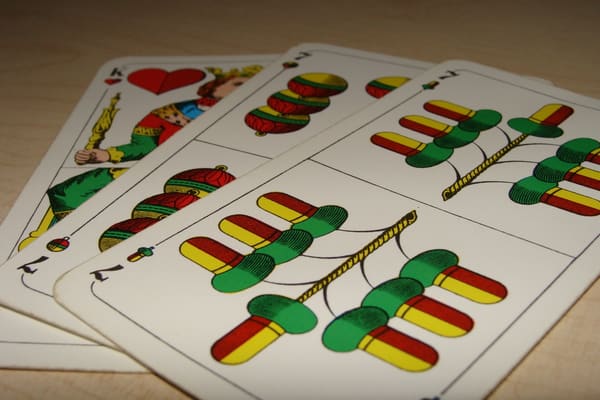
Watten is the signature card game of the Austrian Tyrol, South Tyrol, and Upper Bavaria, a trick-taking game for four players in fixed partnerships. It is played with a 32-card German-suited Bavarian-pattern pack (Acorns, Leaves/Grün, Hearts, Bells). The defining feature is a three-tier card hierarchy above ordinary trumps: three permanent 'Criticals' (Kritische) that are always the three highest cards (the Max, the Belli, and the Spitz), followed by four cards of a chosen rank called Strikers (Schläge) whose chief one (matching the trump suit) is the fourth-highest card overall. Forehand (player to the dealer's left) names the Striker rank, and the dealer then names the trump suit. Each player holds five cards and plays one per trick. Partners may communicate by secret signals with eye, hand, and face gestures during play: this is not cheating but an accepted part of the game. The first team to win 3 of 5 tricks scores 2 points; however, either team may raise at any time, doubling and redoubling the stakes like in poker. Matches are played to 11 or 15 points. A 'tight' state near the target score forbids raising and caps stakes, which adds a late-game brinkmanship unique to Watten.
Quick Reference
- 32-card Bavarian pack, 4 players in 2 fixed partnerships.
- Deal 5 cards (3+2); forehand names Striker rank; dealer names trump suit.
- Play any card; no obligation to follow suit.
- Kritische outrank everything: Max (K♥) > Belli (7♦) > Spitz (7♣).
- Right Striker (Striker rank + trump) is 4th-highest.
- Either team may raise; opponents accept or fold.
- Winning 3 tricks: 2 points (base) or raised stake.
- Folding: concede stake-1 points to opponents.
- First to 11 (classic) or 15 (modern) wins the match.
Players
Exactly four players, in two fixed partnerships. Partners sit opposite each other. Play rotates clockwise. Deal passes clockwise after each hand. Forehand is the player to the dealer's left and names the Striker rank before trick play begins.
Card Deck
A 32-card German-suited Bavarian or Austrian pack: 7, 8, 9, 10, Unter (Jack), Ober (Queen), King, Ace in each of four suits (Acorns/Eichel, Leaves/Grün or Laub, Hearts/Herz, Bells/Schellen). The Ace is called the Sau (sow) or Deutsche Daus. In French-suited substitutes, Acorns = Clubs, Leaves = Spades, Hearts = Hearts, Bells = Diamonds. The three Kritische are permanent, always highest regardless of trump:
Card Hierarchy (in full)
- Max (Maxi): King of Hearts . Always the highest card in the entire game.
- Belli: 7 of Bells . Always the second-highest card.
- Spitz (also called 'Spitzer'): 7 of Acorns . Always the third-highest card.
- Right Striker (Hauptschlag): The card of the chosen Striker rank that matches the trump suit. Fourth-highest.
- Other three Strikers: The three remaining cards of the Striker rank (in the three non-trump suits). These rank equally: the first one played to a trick outranks any later ones.
- Trump suit cards: The remaining cards of the trump suit (other than any already covered above), ranked K-Ober-Unter-10-9-8 (King high).
- Non-trump suits: Ranked K-Ober-Unter-10-9-8-7 (high to low) within their suit; they can only win a trick if no trump, Striker, or Kritische has been played.
Objective
Win a best-of-5 trick contest each deal for 2 points (or more if raises were accepted). Play deal after deal until one team reaches the match target, usually 11 points (classic game, known as 'auf elf spielen') or 15 points (modern game, 'auf fünfzehn'). A team may also take a deal by forcing the opposing team to fold under a raise.
Setup and Deal
- Determine the first dealer by cutting the deck; lowest card deals.
- Shuffle and cut. The dealer deals 5 cards to each player clockwise in two packets: first 3 cards to each, then 2 cards to each.
- Nobody looks at their hand yet in the standard order: first comes the announcement phase.
- The forehand (player to the dealer's left) looks at the first three cards of their hand and names the Striker rank: any of 7, 8, 9, 10, Unter, Ober, King, or Ace.
- After forehand's call, the dealer looks at their first three cards and names the trump suit.
- The remaining two cards are then distributed to each player (so they do not influence the announcement). Once all 5 cards are in hand, trick play begins.
- Either forehand or the dealer may call 'bessere!' (better ones please) to force a redeal if their opening hand is unplayable; this costs the calling team 2 points.
Trick Play
- The forehand leads the first trick. Winner of each trick leads the next.
- No obligation to follow suit. You may play any card from your hand to any trick.
- Highest-ranking card according to the hierarchy (Max > Belli > Spitz > Right Striker > other Strikers in play-order > trump > led suit) wins the trick.
- Right Striker lead call: When the Right Striker is led, the leader may call 'Trumpf oder Kritische!' which forces all opponents to play a trump or Kritische if they have one; partners must play a trump. This is the only time non-free-play is mandatory.
- Partners may signal to each other using pre-agreed face and hand gestures. This is expected and legal, but blatant verbal signals are not.
- Play five tricks. The first team to 3 tricks wins the deal.
Raising (Betten)
- At any point before playing to a trick, a player may raise by calling 'gehts?' or just raising a finger to increment the stake by 1 point.
- Opponents must choose: accept (call 'ja' or just tap the table) and continue for the higher stakes, or fold (call 'aus' or 'gut') and concede the current stake-1 points to the other team.
- After acceptance, the opposing team may raise back by 1. There is no cap on raises.
- Deals are worth the stake if played out; folded deals pay (stake - 1).
- Example: Basic stake is 2. Team A raises to 3. Team B accepts and raises to 4. Team A accepts. The deal is now worth 4 points if played out, or 3 points if Team B later folds.
Tight (Gespannt) Rule
When a team is within 2 points of winning the match (usually at 9-10 points in an 11-point game or 13-14 in a 15-point game), they are 'tight' (gespannt) and may no longer raise. They can still accept opponents' raises. If a tight team loses the deal, they simply concede the base 2 points, not a multiplied stake. This tight state rewards steady winners and prevents last-deal jackpots.
Scoring
- Winning 3 of 5 tricks: team scores 2 points (base stake) or the agreed raised stake.
- Opponents folding under a raise: team scores (current stake - 1) points.
- Bessere redeal: Calling team pays 2 points penalty.
- Running score is kept on a chalk board or paper; first team to 11 (classic) or 15 (modern) wins the match.
- Some houses play to 21 points in tournament settings, with a mandatory fold-acceptance rule if the stake would push the winning team past 21.
Winning
The first team to reach the target score (11, 15, or 21 depending on house) wins the match. Both teams may reach the target in the same deal; whichever reaches first wins. In a competitive Watten tournament, matches are best of three to balance out luck.
Common Variations
- Bavarian Watten: Closest to the rules described above; uses a 32-card Bavarian-pattern deck and plays to 11 or 15.
- Tyrolean Watten (Kritisch): Played in North Tyrol and South Tyrol, uses a 33-card pack (adds a Weli, the 6 of Bells, which acts as a fourth permanent high card between Belli and Spitz). Match target is often 15 or 18.
- Blind Watten (Blinder Watten): South Tyrolean variant with no signalling allowed. Trump and Striker are determined by revealing the lowest cards between dealer and forehand. Pure card play, no partner communication.
- Wurftwatten: A 3-card-per-player shorter variant for training; base stake remains 2.
- Kritischer Watten: Tournament form in which raises must be multiples of 2 rather than 1.
Tips and Strategy
- Learn the signals first: Watten without signals is badly handicapped. Pre-agreed face gestures for 'I have a Kritische', 'I have the Right Striker', and 'lead trumps when you get the chance' are the backbone of partnership play.
- Count the Kritische: There are only three Kritische in the deck. Track which have appeared each trick so you know whether your partnership controls the top of the hierarchy.
- Raise when you have 3 near-certain tricks: A raised contract is worth twice as much; if you hold Max + Belli + trump Ace, a raise is almost always correct. Only accept an opponent's raise when you can defensibly take 3 tricks.
- Bluff raises near the end: Bluffing a raise when you have a weak hand can steal a deal if opponents fold; it is risky but a key part of the game's drinking-hall charm.
- Watch the Right Striker lead trap: If you lead the Right Striker, opponents must play a trump or Kritische, which reveals information. Use this to discover where the Max is hiding before committing to a big raise.
Glossary
- Kritische (Criticals): The three permanent high cards: Max, Belli, Spitz.
- Max / Maxi: King of Hearts . Highest card in the deck.
- Belli: 7 of Bells . Second-highest card.
- Spitz / Spitzer: 7 of Acorns . Third-highest card.
- Schlag / Striker: Any card of the rank chosen by forehand. Four exist (one in each suit).
- Hauptschlag / Right Striker: The Striker card that also matches the trump suit. Fourth-highest card overall.
- Forehand: Player to the dealer's left. Names the Striker rank.
- Bessere: Call for a redeal when your initial three cards are unplayable; costs 2 penalty points.
- Gehts?: Call to raise the stake. Literally 'does it go?'
- Gespannt (tight): State of a team within 2 points of victory; cannot raise.
- Weli: The 6 of Bells in the 33-card Tyrolean pack; not present in 32-card Bavarian.
Tips & Strategy
Signalling between partners is the soul of Watten. Develop a reliable gesture set with your partner (one for 'I have a Kritische', one for 'lead trumps when you can', one for 'weak hand, accept a fold'). Track which of the three Kritische have appeared each trick.
Knowing when to raise versus when to fold is the deepest skill. A well-timed bluff raise with moderate cards can win more points than actually playing out a deal with strong cards; conversely, accepting every opponent's raise when you hold the right two Kritische turns an 11-point match into a 4-deal sweep. Reading opponents' partner-signals is the other half of winning Watten.
Trivia & Fun Facts
Watten is one of the very few card games in the world where silent partner signalling is not only tolerated but is a celebrated and essential part of play; official tournaments even award a 'best signalling pair' prize. The Kritische cards (Max, Belli, Spitz) have names so iconic in Tyrolean culture that local beers and inns have been named after them.
-
01What is the term for the three permanent highest-ranking cards in Watten, and which specific cards are they?Answer They are called the Kritische (Criticals): the Max is the King of Hearts [K♥], the Belli is the 7 of Bells [7♦], and the Spitz is the 7 of Acorns [7♣].
History & Culture
Watten dates back to the late 18th century in the Alpine regions of Bavaria and Tyrol and has been mentioned in Bavarian legal and tavern documents since the 1820s. It remains the single most popular card game in South Tyrol and is the subject of dedicated town tournaments across the region.
Watten is woven into Bavarian and Tyrolean life: pubs in South Tyrol keep wooden Watten score-boards nailed to the wall, village tournaments attract hundreds of entrants, and the game features in regional folk songs, films, and poems. It is the single strongest marker of Alpine card-game culture.
Variations & House Rules
Bavarian Watten uses a 32-card deck and plays to 11 or 15. Tyrolean Watten adds the Weli (6 of Bells) for a 33-card deck and a fourth permanent Kritische. Blind Watten forbids signalling for purists. Kritischer Watten raises in multiples of 2 for tournament play.
Beginners can play with open signalling (say out loud 'I have a Kritische') until the gesture system is learned. Set the match target to 7 points for a teaching game, 11 for a standard family match, or 15 for a competitive evening.


