
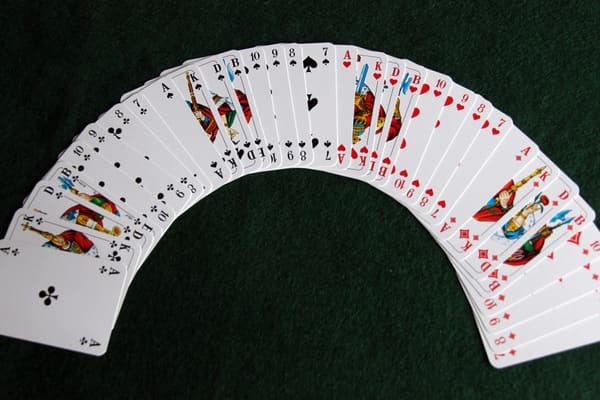
How to Play
Rolling Stone is an inverted trick-taking game for 4 to 6 players where you want to avoid the pickup, not win tricks. Each player starts with 8 cards from a stripped deck; any player unable to follow suit scoops every card in the current trick back into their hand. First to empty their hand wins.
Rolling Stone (also Enflé, Schwellen, Bumblepuppy) is a German-origin trick-taking card game for 4 to 6 players in which the goal is inverted: you do NOT want to win tricks, you want to AVOID the awful penalty of picking cards back up. Each player is dealt exactly 8 cards from a stripped deck (32 cards for 4 players, 40 for 5, 48 for 6). The first leader plays any card; subsequent players must follow suit if they can. If any player cannot follow suit, the trick is scrapped: that player gathers ALL the cards played so far in that trick and adds them back to their hand, then leads the next trick. Only when every player successfully follows suit does the trick complete normally (highest card of the led suit wins it, and those cards go to a permanent won-cards pile away from hands). The winner of the last completed trick leads the next one. The first player to play their final card wins; the tortured player still holding a massive hand loses. Because a single off-suit player can dump an 8-card pile back onto themselves, the game is famously volatile.
Quick Reference
- 4 to 6 players. Strip the pack so each player gets 8 cards (32 cards for 4, 40 for 5, 48 for 6).
- Deal 8 cards each. No stock pile remains.
- Leader plays any card. Each other player must follow suit if possible.
- If a player cannot follow suit, they pick up every card in the current trick and lead the next.
- If every player follows suit, the highest card of the led suit wins and those cards leave the game; trick winner leads next.
- No points; first to empty their hand wins the game.
Players
4 to 6 players, each for themselves. The stripped deck is sized so each player begins with exactly 8 cards. A single hand typically lasts 5 to 20 minutes; one pickup can double or triple the unlucky player's hand size, producing long dramatic swings. Turn order is clockwise. The first dealer is chosen by a cut (highest card); the deal rotates clockwise.
Card Deck
- 4 players: use a 32-card pack (remove all 2s, 3s, 4s, 5s, and 6s; keep A, K, Q, J, 10, 9, 8, 7 in each suit). Deal 8 cards each.
- 5 players: use a 40-card pack (remove 2s, 3s, 4s, 5s; keep A, K, Q, J, 10, 9, 8, 7, 6 in each suit). Deal 8 cards each.
- 6 players: use a 48-card pack (remove the four 2s only). Deal 8 cards each.
- Rank order (high to low): A, K, Q, J, 10, 9, 8, 7 (and 6, 5, 4, 3 if present).
- No trumps: all suits are equal. There is only the led suit in each trick.
Objective
Be the first player to empty your hand. Cards in won tricks leave the game permanently, so you shed cards by contributing to complete tricks (whether you win them or not, as long as every player followed suit). You add cards back to your hand only when you cannot follow suit, triggering a pickup. The last player holding cards loses; the first to empty their hand wins immediately.
Setup and Deal
- Strip the pack according to player count so each player ends with exactly 8 cards.
- Shuffle. The player to the dealer's right cuts.
- Deal 8 cards face-down to each player, one at a time, starting to the dealer's left.
- No stock pile remains; every card is in a hand at the start.
- The player to the dealer's left leads the first trick.
Turn Flow and the Pickup Rule
- Lead: the leader plays any card from their hand face-up in the centre.
- Follow suit: each subsequent player, going clockwise, must play a card of the led suit if they have one. There is no trump, so a player with no led-suit card cannot use any other card to win; they can only trigger a pickup.
- Pickup on void: the moment a player cannot follow suit (they are 'void' in the led suit), they must immediately take every card played so far in this trick (the lead plus any subsequent contributions) back into their hand, add their own hand's cards back to their hand too. They then lead the NEXT trick.
- Pickup does NOT include the voiding player's own intended card. The voided player does not contribute anything to this trick; they simply scoop the cards already played and lead the next trick.
- Completed trick: if every player follows suit, the highest card of the led suit wins the trick. Those cards are set aside OUT of the game (nobody's hand; a pile of dead cards). The trick winner leads the next trick.
- Trick winner leads: on a completed trick the winner leads; on a scrapped trick the voided player leads.
- Playing your last card: if your last card wins (or merely completes) a trick, you have emptied your hand and immediately win the game. If your last card is followed by a void and pickup, you are no longer out; you pick up the trick and are back in the game with cards.
Winning
The first player to play their final card into a completed trick (where every subsequent player followed suit) wins. Other players may continue to determine finishing order in a 'last-place is fully-buried' casual match, or the game may simply end as soon as one player goes out.
Scoring
In casual play there is no scoring; winning the hand is the whole prize. For multi-hand sessions or ties, score 1 penalty point per card still in hand at the end, and play until a target total (often 30 or 50) is reached; low score wins. Alternatively, score face value points (A=11, K=4, Q=3, J=2, 10=10, others face value) per remaining card; this makes scooping high cards especially painful.
Common Variations
- German Enflé: the original name; rules identical. In German-speaking regions the game is also called Schwellen (to swell) because the hapless picker-upper's hand swells dramatically.
- Bumblepuppy: an older English-language name for the same game, mostly historical.
- Penalty points: instead of first-out wins, tally penalty points per card left in hand at the end of each hand, play multi-hand matches to a target.
- Trump variant: some households add a trump suit (fixed for the hand or set by the last card dealt); trumps beat non-trumps, but the void-pickup rule still applies for the led non-trump suit. This reduces volatility.
- Stripped-deck tuning: with 7 or 8 players, strip down to 7 cards each, though the game becomes chaotic.
- Silent rule: voids must be spotted by the table; a player who tries to quietly refuse to follow suit but is caught gets double the pickup.
Tips and Strategy
- Track who voids which suit. Once a player has voided hearts, leading hearts will just pile hearts onto them (good for you, bad for them).
- Lead from your LONGEST suit to maximise the chance that every opponent can follow, completing the trick and sending its cards out of the game.
- Do not lead a suit you are short in if you suspect opponents are shorter; the opponent void is what saves you from winning the trick, but a void earlier in the rotation means someone else picks up.
- Lead HIGH in a long suit so you also win the completed trick; winning tricks is neutral (the cards go out of the game regardless of who won them), but leading high discourages others from playing their highest.
- Save one or two off-suit 'emergency' cards for late hand; if you run out of the suit someone else loves to lead, you lose badly.
- Watch the discard pile of already-completed tricks to note which cards are dead and which are still live.
- If YOU are about to be out and only one card remains, prefer to play it into a clearly complete trick (a suit the table has been following) rather than as a lead that could be voided.
Glossary
- Void: holding no cards of the currently led suit; triggers the pickup.
- Pickup / scoop: a voided player collects all cards already played in the current trick and takes them back into their hand.
- Led suit: the suit of the card played by the leader of a trick; other players must follow if they can.
- Leader: the player who plays the first card of a trick. After a completed trick, the trick winner leads next; after a void and pickup, the voided player leads next.
- Stripped deck: a standard pack with low cards removed so the hand size divides evenly.
- Enflé / Schwellen: German names for Rolling Stone; both describe the swelling of a picker-upper's hand.
Tips & Strategy
Track who has voided which suit; once someone cannot follow hearts, repeated heart leads will steadily bury them. Lead from your longest suit so every opponent is more likely to follow and the trick completes (all cards exit the game). If you are ONE card from empty, save that card for a completed trick, not a lead that might be voided and boomerang the whole pile back to you. High leads win the completed trick but that is neutral, because the cards leave the game regardless; so prefer a long-suit lead even if it is medium-rank.
The central strategic layer is void-tracking: once a player shows a void in a suit (by triggering a pickup or by failing to play a suit after it has been led), you gain information that suit is now one you can lead against them. Long suits are safe to lead because more hands can follow; short suits are risky because a void is likely. End-game discipline matters: when you are 1 or 2 cards from empty, prefer plays that contribute to tricks already shown to be void-free rather than leads that might backfire.
Trivia & Fun Facts
One pickup can double a player's hand, turning near-victory into a desperate dig. The German name Schwellen literally means 'to swell', a vivid description of the loser's fate. The name Bumblepuppy is a Victorian pejorative for poor card play; it was briefly popular as an English name for this game but has almost vanished from modern usage.
-
01What exactly happens in Rolling Stone when a player cannot follow the suit that was led?Answer That player immediately picks up every card already played in the current trick and adds them back to their own hand. They do not contribute a card to the current trick; the trick is simply scrapped, and the voided player becomes the leader of the next trick.
-
02How is the deck sized for different player counts in Rolling Stone?Answer The deck is stripped so each player is dealt exactly 8 cards. 4 players use a 32-card pack (remove 2s through 6s); 5 players use a 40-card pack (remove 2s through 5s); 6 players use a 48-card pack (remove only the four 2s).
History & Culture
Rolling Stone descends from German trick-taking games of the 18th and 19th centuries, known there as Enflé or Schwellen ('to swell', for the unlucky player's expanding hand). It appears in English-language game compendia as early as the late 19th century under the names Bumblepuppy and Rolling Stone. The inverted objective (avoid accumulating cards) makes it one of a small family of 'misère-like' trick-takers, alongside games such as Krypkasino.
Rolling Stone is a traditional European family card game, especially popular in Germany and the Alpine region under its Enflé and Schwellen names. The inversion of the trick-taking objective makes it a memorable teaching tool: it demonstrates that following suit is a duty, not just a tactic, and that card games can invert their own reward structure. English-language players know it as a curiosity in old Hoyles.
Variations & House Rules
Penalty-point scoring across multi-hand matches replaces first-out for sessions. A trump-suit variant softens the volatility by letting some void plays win tricks instead of triggering pickups. Very large tables strip the deck further to keep 7 or 8 cards per player, though with 7+ players the swings become extreme.
For new players, play penalty-point scoring (1 point per card remaining at hand end) across 3 hands; this smooths the variance so one bad pickup does not doom a player for the whole evening. For more strategic play, add a trump suit (fixed as Spades, or set by the last card dealt) so players have a counter to being short in a suit.


