
How to Play
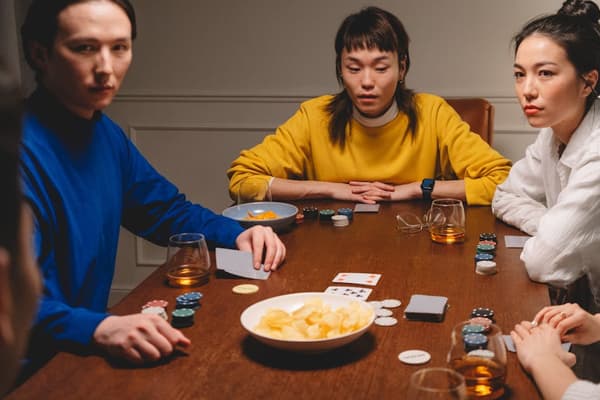
Rikken is the southern Dutch and Belgian Limburg auction trick-taking game. Four players bid through a contract ladder from Rik (8 tricks with a called-Ace partner) up to Open Misère and Pico, then play all 13 tricks of a 52-card deal under the chosen contract.
Rikken is the iconic trick-taking auction game of the southern Netherlands (Brabant and Limburg) and Belgian Limburg. Four players use a full 52-card deck and bid through a tiered ladder of contracts: from a humble Rik (8 tricks with a partner) up through Piek, Misère, Solo, and the spectacular Open Misère. The high bidder names trumps and 'calls an Ace' to find a hidden partner, then must fulfill the contract or pay the table. Played for points (or for stakes) over many deals; weekly Rikken evenings (rikavonden) are a Brabant cultural institution.
Quick Reference
- 4 players (or 5 with dealer sitting out) use a 52-card deck.
- Deal 13 cards each in batches of 7+6.
- Mallure: declare 3 aces immediately if held.
- Auction left of dealer first; bid up the contract ladder or pass.
- Rik: declarer + called-Ace partner take 8/13 tricks.
- Piek: 1 trick alone; Misère: 0 tricks alone; Solo: 8+ alone with trump.
- Open Misère: 0 tricks with hand face-up after trick 1.
- Pico/Slem: all 13 tricks alone (highest bid).
- Each contract has a fixed score per opponent (e.g. Rik 1, Solo 5, Open Misère 8, Pico 16-32).
- Failed contract: declarer pays each opponent the same.
- Solo bids pay/cost triple (alone vs three).
- Track running scores; settle at evening's end.
Players
Rikken is played by exactly 4 players, each on their own (no fixed partnerships). The high bidder names a partner each hand by 'calling an Ace'; the rest defend. Five-handed Rikken (with the dealer sitting out each hand) is also common; this guide describes the 4-player game.
Card Deck
- Use a standard 52-card pack with no jokers.
- Card rank within a suit, high to low: Ace, King, Queen, Jack, 10, 9, 8, 7, 6, 5, 4, 3, 2.
- The trump suit is named by the high bidder during the auction (and is suppressed in Misère contracts).
Objective
Win the auction with a bid you can fulfill. Successful contracts add points to your score; failed contracts subtract. The match is played either to a fixed point target, a fixed number of deals, or simply for the duration of the rikavond, with whoever has the highest cumulative score winning.
Setup and Deal
- Cut for first dealer; the deal then passes to the right (clockwise) after each hand.
- Deal all 52 cards face-down, 13 to each player, in batches of 7+6 (or 6+7) per tradition.
- After the deal, before bidding, any player who holds 3 aces MUST declare 'Mallure' aloud. The holder of the missing 4th ace then becomes the declarer's automatic partner for that hand at the lowest contract (Rik). This rule prevents a sandbagged 'too good' Solo from being hidden.
- Bidding order: The player to the dealer's left speaks first. Each player in turn either bids a contract higher than the current top bid OR passes. Once a player passes they cannot bid again. Bidding continues around the table until three players have passed in succession; the highest standing bid becomes the contract.
- If all four players pass, the deal is annulled (or in some house rules, played as a forced 'Bedelen' that hands all tricks to the lowest score holder).
The Bidding Ladder
- Contracts are bid in this fixed ascending order; each must outrank the previous. Exact thresholds vary regionally; this is the most common Brabant ladder:
- 1. Rik (8 tricks with partner): The basic contract. Declarer names a trump suit AND calls an Ace they do NOT hold (e.g. 'Ace of Hearts'). The holder of that Ace becomes the secret partner for this hand and must take 8 of 13 tricks together with the declarer. Worth a small base score.
- 2. Rik-betteren (overrik, 9+ tricks with partner): Same as Rik but declarer aims for 9 of 13 tricks. Higher stakes.
- 3. Piek (1 trick alone): Declarer plays alone (no partner) and must take EXACTLY ONE TRICK in 13 (no fewer, no more). No trumps; the declarer cannot duck or overload.
- 4. Misère (0 tricks alone): Declarer plays alone with no trumps and must take zero tricks.
- 5. Solo (8+ tricks alone): Declarer plays alone (against all three opponents combined) with a named trump suit and must take 8 of 13 tricks.
- 6. Solo-betteren (9+ tricks alone): Solo with a higher trick target.
- 7. Open Misère (0 tricks alone, hand face-up): Declarer plays alone with their hand revealed face-up to all opponents from the start; opponents try to force the declarer into taking a trick. The most prestigious bid.
- 8. Pico/Slem (all 13 tricks alone): Declarer plays alone and tries to take ALL 13 tricks. Highest-paid contract; rarely bid.
- Some clubs add intermediate contracts such as Vrederik, Kleine Misère, and Bettel-Solo, and the exact rank order can vary by region.
Gameplay
- Lead first: In Rik (with partner) and Solo, the player to the dealer's left leads the first trick. In Misère and Open Misère, the declarer's left-hand opponent leads.
- Calling the Ace (Rik/Rik-betteren only): Before play, the declarer announces the Ace they call. The holder of that Ace says nothing; their identity is revealed only when they play the called Ace.
- Follow suit if possible. If void in the led suit, you may play any card.
- No obligation to overtrump in standard Rikken; you may underplay if you wish.
- Open Misère: After the first trick has been played, the declarer must lay all remaining cards face-up on the table. The defenders play together against this open hand to force the declarer to take a trick.
- Trick winner leads next. Continue until all 13 tricks are played.
- Bonus card: In Rik with the calling-Ace rule, the holder of the Ace must keep playing it as the called trick demands (i.e. cannot misplay the Ace to disguise identity).
Scoring
- Each contract has a base score that the declarer's side wins on success or pays on failure. Typical Brabant club scores (in scoring units; 1 unit = 1 cent or 1 token):
- - Rik (8 tricks made): Declarer and partner each win 1 unit from each opponent.
- - Rik (failed): Each pays 1 unit to each opponent.
- - Rik-betteren (9 tricks): 2 units from/to each opponent.
- - Piek (exactly 1 trick): 3 units from each of the three opponents (Piek's reward, since failure is hard).
- - Misère (0 tricks): 4 units from each opponent.
- - Solo (8 tricks): 5 units from each opponent (declarer plays alone so receives 3x normal).
- - Open Misère: 8 units from each opponent.
- - Pico/Slem: 16 or 32 units from each opponent (the jackpot bid).
- - Overtricks/undertricks: Add or subtract 1 unit per trick beyond/under the contract.
- Mallure scoring: The declarer's automatic partner shares any winnings or losses 50/50.
- Match settlement: Track running scores after each hand. The match is settled at the end of the agreed evening or at a fixed target.
Winning
There is no single 'win' condition for the night; Rikken is played for cumulative score across many deals. At the end of the rikavond, the player with the highest positive total wins. In some clubs the bottom scorer pays for the next round of drinks; in others, scores are summed across the season for league standings.
Common Variations
- Limburg Rikken: Uses a slightly different contract ladder; Piek is sometimes worth more than Misère.
- Brabant Rikken: The mainstream variant described above; Open Misère is the showcase bid.
- Rikken met troef: A simplified family version where the dealer flips a card to set trump and only Rik and Misère contracts are allowed.
- 5-handed Rikken: The dealer sits out each hand; the four playing players bid normally. The dealer rotates each hand so everyone plays equally over a 5-deal cycle.
- Verzwaarde Rikken (Tournament Rikken): Stricter scoring, larger contract ladder, formalised Mallure rules; played in Brabant tournaments.
Tips and Strategy
- Bid Rik with at least 6-7 likely tricks. The called Ace adds 1 trick on average, so a hand with strong trumps and at least one side-suit Ace is a safe Rik.
- Solo demands 7+ near-certain tricks alone. Long trump suit plus side-suit Aces; expect opponents to lead through your weak suits.
- Misère requires no high cards. A single Ace or King in a side suit can be lethal because the opponents will simply lead that suit until you must take it. Hands with 2-3-4-5 spreads in every suit are misère gold.
- Track the Ace called. In Rik, knowing your partner is the holder of (say) the Ace of Spades tells you the entire spade situation; play to draw out trumps before cashing your partner's spade winners.
- Mallure is mandatory. Hiding 3 aces to bid Solo is forbidden by the rules; deliberately concealing them is grounds for losing the hand outright in tournaments.
- Open Misère is gambler's paradise. Bid only with a hand that has a low non-trump card in every suit AND no danger of being thrown the lead at a bad moment.
Glossary
- Rik: The base partnership contract; declarer + partner take 8 of 13 tricks.
- Mallure: The mandatory declaration that you hold 3 aces; the holder of the 4th ace becomes your automatic partner.
- Piek: Solo bid to take exactly one trick.
- Misère: Solo bid to take zero tricks (no trumps).
- Solo: Solo bid to take 8+ tricks with named trumps.
- Open Misère / Misère Open: Solo bid to take zero tricks with all cards face-up after the first trick.
- Pico / Slem: Solo bid to take all 13 tricks; the rarest and highest-scoring contract.
- Rikavond: A 'Rikken evening', a regular weekly social-cum-card session in Brabant pubs and homes.
Tips & Strategy
Hand evaluation drives every Rikken decision. Count guaranteed tricks (Aces, long-trump masters), then add probable tricks for finesses and overtrumping. Bid Rik with 6+ probable tricks (the called Ace adds one more on average), Solo only with a 7+ trick lock, and Misère only with low cards in every suit. The Mallure rule is iron-clad: declare 3 aces immediately or you cannot bid above Rik.
The contract ladder makes Rikken a game of judgment, not just luck. Bidding Rik when you should pass is a slow leak, but bidding Solo when you should bid Rik is catastrophic (Solo failures pay triple). The Mallure rule also means that if a partner is forced on you involuntarily, you must adjust your play assuming THEY have the called Ace; the table-talk economy of a single declared Ace shapes every defensive lead.
Trivia & Fun Facts
Open Misère, in which the declarer plays with all cards face-up after the first trick, is so prized that pulling one off in a Brabant cafe earns a round of drinks from the table. The Mallure rule (mandatory declaration of 3 aces) is named for the French word for 'misery', reflecting the bad position of the unlucky player who would otherwise be saddled with a too-strong Rik partner.
-
01In Rikken, what is 'Mallure' and why is it required?Answer Mallure is the mandatory declaration that a player holds three aces. Once declared, the holder of the fourth ace automatically becomes that player's partner at a Rik contract; the rule prevents a player from concealing a strong hand to bid an easy Solo or Open Misère.
History & Culture
Rikken is documented in Brabant and Limburg from the late 19th century and is widely considered the regional trick-taking game alongside Klaverjas (the rest of the Netherlands) and Wiezen (Flanders). It descended from a fusion of Whist (English) and Manille (French) and developed its own contract ladder during the early 20th century. Weekly rikavonden in cafes are a fixture of Brabant cultural life and many villages run year-long club leagues.
Rikken is the social card game of southern Dutch life. Cafes in Eindhoven, Den Bosch, Maastricht and Tilburg run weekly rikavonden; village championships are seasonal events; and learning Rikken from a parent or uncle is a Brabant rite of passage.
Variations & House Rules
Limburg and Brabant variants use slightly different contract orderings. Tournament Rikken (Verzwaard Rikken) formalises the contract ladder and Mallure rules. Family Rikken simplifies to Rik and Misère only with a flipped trump card.
Pick a contract ladder and stake unit BEFORE play (clubs vary widely). Decide whether overtricks/undertricks score, and whether your house plays 4-handed or 5-handed (with the dealer sitting out).


