
How to Play
A real-time competitive multiplayer solitaire from 1890s England where every player plays their own Klondike layout simultaneously, racing to empty a 13-card demon pile onto shared foundations.
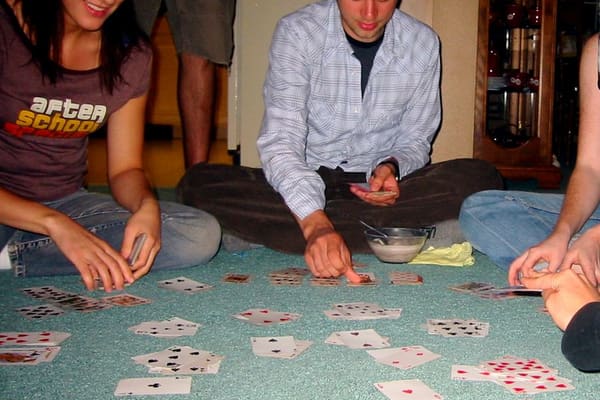
Racing Demon is a real-time multiplayer solitaire from late-Victorian England (the American name is Nerts; other regional names include Pounce, Peanuts, and Squeal). Every player plays their own Klondike-style layout simultaneously, with no turns, racing to empty a personal stockpile called the 'demon' (or 'nerts pile'). At the same time, everyone shares a common pool of foundation piles in the middle of the table: whenever an ace reaches the table, it starts a foundation, and any player may play cards of the matching suit on that foundation in ascending order. The round ends the instant one player empties their demon pile and shouts 'Out!' (or 'Nerts!'). Players then sort the shared foundations by card back, count contributions, and score 1 point per card placed on the foundations and -2 points per card still in the demon pile. Play continues round by round until someone reaches the target score, usually 100.
Quick Reference
- Each of 2-8 players uses a 52-card deck with a unique back.
- Deal 13 face-down as the demon pile; turn the top card up.
- Deal 4 face-up work columns; the rest is a hand pile flipped three at a time.
- Play simultaneously with no turns.
- Build shared foundations from ace up by suit.
- Build work columns down in alternating colours.
- Shout 'Out!' when your demon pile is empty; play stops at once.
- +1 point per card you placed on a foundation.
- -2 points per card still in your demon pile.
- First to 100 across multiple rounds wins.
Players
Two to six players works best; with care, up to eight can play. Each player plays for themselves. The table must be big enough to fit everyone's four-column work row and hand pile, plus a shared centre for up to forty foundation piles (one per suit per deck).
Card Deck
Each player uses one complete 52-card deck with a distinct back design so that cards can be sorted out at the end of the round. A popular workaround for large groups is to mark the edges of each deck with a unique coloured dot. Standard ranking applies: ace low (on foundations) to king high.
Objective
Be the first to empty your 13-card demon pile each round, and over the course of several rounds be the first to reach the target score (traditionally 100 points). You score 1 point per card you played to the shared foundations and lose 2 points per card left in your demon pile.
Setup and Deal
- Each player shuffles their own deck.
- Deal 13 cards face-down into a pile to the left; turn the top card of this pile face-up. This is your demon pile (also called the nerts pile).
- Deal 4 cards face-up in a row to the right of the demon pile. These are your work piles (also called the river or tableau columns); you will build them down in alternating colours.
- The rest of the deck (35 cards) becomes your face-down hand pile, held in your non-dominant hand.
- Leave space in the centre of the table for shared foundations, which begin empty.
- Agree on a starting signal. When the signal is given, play begins and does not pause until someone goes out.
Gameplay
- Simultaneous, no turns: Every player plays as fast as they can. There is no forced order.
- Foundations: An ace played to the centre starts a new foundation. Any player may then add the 2, 3, 4, etc. of that suit, in ascending order. The foundations are shared: it does not matter who plays the card.
- Work piles: Build your four work piles downward in alternating colours (red on black, black on red). You may move a single card or an entire ordered sequence from one work pile to another. An empty column may be filled with any available card.
- Demon pile: The top card of the demon pile is always face-up and available to play onto a work pile (same rules: one lower, alternating colour) or onto a foundation. Every time you play a demon card, turn the next one face-up.
- Hand pile: When you cannot make a useful move from the face-up cards in play, flip the top three cards from your hand pile face-up as a packet onto a waste pile next to it. Only the top card of the waste pile is in play. When the hand pile is exhausted, flip the waste pile over (do not shuffle) and continue flipping in threes. Redeals are unlimited.
- Priority rule: If two players try to place the same card on the same foundation at the same instant, the card that physically lands first counts. The other player takes the card back and plays it elsewhere. Arguments are settled by replaying the last hand or by agreement before the game.
- Going out: The first player to empty their demon pile calls 'Out!' (or 'Nerts!' or 'Stop!'). All play halts immediately, even mid-placement.
Scoring
- Sort the shared foundations by deck back: each player retrieves the cards they contributed.
- +1 point per card you placed on a foundation.
- -2 points per card remaining in your demon pile (including the face-up top card).
- Cards left in work piles, the hand pile, or the waste pile score zero; only demon cards carry a penalty.
- Some groups award a bonus of 10 points to the player who called 'Out!', recognising that going out is a distinct achievement; other groups drop this bonus to keep scoring purely card-based.
- Tally scores round by round on paper.
Winning
Play successive rounds until one player reaches the agreed target score. 100 points is standard. Short games end at 50; long sessions run to 200. The player with the highest cumulative score at that point wins. If two players cross the target in the same round, play one more round and the higher score wins.
Common Variations
- Nerts (USA): Identical rules, but the demon pile is called the nerts pile and 'Nerts!' is shouted when going out.
- Pounce: Another American name; some Pounce rulebooks count only cards played to foundations (no demon penalty) or use a 13-card pile called the pounce pile.
- Flip one (Klondike mode): Flip hand-pile cards one at a time instead of three, with a single redeal. Makes the game slower and more forgiving for beginners.
- Team Nerts: In games of four or six, pair into teams of two, combine scores, and let partners play cards to the same foundations. Calling out ends the round for the whole table.
- Solo target: Lower the target to 50 points for short family games, or raise it to 200 for tournament play.
Tips and Strategy
- Demon cards first: Every card you play from the demon pile is effectively worth 3 points (you gain 1 on the foundation and avoid the -2 penalty). Prioritise demon plays over work-pile shuffling.
- Keep one empty column: A cleared work pile is a free parking spot for any card, which is invaluable when the demon's top card cannot otherwise be placed.
- Scan the foundations constantly: A useful foundation card played by someone else changes what you can contribute. Keep one eye on the centre at all times.
- Do not hoard aces: Play aces to the centre immediately, even if you had plans for a clever work-pile move. Aces lock nothing in your own layout and unlock plays for everyone (including you).
- Vocal 'out' calls: Practice saying the word clearly. A mumbled 'out' lets opponents sneak in another placement and ruins the stopping rule.
Glossary
- Demon pile / nerts pile: Your 13-card face-down pile. Emptying it ends the round.
- Work pile / river column: One of your four tableau columns, built down in alternating colours.
- Hand pile: The remaining 35-card face-down pile held in hand; flipped three at a time to a waste pile.
- Foundation / lake: A shared centre pile, built up by suit from ace to king. Any player may contribute.
- Out (or 'Nerts!'): The call that ends the round when the demon pile is empty.
- Packet of three: The three cards flipped together from the hand pile. Only the top card is playable.
- Copy back: Unique deck design that lets players separate their foundation contributions after the round.
Tips & Strategy
Every demon card played is worth 3 points on balance (one gained, two penalties avoided), so prioritise demon plays over work-pile tidying. Keep at least one empty work column as a parking spot, and send aces to the centre the moment you see them.
The best players develop a constant three-way scan: one glance at the demon-pile top, one at the shared foundations, one at their own work piles. The hand pile is checked only when nothing else can move, and cleared columns are guarded jealously as temporary parking spots.
Trivia & Fun Facts
Because every player needs a distinctly backed deck, serious Nerts players build a collection of novelty decks; at competitive tournaments the most common sight is a tableful of souvenir airline, casino, and holiday resort decks.
-
01What is the American name for Racing Demon, and what do players shout when they empty their demon pile?Answer The American name is Nerts, and players shout 'Nerts!' (some groups simply shout 'Out!' or 'Stop!').
History & Culture
Racing Demon first appeared in English drawing rooms in the 1890s and was exported to the United States under the names Pounce (mid-1930s) and later Nerts (from the 1940s onward). A German translation, Rasender Teufel, was documented in 1927. The exact inventor is unknown.
Racing Demon is a fixture of British family card cabinets and holiday gatherings, where it occupies the same cultural slot that Dutch Blitz or Nerts occupies in North America: a fast, noisy, multi-deck game that lets any number of players join in with minimal teaching.
Variations & House Rules
Nerts is the American name with identical rules. Pounce and Peanuts are regional American variants with minor scoring tweaks. Team Nerts pairs four or six players into shared-score partnerships. Flip-one rules slow the pace for beginners, and tournament play usually bumps the target to 200 points.
Shrink the demon pile to 10 cards for quicker rounds, or raise the target score to 200 for long tournaments. For beginners, try flipping the hand pile one card at a time with a single redeal, which drastically reduces frustration.


