
How to Play
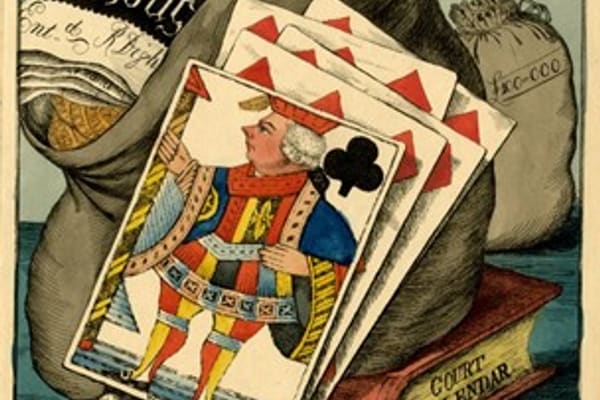
A classic 17th-century English trick-taking pool game. Players ante into a pot and must win a trick to avoid being looed and paying into the next deal's pool. 5-card Loo adds Pam (the Jack of Clubs) as top trump and pot-winning flushes.
Loo (Lanterloo) is a 17th-century English trick-taking pool game whose family name covers two closely related forms: 3-card Loo (the usual parlour game) and 5-card Loo or Pam-Loo (the louder gambling variant featuring Pam, the Jack of Clubs, as the top trump). In both forms, players ante into a pool, receive a small hand, and must win at least one trick to claim a share. A player who participates in a deal but fails to take a trick is 'looed' and must contribute a fresh stake equal to the whole pool, setting up a pot that can balloon with every failed hand. Both forms use a strict-following, trump-if-void, head-the-trick rule set, and both end matches on a big pot rather than a fixed score. Loo was the signature English card game of the Restoration and Georgian periods; the novelist Fielding and the diarist Pepys both mention it in their accounts of coffee-house and drawing-room life.
Quick Reference
- 3 to 8 players. Standard 52-card deck.
- Ante to the pool; deal 3 cards (3-card Loo with Miss hand) or 5 cards (5-card Loo with Pam).
- Turn up next card for trumps (or skip in Irish Loo).
- Declare play, pass, or take Miss (3-card Loo only).
- Lead a card. Others must follow suit, trump when void, and head the trick if able.
- In 5-card Loo, Pam (Jack of Clubs) beats the Ace of trumps; flushes sweep the pool.
- Each trick wins one share of the pool. Zero-trick players are looed.
- Unlimited Loo: penalty = whole pool. Limited Loo: penalty = fixed cap.
- 5-card Loo flush sweeps the pool and loos everyone else.
Players
3 to 8 players, best at 5 or 6. No partnerships; every player is for themselves. Deal passes clockwise each hand. A casual session lasts 30 to 60 minutes; a high-stakes Unlimited Loo can end faster or slower depending on how quickly a big pot explodes.
Card Deck
One standard 52-card French-suited pack, jokers removed. Rank within a suit (high to low) in 3-card Loo: A, K, Q, J, 10, 9, 8, 7, 6, 5, 4, 3, 2. In 5-card Loo / Pam-Loo, Pam (the Jack of Clubs) is the highest single card in the entire deck, outranking the Ace of trumps; the rest of the ranking is standard. Cards of the trump suit always beat cards of other suits.
Objective
Each deal: win at least one trick to claim your share of the pool and avoid being looed. Looed players refund the pot and set up the next deal. Across the session, end with the most chips.
Setup and Deal
- Each player antes an agreed stake (often 3 chips in 3-card Loo; a multiple of 5 in 5-card Loo) into the pool before the deal.
- Deal a hand to every player: 3 cards each in 3-card Loo, 5 cards each in 5-card Loo.
- 3-card Loo: Also deal an extra hand called Miss face down on the table, between the dealer and the player to the dealer's left. Turn the next card face up beside the stock to set the trump suit. A player may exchange their entire hand for the Miss hand sight-unseen (see Gameplay).
- 5-card Loo / Pam-Loo: No Miss hand. Turn the next card face up to set the trump suit. Each player may either pass (fold) or declare; players who declare may discard any number of cards and draw replacements from the stock before leading begins.
- Players examine their hands and then declare in clockwise order starting with the player to the dealer's left.
Gameplay
- Declaration (3-card Loo): Each player in turn announces 'pass' (fold and do not participate this deal), 'play' (keep the hand and commit to play), or 'take Miss' (blindly swap the entire hand for the Miss hand and commit to play). Only one player may take Miss, and they must commit before seeing its cards.
- Declaration (5-card Loo): Each player says 'pass' or 'play'. Players who play may exchange any cards they like for fresh ones from the remaining deck before leading begins.
- Forced play (bold stand): If the pool contains only the dealer's ante (not a looed pot) and all other players pass, the dealer and the last player in the circuit must play; no one may pass out a small single-ante pot.
- Leading: The eldest hand (first player to the dealer's left who is still in) leads. In many variants, any player who holds the Ace of trumps (or Pam in 5-card Loo) must lead it on the first trick.
- Follow suit strictly: Subsequent players in the trick must follow suit if able.
- Trump if void: A player who cannot follow suit must play a trump if they have one.
- Head the trick: A player who follows suit or trumps must play a higher card than the current best card on the table if able. This is the 'must-head-the-trick' rule and it is enforced strictly.
- Pam be civil (5-card Loo only): When a player leads the Ace of trumps, they may say 'Pam, be civil', and the holder of Pam must not play it on that trick. This protects the Ace-lead from being stolen by Pam.
- Flushes (5-card Loo only): Five cards of one suit is a flush. A flush sweeps the pool immediately, and every other player who stayed in is looed. A flush that includes Pam (a Pam-flush) beats a plain flush.
- Winning tricks: Highest trump in the trick wins, or the highest card of the suit led if no trump was played. Winner of each trick leads the next.
Scoring
- Pool share (3-card Loo): The pool is divided equally into three shares, one per trick. A player who wins 1 trick collects 1/3 of the pool; 2 tricks collects 2/3; 3 tricks collects the whole pool.
- Pool share (5-card Loo): The pool is divided into five shares, one per trick. Take as many shares as tricks won.
- Loo penalty: A player who declared to play but wins zero tricks is looed. They must pay the entire previous pool value into the next deal's pool (Unlimited Loo) or a fixed agreed amount (Limited Loo). In either case, taking Miss also exposes you to the loo penalty if you still win no tricks.
- Flush win (5-card Loo): A flush takes the whole pool. Every other player who played (but did not flush) is looed.
- Pam-flush trumps plain flush: A flush containing the Jack of Clubs beats a flush without Pam.
- Session scoring: No fixed target. Most groups play to a fixed number of deals or until one player runs low on chips.
Winning
There is no single deal that wins the game; the match is a chip-count contest. Each deal produces trick-share winners and possibly looed losers, and the session ends when the group has agreed to stop (a fixed number of deals or a time limit). Whoever has the most chips then is the session winner. A flush in 5-card Loo is the game's single biggest swing, since one player sweeps the whole pool and every other player is looed.
Common Variations
- 3-card Loo (standard): Smaller deals, faster hands, Miss option. The traditional parlour version.
- 5-card Loo / Pam-Loo: Bigger deals, flushes possible, Pam as super-trump. Higher-stakes gambling form.
- Irish Loo: No turn-up card; trumps are set by the lead of the first trick. No Miss hand. Otherwise follows the 3-card Loo rule set.
- Unlimited Loo: Loo penalty equals the whole current pool, so pots can double, quadruple, and balloon. Creates dramatic swings.
- Limited Loo: Loo penalty is a fixed cap (often equal to the original ante), so the pool grows predictably. Safer for casual groups.
- Bold Stand (fixed rule in some groups): When only the dealer's ante is in the pool, everyone MUST play; no pass-outs for small pots.
- Mississippi (17th-century French form): Close cousin of Loo played with 3-card hands, a Miss, and the same loo penalty mechanic.
Tips and Strategy
- Fold without shame. The most frequent beginner mistake is staying in with a weak hand; being looed for the whole pool costs far more than skipping a small pool.
- In 3-card Loo, take Miss when you hold nothing (no Ace, no face, no trump). Blindly swapping cannot make you worse.
- Count the trumps already played. Once most trumps are out of the remaining hands, a high non-trump card becomes a reliable winner.
- In 5-card Loo, the flush is the biggest single play. If you hold four of one suit at declaration, it may be worth exchanging your off-suit card to try for the fifth, even at the risk of being looed for the entire pool.
- The 'must head the trick' rule makes hands of middle cards dangerous. A 7 that is your highest card of a suit will often force a loss to an opponent's 8; plan a discard line that ends with your lowest cards going on partner-winning tricks.
- Track who has been looed and the size of the current pot; as the pot grows, other players will play tighter, so a marginal hand that would normally fold becomes playable purely because fewer opponents will contest tricks.
Glossary
- Loo / Looed: Losing a deal by playing and winning zero tricks; triggers the loo penalty.
- Pool: The central chip pot, built from antes and loo penalties.
- Miss (3-card Loo): An extra face-down 3-card hand dealt for the table; any player may swap their whole hand for it sight-unseen before play.
- Pam (5-card Loo): The Jack of Clubs, the single highest card in the entire deck.
- Flush: A 5-card hand of one suit; in 5-card Loo, sweeps the pool. A Pam-flush beats a plain flush.
- Pam-flush: A flush that includes the Jack of Clubs.
- Bold stand / Force: A rule requiring everyone to play when the pool contains only the dealer's ante.
- Head the trick: Strict rule that a player who follows suit or trumps must play a higher card than the current best, if able.
- Pam, be civil: Phrase uttered when leading the Ace of trumps in 5-card Loo, protecting the lead from being overtrumped by Pam.
- Unlimited Loo / Limited Loo: Loo penalty equals the whole pool, or a fixed cap, respectively.
Tips & Strategy
Fold weak hands without hesitation; being looed costs the whole current pool, so skipping a small pool is nearly always the right move. Take Miss in 3-card Loo only when your dealt hand has no trumps or high cards to protect. In 5-card Loo, chasing a flush is worth it if you hold 4 of one suit at declaration; the flush sweeps the pool and loos everyone else. Remember 'must head the trick': hands full of middle cards lose tricks to opponents holding one card above yours.
Loo rewards discipline above card power. The sole big decision every deal is 'play or fold' and novices almost always play too often; with 3-card hands, the odds of winning zero tricks against 4 or 5 opponents are high even with a couple of small trumps. Experienced players fold 40 to 60 percent of deals, bank antes, and hunt for the big flush (5-card Loo) or the triple-trick hand (3-card Loo) when the pool is large and opponents are loose.
Trivia & Fun Facts
The popularity of Loo was so great in 18th-century England that the 'loo table', a small round card table with a green baize top, became a standard piece of Georgian parlour furniture; surviving examples are sought-after antiques today. The 5-card variant's super-trump, Pam (Jack of Clubs), takes its name from the Latin word pamphilus meaning 'beloved'; the card appears with the same role in the older French game of Pamphile.
-
01In 5-card Loo, which specific card is the top-ranked card of the entire deck, outranking the Ace of trumps?Answer Pam, the Jack of Clubs. When leading the Ace of trumps, the leader may say 'Pam, be civil' to protect their trick from Pam capturing it.
-
02What is the face-down spare 3-card hand in 3-card Loo called, and what is the risk of taking it?Answer The Miss. A player who takes Miss swaps their whole hand for it sight-unseen, and is still looed for the full pool if they then win no tricks.
History & Culture
Loo was one of the most widely played card games in England from the 1660s to the 1830s and was the signature gambling pastime of Restoration and Georgian drawing rooms. It is mentioned in Pepys's diary (1660s) and appears repeatedly in novels by Fielding and Austen. The game's potential for rapidly swelling pots (Unlimited Loo) made it controversial; 18th-century moralists warned against the game because a single looed deal could ruin a player's evening. The word 'loo' comes from the 17th-century French nonsense refrain 'lanturlu'.
Loo was the defining gambling card game of Restoration and Georgian England, and its presence in the literature of Pepys, Fielding, and (obliquely) Austen cements it as a historical social fixture. The game survives today primarily in history-of-cards circles and historical re-enactment, but its influence on later English card games (including the pool-and-penalty mechanics of early poker variants) is substantial.
Variations & House Rules
3-card Loo is the parlour standard with a Miss hand. 5-card Loo / Pam-Loo adds Pam as the top trump and flushes that sweep the pool. Irish Loo drops the turn-up and sets trumps by the first lead. Unlimited Loo and Limited Loo differ by whether the loo penalty equals the pool or a fixed cap. Bold Stand forces all players to play when only the dealer's ante is in the pool.
For casual play, use Limited Loo so the pot cannot ruin an evening. For a fast-paced game, play 3-card Loo with a Miss hand and a small fixed penalty. For a high-drama evening, play 5-card Loo with Pam and Unlimited penalties and pre-agree a chip limit so no one goes broke. Use matchsticks or play-chips rather than cash to keep stakes social.


