
How to Play
Lorum is a 19th-century Hungarian compendium game for 4 players using a 32-card German-suited pack. Each dealer picks a contract from a set of 4 core (Reds, Obers, No Tricks, Lorum) plus 4 optional contracts; 8 deals per round with 4 rounds makes a 32-deal session. Lowest total penalty wins.
Lorum is a 19th-century Hungarian compendium card game for 4 players, a forerunner of modern trick-avoidance compendium games like Trex and Barbu. 8 deals × 4 rounds = 32 games in a standard session, each deal played under a different contract chosen by the dealer. Four core contracts (Reds, Obers, No Tricks, Lorum) are always in the set; four more optional contracts are often added. Lowest total penalty wins. The game typically runs about 90 minutes.
Quick Reference
- 4 players; 32-card German- or French-suited pack (Ace, King, Ober/Queen, Unter/Jack, 10, 9, 8, 7 per suit).
- Deal 8 cards each, clockwise; dealer picks the contract for that deal.
- Core contracts: Reds (1 pt per heart), Obers (2 pt per Queen), No Tricks (1 pt per trick), Lorum (layout shedder, 1 pt per card left in hand).
- Optional contracts add Red King (-4), First/Last Trick (-4 each), Fifth Trick (-4), and All Bad combos.
- Trick-taking contracts: follow suit if able, highest of led suit wins, no trump.
- Add per-deal penalties to each player's running total; some contracts pay into/from a common pot (pot, beans, or chips).
- Lowest cumulative total wins the session; bean-based variants use 20-bean starting piles.
Players
4 players, each for themselves (no partnerships). The first dealer is chosen by any agreed method; the deal rotates clockwise after each deal. In 8-deal rounds the dealer is also the declarer who picks the contract. A three-hand variant exists (remove the 7 and 8 of Bells); with 3 players each receives 10 cards and the session is 24 games instead of 32.
Card Deck
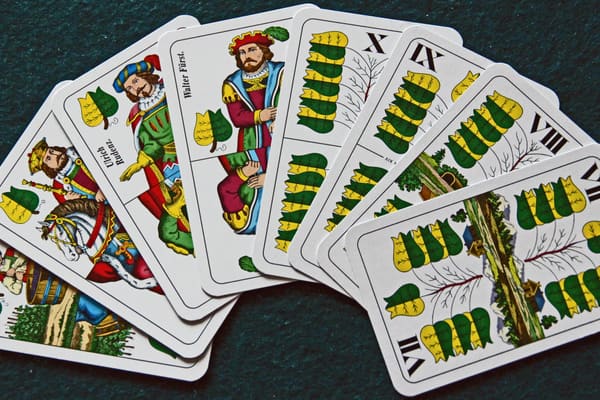
One 32-card German-suited pack: Acorns (Clubs), Leaves (Spades), Hearts, Bells (Diamonds), with ranks Ace, King, Ober (Queen), Unter (Jack), 10, 9, 8, 7 in each suit (no 2s through 6s). Rank order within each suit (high to low): Ace, King, Ober, Unter, 10, 9, 8, 7. No trump suit in any contract. French-suited 32-card packs may be substituted (remove 2s through 6s from a standard deck); the Ober maps to Queen and Unter to Jack.
Objective
Accumulate as few penalty points as possible across the 32-deal session. Each deal imposes penalties based on the current contract (tricks, specific cards, specific trick numbers). The player with the lowest total penalty at session end wins.
Setup and Deal
- Shuffle the 32-card deck thoroughly. The dealer offers a cut to the player on the right.
- Deal 8 cards to each player, one at a time clockwise.
- The dealer chooses the contract for that deal from the 4-8 contracts in the agreed set. In a standard 8-deal round, each contract is played exactly once per round; with 4 rounds of 8 deals, each contract is played 4 times.
- Forehand (the player to the dealer's left) leads the first trick.
The Four Core Contracts
- 1. Reds (No Hearts, Herzlos): Penalty 1 point per red card (heart) captured in tricks. Each heart = 1 point (8 hearts = 8 points total). Hearts cannot be led to the first trick unless the leader's hand is entirely hearts. On subsequent tricks, hearts may be led freely. Standard trick-taking: follow suit if able; highest card of the led suit wins; no trump. The goal is to capture as few hearts as possible.
- 2. Obers (No Queens, Damenlos): Penalty 2 points per Ober (Queen) captured (4 Obers = 8 points total). Obers cannot be led to the first trick unless they constitute your only card in a suit (a singleton). On subsequent tricks, you may discard an Ober when you cannot follow suit; they are not winners unless led, so they are dumped onto tricks led in a different suit.
- 3. No Tricks (Stichlos): Penalty 1 point per trick captured. 8 tricks = 8 points. Pure trick-avoidance. The goal is to take as few tricks as possible; losing every trick scores zero.
- 4. Lorum (also Kirako / Domino): Not a trick-taking contract. A layout contract similar to Fan Tan or Trex: forehand leads any card. Each following player in turn must play either a card of the same rank in a different suit, or a card adjacent in rank in the same suit. A player who cannot play misses a turn (-1 point per missed turn). When the first player empties their hand, the round ends; remaining players score 1 point per card still in hand. Layout-based scoring; strategic card management is critical.
Optional Additional Contracts
- 5. Red King (Herzkönig): Penalty 4 points for capturing the King of hearts. No other penalties. Hearts-broken rule applies: hearts cannot be led until a heart has been discarded.
- 6. First and Last Trick (Erster und letzter Stich): Penalty 4 points each for capturing the first trick and/or the last trick. The player who wins the first trick scores -4; same for the last. Middle tricks carry no penalty.
- 7. Fifth Trick (Fünfter Stich): Penalty 4 points for capturing the fifth trick. Forces defensive play in the exact middle of the deal.
- 8. All Bad (Hairy Ape / Quartel / Train / combined): Combines several earlier contracts (for example Reds + Obers + No Tricks + Red King); penalties aggregate from each constituent contract. The most feared contract in Lorum because every card is dangerous.
Gameplay
- Leading the first trick: Forehand (left of dealer) leads any legal card (no hearts in Reds contract until broken; no Obers in Obers contract except singletons).
- Trick structure (contracts 1-3 and most optional): Play proceeds clockwise. Follow suit if able; otherwise discard any card. Highest card of the led suit wins the trick (no trump). Winner leads the next trick.
- Lorum contract: Non-trick-taking layout play; see contract description above.
- Renege (revoke): Failing to follow suit when able is a renege. Standard penalty: the offending player takes all penalty points for the deal; the three others score zero.
- End of deal: After 8 tricks (or when all Lorum players run out of cards), count each player's penalty points according to the active contract and add to the running total.
Scoring
- Per-deal penalties are governed by the specific contract (see above). Write each player's penalty on the score sheet per deal.
- Counter-based scoring option: Use beans or chips instead of pen-and-paper. Each player starts with 20 beans; losers pay beans to winners based on penalty differences. A player who runs out of beans can pay a penny (real or token) to the pot for another 20 beans.
- Pot-based scoring (some contracts): In certain contracts (Red King, First and Last Trick, Fifth Trick), beans go into a communal pot; in Reds or Obers with all-zero scorers, the 8-bean pool is divided evenly among those who captured none of the penalty cards.
- Running total: Across the 32 deals (4 rounds of 8 contracts each), sum penalty points; lowest cumulative score wins.
Winning
- Session winner: Lowest cumulative penalty total after all 32 deals.
- Tie-breakers: If two or more players are tied on the lowest total, play one extra deal with the tied players choosing the contract by agreement (often a player-requested one); lowest in that tie-break deal wins.
- Bean-based end: In the bean variant, the session can end when one player has all the beans (or runs out); winner is the bean leader at that moment.
Common Variations
- Short Lorum: Play only the 4 core contracts (8 deals total, each contract played twice); a quicker session.
- Extended Lorum: Add all 8 optional contracts for 32+ deals per full round; session lasts 2-3 hours.
- Double-stakes option: The dealer may double penalties for a specific deal before forehand leads; all scores for that deal are multiplied by 2.
- Three-hand Lorum: Remove the 7 and 8 of Bells for a 30-card pack; each player gets 10 cards; session runs 24 games.
- Barbu: A closely related French compendium game with 7 contracts; a direct descendant of Lorum.
Tips and Strategy
- Contract selection is the dealer's most important lever. Save Lorum (or All Bad) for hands with no penalty-heavy cards; lead with No Tricks when you hold many low cards.
- In Reds, short suits are key. If you are void in a suit, you can freely discard hearts there. Lead your short suits early to establish voids.
- In Obers, a lonely Ober (singleton) in a suit is safe; a protected Ober (Ober with other same-suit cards below it) is dangerous. Dump Obers on tricks you cannot win when possible.
- In No Tricks, lead low cards systematically; force opponents to capture tricks they don't want.
- In the Lorum layout contract, holding a 9 or 10 of any suit is powerful because those ranks are common bridge cards that connect both up and down; keep them for tempo control.
Glossary
- Ober / Unter: German-suited rank equivalents of Queen and Jack respectively. Ober ranks above Unter but below King.
- German suits: Acorns (Clubs), Leaves (Spades), Hearts, Bells (Diamonds); used in traditional Hungarian packs.
- Contract: One of the 4 to 8 game modes the dealer selects; each has its own penalty structure.
- Forehand: The player to the dealer's left; leads the first trick in trick-taking contracts.
- Reds (Herzlos): The No-Hearts contract; 1 point per heart captured.
- Obers (Damenlos): The No-Obers contract; 2 points per Ober captured.
- Stichlos: No Tricks; 1 point per trick captured.
- Lorum / Kirako: A layout contract similar to Fan Tan; the game's namesake contract.
- All Bad: A catch-all contract combining penalties from multiple other contracts.
- Bean: A physical counter used in the scoring-by-beans variant.
Tips & Strategy
Contract selection is the dealer's key lever. Save Lorum or All Bad for your strongest defensive hand; burn No Tricks when you hold many low cards; choose Reds when you are short in hearts.
In Reds, short suits are key; void early so you can discard hearts on a lead of your voided suit. In Obers, singletons are safe and protected Obers are dangerous; dump Obers on tricks led in another suit whenever possible.
Trivia & Fun Facts
Beans (not chips) are the traditional Lorum counter; a player who runs out of beans can pay a penny to the pot or a fellow player for another 20 beans, keeping the session going indefinitely.
-
01How many deals make up a full game of Lorum in its standard form?Answer 32 deals (8 contracts x 4 rounds). The four core contracts are Reds, Obers, No Tricks, and Lorum; optional contracts (Red King, First and Last Trick, Fifth Trick, All Bad) round out the set.
History & Culture
Lorum has been popular in Hungary for over a century and is a direct ancestor of the French game Barbu; it helped shape the trick-avoidance compendium family that includes Trex and Quartel.
A beloved Hungarian card game tradition, played at family gatherings and social clubs throughout the country; its compendium structure has influenced trick-avoidance games across central Europe.
Variations & House Rules
Short Lorum plays only the 4 core contracts. Extended Lorum uses all optional contracts (Red King, First and Last Trick, Fifth Trick, All Bad) for a longer session. Three-hand variant removes the 7 and 8 of Bells for 10-card hands.
For a first-timer session play Short Lorum (4 contracts). For a full evening use all 8 contracts with bean-counters. For 3 players, drop the Bells 7 and 8 and deal 10 cards each.


