
How to Play
Five Hundred (500) is an engaging and strategic trick-taking card game where players aim to be the first team to reach 500 points by winning bids and taking tricks. It is played with a 43-card deck and involves bidding and trick-taking.
500 is Australia's national card game and the most popular card game in Canada; it is a 4-player partnership trick-taking game derived from Euchre. It uses a 43-card deck with one Joker and a 3-card kitty (widow). Each player is dealt 10 cards; a rich auction determines both how many tricks (6-10) and what trump the declarer will play, with bids ranked by trick count and then suit, and the declarer picks up the 3-card kitty before play. The winning suit/tricks combination yields a fixed point value (40 to 520), won in full by the declarer if they make their bid and LOST if they are set. First partnership to 500 wins; if either side goes below -500 ('in the bog'), they lose immediately.
Quick Reference
- Use a 43-card deck (remove 2s, 3s, and black 4s) plus one Joker.
- 4 players in 2 partnerships; deal 10 cards each with 3 in the kitty.
- Bid 6-10 tricks with a trump suit; highest bidder picks up the kitty and discards 3.
- Declarer leads first; follow suit if possible.
- Joker is highest, then Right Bower, Left Bower, then A-K-Q down.
- Bidding team scores bid value if they meet it; loses bid value if they fail.
- Non-bidding team scores 10 points per trick won.
- First team to 500 points wins.
Players
Exactly 4 players in 2 fixed partnerships, partners sitting opposite each other at the table. 500 also has 3-player (cutthroat) and 6-player (3 vs. 3 or individual) variants, but the 4-player partnership form is dominant in Australia and Canada. Turn order is clockwise; deal rotates clockwise after each hand. A full match to 500 typically runs 60 to 90 minutes; the -500 loss rule can end games earlier.
Card Deck
- 43-card deck: start with a standard 52-card pack; remove all 2s, 3s, and the black 4s (keep the red 4s). Add one Joker for a total of 43 cards.
- Rank order in the trump suit (from highest): Joker > Right Bower (J of trump) > Left Bower (J of same colour as trump) > A > K > Q > 10 > 9 > 8 > 7 > 6 > 5 > 4 (if red)
- Rank order in non-trump suits: A (high), K, Q, J, 10, 9, 8, 7, 6, 5, 4 (red only).
- The Joker is the highest trump in any trump suit; in a No-Trumps bid, the Joker is an unbeatable 'boss' that the holder may play at any time but must nominate a suit that subsequent players follow if any.
- Left Bower behaviour: like in Euchre, the Left Bower (Jack of same COLOUR as trump) counts as trump for the hand; its printed suit is ignored.
Objective
Be the first partnership to reach a cumulative +500 points. Each hand, a partnership wins the auction by promising to take a certain number of tricks with a nominated trump (or no trump); making the bid scores the bid's value, failing it subtracts that value. A partnership that drops to -500 ('in the bog') loses the match outright. The non-declaring partnership scores 10 points per trick taken regardless of the bid.
Setup and Deal
- Shuffle the 43-card deck. Cut for first dealer (low card deals).
- Deal pattern: 3 cards to each player clockwise, then 1 face-down to the kitty (widow); 4 cards to each player, then 1 to the kitty; 3 cards to each player, then the last card to the kitty. Each player holds 10 cards and the kitty holds 3 face-down cards.
- The player to the dealer's left bids first; the auction proceeds clockwise.
- After each hand, shuffle and the deal rotates one seat clockwise.
Bidding (Auction)
- Bid format: a bid is a NUMBER of tricks (6-10) plus a NOMINATED trump (spades, clubs, diamonds, hearts, or 'No Trumps'). Bids are ranked first by trick count, then by trump suit in the order Spades < Clubs < Diamonds < Hearts < No Trumps. Example: 7 Spades is the lowest 7-bid and 6 No Trumps outranks 6 Hearts.
- Minimum bid: 6 of any suit (or 6 No Trumps).
- Maximum bid: 10 No Trumps (the absolute top at 520 points).
- Bidding order: starting with the player left of dealer, each player bids ONCE in turn: they either name a higher bid than any so far, or PASS. Once a player passes, they cannot re-enter the auction.
- Misère bids: some tables allow a special 'Misère' bid (take 0 tricks in no-trump) worth 250 points, or 'Open Misère' (play with your cards face-up) worth 500. Misère ranks between 7-hearts and 8-spades in most auction orders.
- Auction ends when 3 players pass in a row after a bid, leaving one declarer; OR when all 4 pass (the hand is thrown in and the deal rotates).
Gameplay
- Kitty pickup: the declarer (highest bidder) picks up the 3-card kitty face-down (opponents do not see them), adds them to their hand (now 13 cards), and discards any 3 cards face-down. The declarer's partner contributes nothing at this stage.
- The declarer leads the first trick. Any card may be led.
- Follow suit if possible: clockwise, each player plays a card of the suit led if they hold one. If not, they may play any card, including a trump.
- Left Bower note: the Left Bower counts as trump; do NOT play it as a follow-suit card on a lead of its printed suit (hearts Left Bower on a diamond lead is NOT a follow-suit play and is a renege if you hold a real diamond).
- Joker in a trump bid: the Joker is the highest trump and may be played any time; in a No-Trumps bid, the Joker's holder must announce the suit they are treating it as when they play it, and opponents must follow that suit if possible.
- Winning the trick: highest trump wins; if no trump, highest card of the suit led. Winner leads the next trick.
- Play continues for 10 tricks (all cards in every hand played).
Scoring
- Scoring table (bid value in points): 6 tricks = Spades 40, Clubs 60, Diamonds 80, Hearts 100, No Trumps 120. 7 tricks = Spades 140, Clubs 160, Diamonds 180, Hearts 200, No Trumps 220. 8 tricks = 240/260/280/300/320. 9 tricks = 340/360/380/400/420. 10 tricks = 440/460/480/500/520.
- Making the bid: if declarer wins the bid's trick count (or more), their partnership scores the bid value ONCE. Overtricks (winning more than bid) usually score 10 each, unless they bring the total past 10 No Trumps' value.
- Failing the bid ('set'): if declarer wins fewer tricks than bid, their partnership LOSES the bid value (score goes down by that amount). No partial credit.
- Defenders: the non-declaring partnership scores 10 points per trick they take, regardless of whether the declarer makes the bid.
- Slam bonus (10-trick sweep): a made 10-trick bid is automatic at its scoring-table value; no extra bonus.
- Misère: making a misère scores 250; failing it costs 250. Open Misère is 500 / -500.
- In the bog: if a partnership's total drops to -500 or lower, they LOSE the match immediately, even if opponents have not reached +500.
Winning
The first partnership to reach or exceed +500 points wins the match. If a partnership drops to -500 or below, they lose the match regardless of the opponents' score. In the rare case both partnerships cross the threshold in the same hand (one up to 500+, the other down to -500), the partnership that hit +500 wins. Because 500 has heavy penalty scoring, a single 8 or 9-trick failed bid can flip the game instantly; this is by design.
Common Variations
- Australian 500 (the dominant form): auctions include Misère (250) and Open Misère (500); bid ranks follow the classic ordering above.
- Canadian 500: similar core rules; the Joker is sometimes treated as a No-Trumps-only card that has no 'suit' until played, and must be nominated.
- 3-player 500 (Cutthroat): use the same 43-card deck; each player plays solo. Declarer's partnership is 'the declarer alone' and all 3 scores are tracked individually.
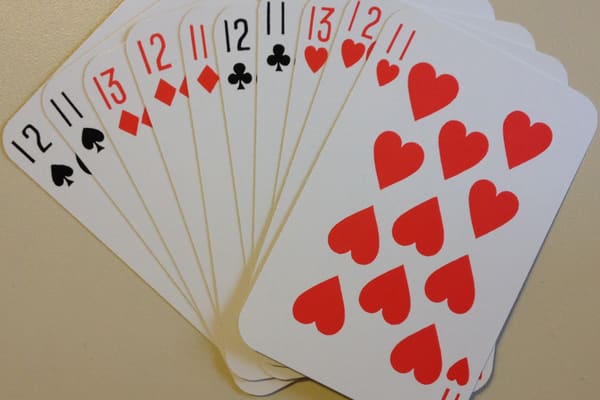
- 6-player 500: two partnerships of 3 (alternating seating); use a 63-card deck by adding the 11, 12, and 13 of hearts and diamonds and a second Joker.
- No-bog rule: some house rules disable the -500 loss trigger; the game ends only at +500.
- Nullo: like Misère but scored 500 / -500; no 'Open' variant.
- Inkle (advanced bidding): rare, allows a 'call partner' mid-auction where declarer swaps cards with partner. Tournament-level variant.
- Americas 500: a 1900s US variant with only the 6-10 scoring and no Misère; not common today but historically important.
Tips and Strategy
- Bid the kitty. The 3-card kitty is your chance to transform 2-3 garbage cards into playable ones; bid boldly when you hold the Joker + both Bowers.
- Bower pairs are decisive. Holding both Bowers in the trump suit is worth about 2 guaranteed tricks; with the Joker that becomes 3 certain winners, enough for a 6-bid on most hands.
- Lead trumps early as declarer. Two rounds of trump leads usually clear defenders' trumps; after that your side aces run free.
- Defenders: lead long side suits early. If you hold a long side suit (4+ cards) with high cards, attack it immediately; declarer's side must trump in eventually.
- Misère is a strong side bid. Holding only low cards and one short suit is the Misère profile; 250 points is a substantial reward.
- Beware the bog. If your partnership is at -350 and facing a potential 200-point set, consider bidding to deny opponents the contract even at the cost of a modest underbid.
- Communication by bidding: your bid level signals hand strength to your partner; an opening 7-Hearts bid says 'I have strong hearts + at least one Bower'.
Glossary
- Kitty / widow: the 3-card face-down packet dealt to the centre; picked up by the declarer after the auction.
- Declarer / maker: the player who wins the auction; plays the contract.
- Right Bower: the Jack of the trump suit; second-highest card below only the Joker.
- Left Bower: the Jack of the same colour as trump; third-highest.
- Joker: the top card of the deck and highest trump.
- Misère: a bid to take NO tricks in no-trump play; 250-point bid.
- Open Misère: Misère played with the declarer's hand face-up; 500-point bid.
- Bog: a partnership's score below -500; triggers an immediate match loss.
- Set: failing the bid; the bid value is subtracted from the partnership's score.
- Void: holding no cards of a given suit.
- No Trumps (NT): a bid with no trump suit; highest card of the suit led wins every trick.
Tips & Strategy
Effective communication, strategic bidding, and careful observation are key to success in Five Hundred. Consider variations in bidding systems and scoring to keep the game fresh and exciting.
Strategic planning and communication are essential in Five Hundred. Coordinate with your partner, assess bidding opportunities, and adapt your gameplay based on opponents' actions.
Trivia & Fun Facts
Did you know? Five Hundred is also known as Bid Euchre, reflecting its origins from the game of Euchre.
What is the origin of Five Hundred, and how does it relate to Euchre? How many points are required for a team to win a game of Five Hundred?
History & Culture
Five Hundred has a rich history and is believed to have originated from Euchre, a popular card game. It has evolved over time and remains a favorite among card players for its strategic depth and dynamic gameplay.
Five Hundred holds cultural significance in regions where it is played, serving as a social pastime that brings people together and fosters friendly competition and camaraderie.
Variations & House Rules
Explore variations in bidding systems and scoring rules to customize your Five Hundred experience. Experiment with different deck sizes and additional set types for added complexity.
Customize your Five Hundred games by trying out different bidding systems, scoring variations, and deck configurations. Incorporate house rules to add unique twists and challenges.


