
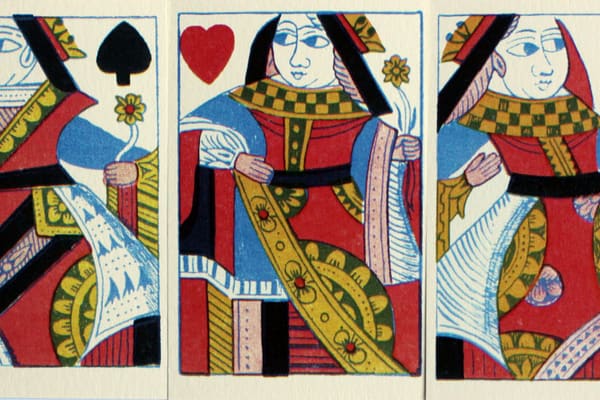
How to Play
A 16th-century English fishing card game for five players: capture table cards by matching ranks, lay down priåls and mournivals on sight, and 'lie down' (drop out) when you cannot capture.
Laugh and Lie Down is a 16th-century English fishing game for five players, first documented in 1522 and described in detail in Francis Willughby's Book of Games (c. 1660-1672). It is the earliest surviving European example of a fishing game: each player is dealt eight cards and tries to capture cards from the face-up table pool by matching ranks. A player who cannot match must 'lie down', adding their unplayed hand to the table and dropping out for the rest of the round while the others laugh. The goal is to finish with more captured cards than your share of the deal, and chips move around the pot accordingly.
Quick Reference
- 5 players; dealer antes 3 chips, others 2 each (pot of 11).
- Deal 8 cards to each player; 12 cards face up as the pool.
- Lay down priåls and mournivals for instant captures before play begins.
- Play one card from hand to capture a table card of the same rank.
- Pair-on-pair and priål-on-singleton plays capture multiple cards at once.
- If you cannot match, lie down: add your hand to the pool and drop out.
- Par is 8 cards; take 1 chip per 2-card surplus, pay 1 chip per 2-card shortfall.
- The player making the final capture takes 5 chips from the pot.
Players
Strictly 5 players, each for themselves. The historical text specifies five; with fewer or more players the card math does not divide cleanly. Adaptations exist for 3 or 4 players (see Common Variations).
Card Deck
- Standard 52-card deck. In the original rules, Aces are low (1) and face cards are never valued; only rank matters.
- Suits are used only for identifying cards; no suit beats another.
- A priål is three cards of the same rank; a mournival is four cards of the same rank (think for a Jack mournival).
- A small supply of chips or counters is needed for scoring (10 to 20 per player is plenty).
Objective
Capture more than your fair share of the cards in play. Each player is dealt 8 cards (40 total to players and 12 left on the table), so your target is to finish with more than 8 captured cards. Whoever wins the final capture also takes 5 chips from the pot.
Setup and Deal
- Cut for first deal; lowest card deals. The deal passes left each hand.
- Ante to the pot: the dealer puts in 3 chips, each other player puts in 2 chips, for a pot of 11 chips.
- Deal 8 cards face down to each of the five players, one at a time clockwise.
- The remaining 12 cards are spread face up in the middle of the table as the pool (sometimes called the melee).
- Before the first play, any player holding a priål (3 of a kind) may set aside 2 of the 3 cards face down as an instant capture; any player holding a mournival (4 of a kind) may set all 4 aside at once.
- The eldest hand (to the dealer's left) takes the first turn. Turns pass clockwise.
Gameplay
- Step 1 (pair capture): On your turn, play one card from your hand and capture a single table card of the same rank; set both cards aside face down as your capture pile.
- Step 2 (pair-on-pair): If you hold a natural pair and the pool contains a pair of the same rank, you may capture the whole pair with yours, four cards into your capture pile in one play.
- Step 3 (priål on singleton): If you hold a priål of some rank and the pool holds the fourth card of that rank, you may capture the singleton by laying down the priål with it (four cards captured at once).
- Step 4 (mid-turn drop): If at any moment you hold the last remaining cards of a rank so that no opponent can ever match them, you may lay them down face up out of turn for safe capture.
- Step 5 (lie down): If you cannot make any capture on your turn, you must throw your remaining hand face up into the pool and drop out of the round. The other players now have extra matching options among the freshly exposed cards, and table talk (and laughter) typically accompanies the lay-down.
- Step 6 (ending the round): Play continues until only one player still holds cards. That player's remaining hand is added to the dealer's capture pile along with any remaining cards on the table. The player who just made the last capture collects 5 chips from the pot.
Scoring
- Each player was dealt 8 cards; 8 captured is par.
- For every 2 cards you captured over 8, take 1 chip from the pot; for every 2 cards short of 8, pay 1 chip to the pot. If the shortage or surplus is odd, round down.
- The player who captured the very last card of the round takes an additional 5 chips from the pot (these are the 5 chips from step 6 above).
- Any chips left in the pot at the end of a round stay there to sweeten the next round.
- Over a session, cumulative chip totals decide the overall winner.
Winning
Each round is scored individually by chip settlement. There is no fixed target; play an agreed number of rounds (commonly one round with each player dealing once, for five rounds total) and the player with the most chips at the end wins. If two players end tied, play one more round with the tied players as the active dealer rotation.
Common Variations
- Four-player adaptation: Deal 10 cards each and leave 12 face up; par becomes 10.
- Three-player adaptation: Deal 13 cards each and leave 13 face up; par becomes 13.
- Short stakes: Replace chip scoring with simple card count; highest capture total wins the round.
- Modern laugh: Allow a player who cannot match to trail a card face up instead of lying down, extending the round and softening the penalty.
- Silent drop: Drop the laughing custom for formal play; the historical text is explicit that the laughter was part of the social experience.
Tips and Strategy
- Keep pairs and priåls intact. Breaking a priål for a single same-rank capture wastes its bigger value as a four-card take on the singleton later.
- Read the pool. Before playing, look at all 12 initial table cards and all cards exposed by earlier players; a card with no possible match left should be grabbed as soon as it falls into the pool.
- Delay the lay-down. If your hand contains only one playable card, hold the easy capture and try to force an opponent to lie down first; the cards they dump may include matches for your remaining high-fan-out cards.
- Track who has already dropped. Once a player has lied down, the remaining pool grows rapidly and late-round captures get easier; aim to still have multiple cards when that happens.
Glossary
- Pool / Melee: The face-up cards in the middle of the table available for capture.
- Lie down: To throw your remaining hand face up into the pool because you cannot capture; drops you out of the round.
- Priål: Three cards of the same rank; two of them are laid aside as an instant capture at setup.
- Mournival: Four cards of the same rank; the whole set is laid aside at once for an instant capture.
- Par: The 8 cards per player dealt in the opening; capturing more than par scores chips, fewer pays chips.
Tips & Strategy
Keep priåls and mournivals intact for their larger same-rank captures, and avoid committing to pair-on-pair plays until you have read the full pool. The longer you stay in, the more lay-downs fall into the melee and the easier your late captures become.
Skill hinges on hand preservation. Lay down your mournivals and priåls at setup to bank guaranteed captures, then trade mid-strength singletons efficiently so you outlast the first two lay-downs; by that point most of the pool will be visible and your remaining hand will capture easily.
Trivia & Fun Facts
The game's name is literal: when a player cannot match, they 'lie down' by placing their remaining cards face up on the table, and the others laugh at their misfortune. The custom was part of the social entertainment, not merely a rule.
-
01What must a player do in Laugh and Lie Down when they cannot match a card on their turn?Answer They must 'lie down', placing their remaining hand face up into the pool and dropping out of the round while the other players continue capturing and (traditionally) laugh at their fate.
History & Culture
First named in 1522 in an English government pamphlet banning unproductive card games for working men, Laugh and Lie Down is the oldest English fishing game with surviving rules. Its fullest historical description comes from Francis Willughby's Book of Games (c. 1660-1672), preserved in a manuscript at Nottingham University Library.
Laugh and Lie Down is the oldest named English card game that has preserved playable rules, giving it a special place in the history of Western card gaming. It is a direct ancestor of the whole European fishing-game family that includes Cassino, Scopa, Seep, and Kseri.
Variations & House Rules
Adaptations for 3 or 4 players adjust both hand size and pool; a softer modern version allows trailing instead of dropping out; stakes-free variants simply count captured cards instead of settling chips.
For a historical reenactment, use a printed 16th-century deck image and pewter or wooden chips. For a casual modern game, use poker chips and play a five-round session with each player dealing once.


