
How to Play
Bouillotte is an 18th-century French gambling game for 3 to 5 players using a stripped deck (16, 20, or 24 cards) and a single face-up community card (the retourné). Each player is dealt three cards; after one betting round the highest brelan (three of a kind) or single-suit point total wins the pot.
Bouillotte is an 18th-century French gambling card game of the Brelan family and one of the most direct ancestors of modern poker. It is played by 3 to 5 players with a stripped piquet deck of 16, 20, or 24 cards (depending on the player count) and revolves around a single face-up communal card called the retourné that can be combined with any player's hand to improve the strongest combinations. Every player is dealt three cards face-down, then a single card is turned face-up in the centre as the retourné. A betting round follows in which players may pass, match, raise, or fold. At showdown, surviving players expose their hands and the winner is either the holder of the best brelan (three of a kind) or, in the absence of a brelan, the player whose single-suit point total is highest. Both Kings and Aces count high and the retourné often acts as a fourth card that can complete a brelan carré (four of a kind).
Quick Reference
- 3 players: 16-card deck (8, 9, K, A); 4 players: 20 cards (8, 9, Q, K, A); 5 players: 24 cards (8, 9, J, Q, K, A).
- Each player antes into the pot. Deal 3 cards face-down per player.
- Turn one card face-up as the retourné, the community card.
- Eldest acts first; one round of betting (pass, call, raise, fold).
- Holders of a brelan may announce it for a side-fee from every other player.
- Survivors reveal hands at showdown.
- Hand ranking: Brelan Carré > Brelan Favori > Brelan Simple > Best suit-point total including retourné.
- Any brelan beats any point hand; higher brelan rank wins within a class.
- Point hands use Ace=11, all others = 10; ties are broken by the retourné's suit.
Players
Most commonly 4 players; 3 or 5 are legal with adjusted deck sizes. All players play for themselves without partnerships. Seats are chosen by drawing cards: highest draws seat first and becomes first dealer; deal rotates clockwise.
Card Deck
A stripped piquet deck: 7s and 10s are always removed; additional removals depend on the player count. 3 players: 16 cards (8, 9, K, A in each of four suits; Queens also removed). 4 players: 20 cards (8, 9, Q, K, A in each suit). 5 players: 24 cards (8, 9, J, Q, K, A in each suit). Card point values for point hands: Ace = 11, King / Queen / Jack / 9 / 8 each = 10 (court and pip values differ by rule, but in practice every card counts 10 except the Ace which counts 11).
Objective
Win the pot by either (a) being the last player who has not folded during the single betting round, or (b) holding the best hand at showdown under the Brelan Carré > Brelan Favori > Simple Brelan > Best Suit-Point Total ranking.
Hand Rankings (high to low)
- Brelan Carré: Three of a kind in the hand plus the retourné of the same rank, making a hidden 'four of a kind'. The highest-possible hand; ranks ties by the rank of the four cards (four Aces beat four Kings, and so on).
- Brelan Favori: Three of a kind in the hand, where the retourné happens to be the same rank (even though it is not in your hand). Slightly weaker than Brelan Carré.
- Simple Brelan (Brelan Simple): Three of a kind held entirely in the player's hand, where the retourné does not match. Any brelan beats any non-brelan hand.
- Best Suit-Point Total: In the absence of brelans, sum the point values of your own cards plus the retourné that share a single suit. The highest total wins. Ace = 11, any King/Queen/Jack/9/8 = 10.
- Tie-breakers: Rank of brelan (higher rank wins ties within a class). In point hands, on equal suit totals, the highest single card wins; on equal cards, the suit of the retourné breaks the tie in favour of the player whose suit matches.
Setup and Deal
- Agree the ante (typically 1 chip) and the maximum raise. Every player places the ante into the central pot before each deal.
- Shuffle the appropriately sized stripped deck; the player to the dealer's right cuts.
- The dealer distributes 3 cards face-down to each player, one at a time, clockwise.
- The dealer then turns one card face-up in the centre; this is the retourné, a community card available to all players for combination purposes.
- Play begins immediately with no draw, discard, or exchange.
Betting
- A single betting round takes place. The player to the dealer's left (eldest) acts first; play proceeds clockwise.
- On your turn you may pass (check if nobody has yet bet; fold if someone has), call (match the current bet), raise (add more chips on top of the current bet, within house-agreed limits), or fold (drop out of the hand, forfeiting any chips already in the pot).
- Betting continues until every remaining player has either folded or matched the current bet; the round then closes.
- Brelan announcement: A player holding a brelan may announce it openly during the betting round, which forces every other player to pay a small additional side-fee (typically one chip each) directly to the announcer regardless of whether the announcer wins the hand. This announcement is a calculated risk because it commits the announcer to stay in to showdown.
- If all players pass: Everyone remains in the hand at the ante level; the showdown takes place immediately without any chip movement during betting.
- If all but one player fold: The remaining player collects the whole pot without revealing their hand.
Showdown and Awarding the Pot
- All players who did not fold reveal their three cards face-up beside the retourné.
- Apply the hand ranking: any brelan beats any non-brelan; the best brelan class (Carré first, then Favori, then Simple) wins; within a class, the higher rank of the brelan wins.
- If no player holds a brelan, each player computes the highest single-suit point total achievable using their three cards and the retourné together (if the retourné shares a suit with cards in the hand, its value is added; otherwise the retourné is ignored for that player). The highest total wins.
- The winner collects the entire pot. Any side-fees from brelan announcements are kept separately by the announcer regardless of the hand outcome.
Winning
- A single deal is won by the showdown above or by the sole surviving unfold player.
- A session is usually played for an agreed number of deals or until one player wins a target amount. The player with the most chips at the session end is the overall winner.
- Misdeal: An exposed card or a miscount forces a redeal by the same dealer; antes remain in the pot.
- Tie-breakers: Applied as above; if even the retourné-suit tie-break fails to separate hands, the pot is split equally.
Common Variations
- Bouillotte à cinq (5 players): Adds Jacks back into the deck for a 24-card pack; rules are otherwise identical.
- Bouillotte à trois (3 players): Removes Queens; 16-card deck (8, 9, K, A in each suit); a very tight game with frequent brelans.
- Double retourné: Two community cards are turned up instead of one; both can be combined with hand cards to extend brelans and point totals. Increases brelan frequency.
- Open Bouillotte: One of each player's three cards is dealt face-up for added information; closer to stud poker in feel.
- Multiple betting rounds: Inject a second or third round of betting after partial reveals; moves the game even closer to poker variants.
- Retourné change: A rule in some 19th-century references where the retourné is replaced by a fresh card midway through the betting round, creating dramatic swings.
Tips and Strategy
- Bet a brelan hard. A brelan Favori or Carré is almost unbeatable; announce it during betting for the side-fee and raise for value. A Simple Brelan is still strong but can occasionally lose to a higher Simple Brelan, so size your raise to fold out the point-hand players.
- Watch the retourné's suit. The retourné breaks ties in favour of whoever shares its suit in a point-total showdown, so a strong point hand in the retourné's suit is much more valuable than the same points in a different suit.
- Fold trash. With a 20-card deck and only 3 cards dealt, most hands are marginal. If you hold three different unsuited cards (say 9♠ Q♥ A♣), your best point total is 11 and you cannot win a brelan showdown. Fold to any significant raise.
- Count the deck. Only 20 cards are in play with 4 players, so 5 cards dealt and 1 retourné leaves 14 cards unseen. Probability of a brelan against you across three opponents' hands is roughly 4% per opponent; the base brelan line is fairly tight, and aggressive bets usually signal either a brelan or a bluff.
- Bluff the retourné's suit. Raising aggressively when the retourné is a low card (say 8) can represent a point hand in that suit; if you actually hold nothing in that suit, it is a clean bluff that is hard for opponents to read.
- Track brelan announcements. An opponent who announces a brelan is committed; their remaining raises are for value, not bluff. Fold anything below a Brelan Simple against an announced Brelan Favori.
Glossary
- Retourné: The single face-up community card turned by the dealer after the deal; used for brelan promotion and as a suit/card contributor for point hands.
- Brelan: Three cards of the same rank in a player's hand.
- Brelan Carré: Three of a kind in hand plus a fourth of the same rank as the retourné, effectively a hidden four-of-a-kind.
- Brelan Favori: Three of a kind in hand, same rank as the retourné.
- Brelan Simple: Three of a kind in hand that does not match the retourné's rank.
- Point hand: A non-brelan hand evaluated by highest single-suit total using own cards plus the retourné when suit-matched.
- Ante: Chip contribution each player pays into the pot before the deal.
- Pass / Call / Raise / Fold: Standard betting actions during the single betting round.
- Stripped deck: A piquet deck from which certain ranks (always 7s and 10s, sometimes Queens or Jacks) are removed.
- Side-fee: The one-chip premium paid by each non-announcing player to the announcer of a brelan, collected regardless of the hand result.
Tips & Strategy
Bouillotte rewards tight hand selection and disciplined brelan play: only raise hard on a brelan or a point hand in the retourné's suit; fold unsuited mixed holdings to any significant bet. Announcing a brelan during betting collects a reliable side-fee from every opponent and is almost always the correct move once you hold one.
With only 20 cards and three-card hands, each unknown card has a large weight in the probability of a brelan elsewhere at the table. Good Bouillotte players track which high cards have been exposed in prior retournés and showdowns, and fold point hands whose lead cards are already out.
Trivia & Fun Facts
The Bouillotte lamp became such an icon of 18th-century French design that it now outlives the game it was made for; restoration hardware shops still sell 'Bouillotte lamps' to homeowners who have never heard of the card game. The retourné is one of the earliest community cards documented in Western card games, predating Texas Hold'em by nearly two centuries.
-
01What is the highest hand in Bouillotte called, and what makes it special compared to a normal three-of-a-kind?Answer A Brelan Carré, which is a three-of-a-kind in the hand combined with the retourné of the same rank, effectively a hidden four-of-a-kind that beats any other brelan.
History & Culture
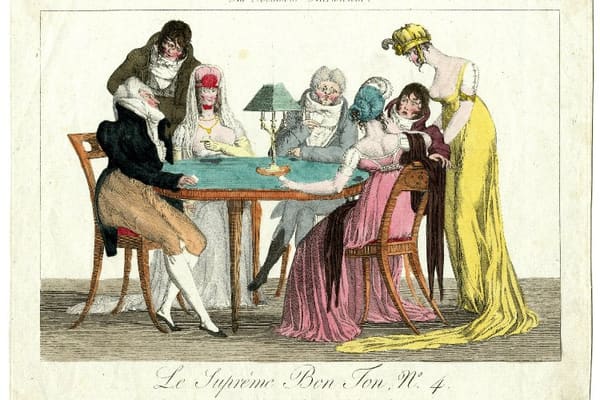
Bouillotte swept French and ex-French salons during the reigns of Louis XVI and Napoleon I (1770s-1810s), and is repeatedly mentioned in the memoirs of Talleyrand and Chateaubriand. The Bouillotte lamp, a shaded oil or candle lamp designed specifically to light a four-player square card table without glaring into players' eyes, is still manufactured today. The game is one of the most direct ancestors of American poker, contributing the brelan hand, the ante-raise-fold mechanic, and the community-card concept (the retourné).
Bouillotte was one of the most fashionable salon games of pre-Revolutionary and Napoleonic France, a game of aristocratic wits before the Revolution and of petty-officer gambling afterwards. It is the probable intermediary that carried the brelan hand concept from French Brelan to American Poker via New Orleans.
Variations & House Rules
Three-, four-, and five-player deck variations (16/20/24 cards) are the most common. Open Bouillotte reveals one card per player face-up, Double Retourné turns two community cards, and a Multiple-betting-round variant inserts additional bets as partial reveals take place.
For casual modern play, agree a fixed bet size and drop the raise rules; this keeps the betting round short and lets new players focus on hand evaluation. For a genuinely historical feel, play with a French 32-card piquet deck (stripping to the appropriate size), use a Bouillotte lamp on the table, and adopt the traditional brelan side-fee.


