
How to Play
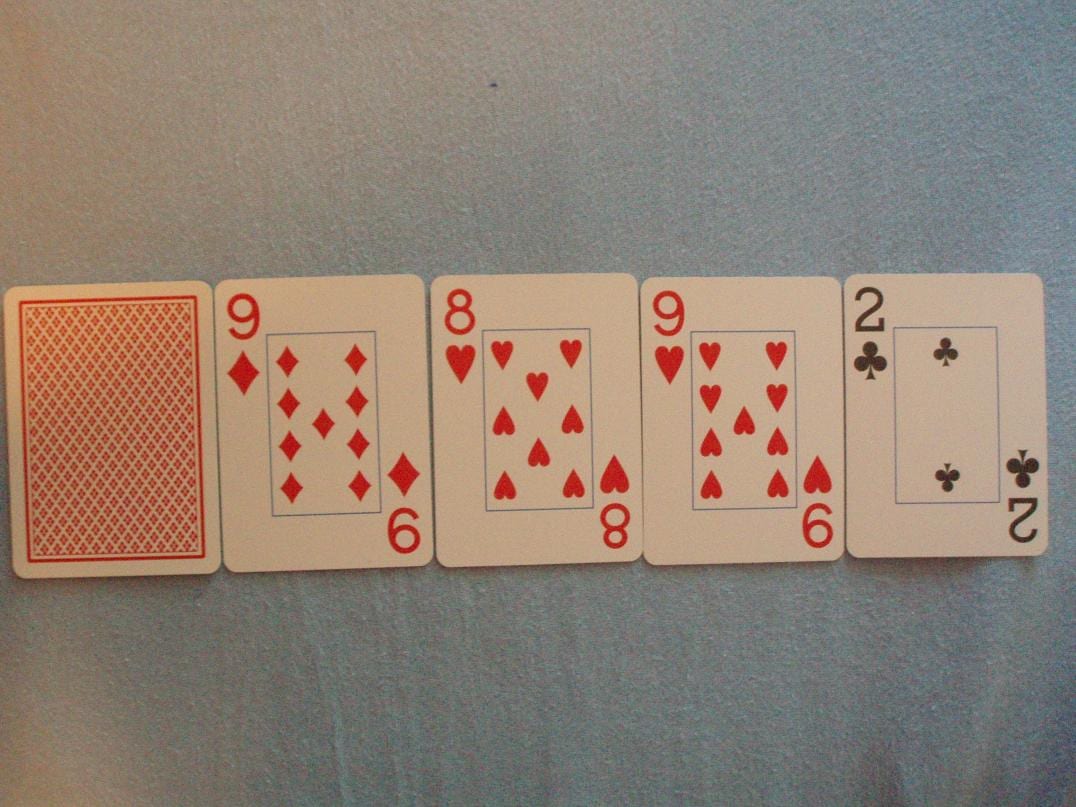
Five-Card Stud is the oldest form of stud poker: each player gets 1 hidden hole card and 4 up-cards dealt one per betting round, with no draw. Only 1 card ever stays hidden, making it the most transparent major poker variant and a sharp test of reading exposed cards.
Five-Card Stud is the oldest form of stud poker and, in some tellings, the oldest form of poker played with betting rounds interleaved through the deal rather than all at once. Each player receives just one hole card followed by four up-cards, one per betting round, and forms the best 5-card poker hand from those 5 cards alone; there is no draw and no discard. Because only 1 of a player's 5 cards ever stays hidden, Five-Card Stud is the most transparent major poker variant: by the final betting round, 4 of every active player's 5 cards are visible to the whole table, leaving little room for the kind of concealed-hand bluffing that powers Texas Hold'em or Seven-Card Stud. That transparency is exactly why the game faded from popularity through the 20th century even as it anchored the earliest American poker rooms, but it remains a favorite of poker historians and a sharp teaching game for reading live cards and calculating exact outs.
Quick Reference
- 2-8 players with a standard 52-card deck.
- All players ante; the dealer deals 1 card face down (hole card) then 1 face up (door card).
- The highest door card is forced to open the betting on the first round.
- Three more up-cards are dealt one at a time, each followed by a betting round.
- From the third card onward, the player with the best visible up-combination acts first.
- At showdown, remaining players reveal their hole card; best 5-card hand wins.
- Standard poker hand rankings apply, from Royal Flush down to High Card.
- The best 5-card hand at showdown takes the pot.
- Ties split the pot evenly.
Players
2 to 8 players. Each player uses only their own 5 cards; there are no community cards and no shared hands. The dealer position is notional and rotates clockwise, but every player antes and plays for themselves. With small tables (2 to 4 players), reads on opponents' up-cards are especially strong since fewer cards are dead.
Card Deck
One standard 52-card deck, no jokers, no wild cards in standard play. Card ranks, high to low: A, K, Q, J, 10, 9, 8, 7, 6, 5, 4, 3, 2. Aces play high or low for straights, so (the 'wheel') is the lowest possible straight. Suits carry no inherent rank but determine flushes. Hand rankings high to low: Royal Flush > Straight Flush > Four of a Kind > Full House > Flush > Straight > Three of a Kind > Two Pair > One Pair > High Card.
Objective
Win chips or cash by (1) making every opponent fold during one of the four betting rounds, or (2) showing down the best 5-card poker hand from your 5 individually dealt cards at the final round. Five-Card Stud is almost always played as a fixed-limit cash game rather than a tournament format today.
Setup and Deal
- Each player posts an ante to the pot before any cards are dealt.
- The dealer deals each player 1 card face down (the hole card), then 1 card face up (the door card).
- First bet: the player showing the highest door card must open the betting; unlike Seven-Card Stud's low-card bring-in, Five-Card Stud forces the highest exposed card to bet, and that player may not check. Ties in the door card are broken by suit order: clubs, diamonds, hearts, spades.
- Betting proceeds clockwise from the forced bettor; each player may call, raise, or fold.
- Five-Card Stud is traditionally a limit game with a small bet size for the first two up-card rounds and a big bet size (usually double) for the final two.
Gameplay
- Second card (first up-card round): dealt after the hole card; the highest door card is forced to bet as described above.
- Third card: one more up-card is dealt to each remaining player. Action now begins with whoever shows the best 2-card up-combination (a pair beats any 2 unpaired cards, then highest card breaks ties), and that player may check or bet.
- Fourth card: a third up-card is dealt (2 down-and-up cards remain: 1 hole card and 3 up-cards on the table, 4 cards total visible plan). Betting moves to the big bet size. The best up-combination among the visible cards acts first.
- Fifth card (the final round): the last up-card is dealt, completing each player's hand of 1 hole card and 4 up-cards. Final big-bet betting round follows, again led by the best visible up-combination.
- Showdown: if 2 or more players remain, each turns over their hole card; the best 5-card poker hand wins the pot. If only 1 player remains after the others fold, they win without revealing the hole card.
- Raise cap: most limit Five-Card Stud games cap raises at 3 or 4 per betting round (one bet plus three raises).
Scoring
- Hand rankings (high to low): Royal Flush > Straight Flush > Four of a Kind > Full House > Flush > Straight > Three of a Kind > Two Pair > One Pair > High Card.
- Pot contributions: ante plus every called or raised bet across the 4 betting rounds.
- Winning the pot: the best 5-card hand at showdown, or the last player standing after everyone else folds.
- Tie (split pot): if 2 or more players hold identical 5-card hands, the pot is divided evenly between them.
Winning
A hand is won by whoever takes the pot at showdown with the best 5-card hand, or by being the only player left after all opponents fold. A cash-game session ends whenever the players agree to stop; results are tallied by each player's net chip change across the session.
Common Variations
- Five-Card Stud Hi-Lo: the pot splits between the best high hand and the best qualifying low hand (commonly an 8-low or better), the same 5 cards used for both comparisons.
- Mexican Stud: the hole card is dealt face down like the standard version, but is turned face up only at showdown, where it and every other card of the same rank in a player's hand become wild; this rewards pairing the hidden card far more than in standard play.
- Southern Cross: deals 2 hole cards instead of 1, with the player discarding one of them before the first betting round, keeping the rest of the deal identical to standard Five-Card Stud.
- Double-Barreled Shotgun: similar to Southern Cross, dealing an extra hole card early and having each player choose which of the 2 to keep face down before play continues.
- No-Limit or Pot-Limit Five-Card Stud: removes the fixed small-bet/big-bet structure, letting players bet any amount up to their stack or the pot; rare today but historically how the game was often played in home games.
Tips and Strategy
- Respect the forced high-card bet. Being forced to bet on the second card does not mean you have a strong hand; treat it as a mechanical rule and size your bet at the table minimum unless your hole card actually pairs your door card.
- Track every dead card relentlessly. With 4 of every player's 5 cards exposed by the river, you can often calculate your exact outs to the card; if 3 of the 4 remaining cards that would complete your flush are already visible in opponents' hands or the discard pile, your draw is nearly worthless.
- Bluffing is far weaker here than in Hold'em or Seven-Card Stud. With only 1 hidden card, opponents can frequently rule out strong hands just by watching your up-cards develop; save aggressive bluffs for spots where your door card and later up-cards could plausibly be concealing a pair or better.
- A concealed pair (in the hole card) is gold. Since only your first card is ever hidden, pairing your hole card with your door card gives you a hand that looks, to opponents, no stronger than a single high card, letting you extract extra bets from players who misread your strength.
- Fold hands that cannot catch up on visible information. If an opponent's 4 exposed up-cards already beat the best hand you can possibly make, fold regardless of pot size; unlike Seven-Card Stud there is no extra hidden card to change the picture.
Glossary
- Hole card: the single face-down card dealt to each player at the start of the hand; the only card that stays hidden until showdown.
- Door card: the first face-up card, dealt immediately after the hole card.
- Up-card: any face-up card visible to the whole table.
- Ante: a small forced contribution to the pot posted by every player before the deal.
- Forced bet: the mandatory opening bet required from the player showing the highest door card, who is not permitted to check.
- Showdown: the final stage where remaining players reveal their hole card to determine the winner.
- Live out: a card that would improve your hand and has not already appeared among opponents' up-cards or folded hands.
- Dead card: a card that could have improved your hand but is already visible elsewhere, removing it from your realistic outs.
Tips & Strategy
Treat the forced high-card bet on the second card as a rule, not a signal of strength, and size it at the table minimum unless your hole card has actually paired. Track every up-card that is dead, whether folded or simply visible in an active hand, since with 4 of 5 cards exposed you can frequently count your exact outs. Save bluffs for spots where a concealed pair in the hole is plausible, and fold immediately once an opponent's visible cards already beat the best hand you could possibly hold.
Five-Card Stud rewards precise, almost arithmetical thinking over the psychological bluffing that defines Hold'em, because so little information stays hidden. Expert players build a running count of every dead card across folded hands and opponents' up-cards, letting them calculate exact drawing odds rather than rough estimates. Because a concealed pair in the hole card is the single biggest informational edge available, skilled players play those hands more aggressively than their apparent strength (a lone exposed high card) would suggest to the rest of the table, extracting value precisely because opponents cannot see the pair forming.
Trivia & Fun Facts
Because only 1 of a player's 5 cards is ever hidden, a sharp Five-Card Stud player can sometimes narrow an opponent's possible hole card down to just a few ranks purely from betting patterns and the visible up-cards. The game's forced-bet rule, requiring the highest door card to open the action, is the opposite of Seven-Card Stud's low-card bring-in and is one of the clearest structural differences between the two related games. Mexican Stud, in which the hole card becomes wild at showdown along with every other card of that rank, was a popular home-game twist specifically invented to restore some of the hidden-information tension that standard Five-Card Stud lacks.
-
01In Five-Card Stud, which player is forced to open the betting on the second card, and how does this differ from Seven-Card Stud?Answer The player showing the highest door card must bet and cannot check; Seven-Card Stud instead forces the player with the lowest door card to post a partial bring-in bet.
-
02How many of a player's 5 cards remain hidden throughout a hand of Five-Card Stud?Answer Only 1, the hole card dealt at the very start; the other 4 cards are dealt face up one per betting round.
History & Culture
Five-Card Stud is widely regarded as the earliest form of stud poker, emerging in American card rooms in the decades after the Civil War, well before Five-Card Draw became the parlor-game standard and long before Seven-Card Stud eclipsed it in the 20th century. Its combination of a single hidden card and heavy reliance on visible information made it a natural fit for the riverboat and saloon gambling culture of the late 1800s, where reading an opponent's exposed cards and demeanor mattered as much as the cards themselves. Some historical accounts place the fatal 1876 card game of Wild Bill Hickok, which produced the famous 'dead man's hand' of black aces and eights, as a hand of five-card stud, although the exact game he was playing is debated among historians. As Seven-Card Stud and later Texas Hold'em offered more concealed information and richer bluffing, Five-Card Stud's popularity steadily declined through the 20th century, and it is rarely spread in modern casinos.
Five-Card Stud holds a foundational place in American poker history as the game played in 19th-century riverboat and frontier gambling halls before Draw and Seven-Card variants took over. It is closely tied to Old West poker mythology, including its disputed association with Wild Bill Hickok's final card game, and is often cited by poker historians as the direct ancestor of every later stud-poker variant. Though rarely spread in casinos today, it remains a respected teaching game for new players learning to read exposed cards and calculate outs without the added complexity of a hidden multi-card hand.
Variations & House Rules
Five-Card Stud Hi-Lo splits the pot between the best high hand and the best qualifying low hand from the same 5 cards. Mexican Stud turns the hole card, and every card sharing its rank, wild at showdown. Southern Cross and Double-Barreled Shotgun both deal an extra hole card early and have the player discard down to 1, adding a small decision point before the standard deal continues. No-Limit and Pot-Limit versions remove the fixed small-bet and big-bet structure entirely.
New groups often start with a small ante and low betting limits, since the forced high-card bet can otherwise escalate quickly on the second card. Adding the Hi-Lo split is a simple way to give more hands a reason to stay in past the forced bet. Mexican Stud is worth trying once players know standard Five-Card Stud well, since making the hole card wild meaningfully changes hand values and rewards pairing it. Capping raises at 3 per round keeps the fixed-limit structure from producing runaway pots in home games.


