
How to Play
Escoba is a Spanish and Argentine fishing game in the Scopa family. Players capture cards from a central layout by playing a card from hand that adds with table cards to exactly 15, scoring for majorities, the 7 of Oros, Setenta, and every sweep of the table.
Escoba, full name Escoba de Quince ('Broom of Fifteen'), is the Spanish member of the Scopa family of fishing games. Played with the 40-card Spanish deck, two to four players fish cards from a central layout by adding one card from hand to one or more table cards to make exactly 15. Sweeping every card off the table in one play is an escoba, a coveted bonus point that names the game. It is widely regarded as the national card game of Argentina and Uruguay and the grandfather card game of Argentine schoolyards.
Quick Reference
- Use a 40-card Spanish deck (or 52-card deck minus 8s, 9s, 10s); 2-4 players.
- Deal 3 cards to each player; lay 4 cards face-up on the table.
- Deal another 3 cards to each when hands are empty, until the deck is used.
- Play one card from hand to the table.
- If your card plus any subset of table cards totals exactly 15, capture them all.
- Clearing every card off the table is an escoba (+1 bonus point).
- If no capture is possible, the card stays face-up on the table.
- Most cards captured: 1 point.
- Most Oros (Coins/Diamonds): 1 point.
- Capturing the 7 of Oros: 1 point.
- Best Setenta (one card per suit combination): 1 point.
- Each escoba: 1 point.
Players
Escoba is played by 2, 3, or 4 players. Four is the classic form and is played in two partnerships of two, partners sitting opposite each other. Three-handed and two-handed Escoba are 'cutthroat' (individual). This guide describes the four-handed partnership game; solo play differs only in scoring by person rather than by team.
Card Deck
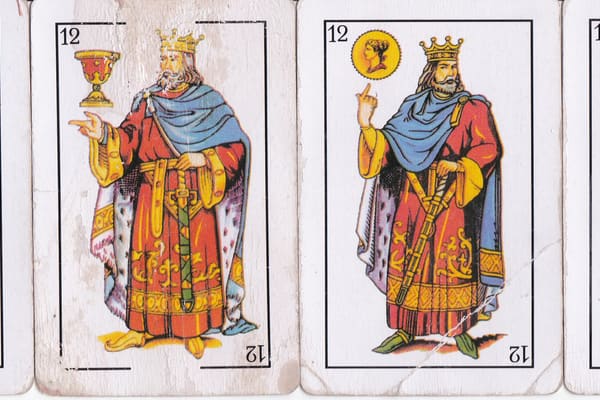
- Use a 40-card Spanish-suited deck with four suits: Oros (Coins / Gold), Copas (Cups), Espadas (Swords), Bastos (Clubs). Each suit contains: 1 (Ace), 2, 3, 4, 5, 6, 7, Sota (Jack), Caballo (Knight), Rey (King). No 8s, 9s, or 10s.
- If playing with a French 52-card deck, remove all 8s, 9s, and 10s and treat Diamonds as Oros (the scoring suit).
- Card values for capturing to 15: Ace = 1, 2 = 2, 3 = 3, 4 = 4, 5 = 5, 6 = 6, 7 = 7, Sota = 8, Caballo = 9, Rey = 10.
Objective
Capture cards by making combinations totalling exactly 15. Over multiple deals, be the first player or partnership to reach 21 points (or 15 or 31, depending on agreed target) by earning points for captured-card majorities, the 7 of Oros, and every sweep of the table (escoba).
Setup and Deal
- Choose a first dealer by any fair method; the deal rotates one seat to the right after each hand (Spanish card games are anti-clockwise).
- Shuffle; the player to the dealer's left cuts the deck.
- Deal three cards at a time, face-down, to each player, anti-clockwise.
- After the first round of hands is dealt (3 cards per player), deal four cards face-up to the centre of the table.
- If those four face-up cards already total 15 or contain a valid 15-combination, the dealer's side does NOT score an escoba for it; flip them face-down to be set aside, or redeal per house rule (agree before play).
- Players take turns anti-clockwise playing one card at a time until all three hand cards are used, then the dealer deals three more cards to each player and play continues. No new table cards are dealt after the first four. Continue until the deck is exhausted.
Playing a Turn
- Play exactly one card from your hand to the table, face-up.
- Capture if you can. If your played card plus one or more of the table cards sums to exactly 15, you must take all those cards plus your played card and place them face-down in your (or your team's) capture pile.
- Multiple captures in one play: If your card can make 15 in more than one way (for example with two different subsets of table cards), choose only one; you cannot take two subsets on the same turn.
- No capture available: leave your card face-up on the table, adding to the layout for future turns.
- Escoba / sweep: If your capture removes every card from the table, mark the capture pile with one of the captured cards face-up (or a distinctive chip). This is worth one bonus point at the hand's end.
- Last capture rule: The player who makes the final capture of the deal claims any remaining face-up table cards as part of that capture (but without scoring escoba if any cards are left on the table).
Scoring Points per Hand
- Most cards captured (1 point): The player or team with the largest capture pile. Ties split the point only if explicitly agreed; usually tied and nobody scores.
- Most cards of Oros / Diamonds (1 point): Majority of the 10 Oro cards.
- 7 of Oros ('Siete de Velo', sometimes called 'the velo') (1 point): Captured in any trick.
- Setenta (1 point): Also called 'Primera' or 'Best Primera'; awarded to the player or team with the best combination of one card from each of the four suits, where card values for Setenta scoring are: 7 = 21, 6 = 18, Ace = 16, 5 = 15, 4 = 14, 3 = 13, 2 = 12, Sota = 10, Caballo = 10, Rey = 10. Count the best card in each suit from your captures; team with the highest four-suit total wins the point. A player missing a suit cannot compete for Setenta.
- Each escoba (1 point): One bonus point per sweep of the table.
Winning
A standard match is played to 21 points (many groups use 15 or 31; agree before play). The first player or team to reach the agreed total at the end of a hand wins outright. If both teams pass the target in the same hand, the higher score wins; ties continue one more hand.
Common Variations
- Escoba de 15 (classic): As described, the near-universal Argentine and Uruguayan form.
- Escoba con Comodines: Adds two jokers as free-value wild cards (worth whatever value is needed to make 15). Changes scoring to exclude joker-assisted escobas.
- Brazilian Escova (de 31): Played to 31 points with the 7 of Diamonds as the super-suit marker instead of Oros.
- Escoba with open table: All players' hands are played face-up for a pure arithmetic game. Useful for teaching children.
- Scopa (Italian): The Italian cousin of Escoba, played with an Italian 40-card deck; same family, slightly different scoring (no Setenta; extra Napola bonus).
Tips and Strategy
- Count to 15 constantly. At each turn, scan all your hand cards against every subset of table cards. Missing a capture because you did not check costs real points.
- The 7 of Oros is a scoring magnet. It contributes three potential points (the 7 itself, most Oros majority, the Setenta). Never let it lie on the table longer than necessary.
- Avoid leaving an 8 on the table when a 7 remains in play. You are practically handing opponents an escoba.
- Partnership signal by card choice. If your partner just played a 6, that can indicate 'do not leave a 9 on the table' for me. Silent signals are the classic form.
- Count Kings carefully. Kings (10) plus any 5 equal 15. Rings at 15 happen most often via the 10-5, 9-6, 8-7, 7-3-5, and 6-4-5 combinations.
- Deny escobas. If the opponent might sweep next, play a low card that leaves a stubborn residue on the table rather than clearing cards yourself.
Glossary
- Escoba: A sweep of all the cards off the table in one capture; worth 1 bonus point.
- Oros: The Coin/Gold suit in Spanish decks; substituted by Diamonds in a French-suited deck.
- Siete de Velo: The 7 of Oros, awarded 1 bonus point for whoever captures it.
- Setenta / Primera: The best one-card-per-suit combination, scored at the end of each hand.
- Capture pile: The face-down pile of cards a player or team has captured; flipped at the end to count scoring categories.
- Misdeal: If the initial four face-up cards already total 15, by house rule the dealer must redeal or simply set them aside without scoring escoba.
Tips & Strategy
Memorise the common 15-combinations (10+5, 9+6, 8+7, 7+5+3, 6+5+4) so you can scan the table instantly. Always prioritise capturing the 7 of Oros and building toward the Setenta; together they can account for three of the five possible points in any deal.
Escoba rewards patience over flash. A player who reliably takes the last capture (often a mid-value card played on the final round) collects any leftover table cards for free and frequently wins the majority-of-cards point. Track what remains in the deck to decide when to go aggressive.
Trivia & Fun Facts
In Argentina, the 7 of Oros has a nickname ('el Siete de Oros') so famous that it appears in tango lyrics and everyday slang as shorthand for 'the lucky card'. Sweeping the table in a single play, an escoba, is traditionally announced by slapping the table once with the flat of the hand.
-
01In Escoba, which specific card is worth 1 point on its own and also contributes to the 'most Oros' and 'Setenta' scoring categories?Answer The 7 of Oros (Siete de Velo).
History & Culture
Escoba arrived in Spain and the Americas through Italian Scopa players in the 18th and 19th centuries and became the dominant Scopa family variant in Argentina, Uruguay, and Paraguay. The Setenta (best-of-four-suits) scoring category is unique to the Spanish-speaking branch; Italian Scopa uses a different Primera scoring.
Escoba de Quince is a staple of Argentine and Uruguayan café culture and a fixture of Sunday family dinners across the Río de la Plata region. The slap of a hand announcing an escoba is as recognisable in Buenos Aires cafés as the kiss of chess pieces in a Madrid park.
Variations & House Rules
Escoba con Comodines introduces two jokers as flexible 15-makers. Brazilian Escova moves the target to 31 points. Scopa is the Italian parent. Each sibling plays almost the same game with small but fiercely defended regional quirks.
For a quick family game, play a single hand to a pre-agreed score limit (say, first past 11). For teaching children, deal all hands face-up so the arithmetic is visible to everyone; it is still surprisingly competitive.


