
How to Play
A 16th-century English bluff-and-trick game for two players. Three cards each, three tricks no-trumps, and the distinctive 'Put' call that forces the opponent to fold or play on for doubled stakes. An ancestor of modern Poker.
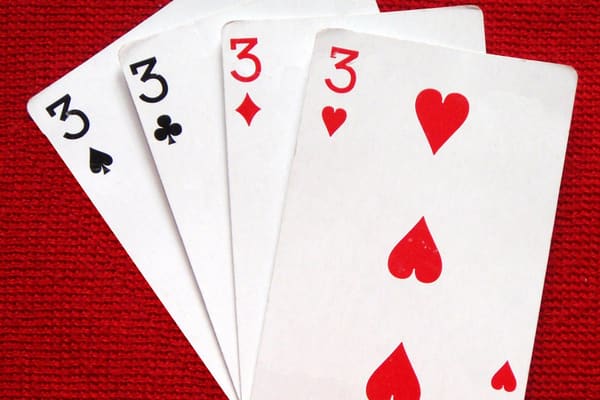
Put is a 16th-century English card game of bluff and bravado that thrived in alehouses and taverns for over two centuries before fading in the 19th. Each player receives 3 cards from a standard 52-card deck, three no-trumps tricks are played, and winning two of them scores one game point. The catch is the eponymous call: at any point during a hand, either player may say 'Put!', challenging the opponent to play the hand out for doubled stakes or fold and give the caller a single point. This simple threat layer turns a three-trick affair into a pure bluff-the-opponent contest. Put uses a distinctive card ranking (3 is the highest card and 4 the lowest; Aces sit mid-pack), and ties on any trick are neutral rather than wins for either side. The first player to 5 game points wins the match. Put is one of the earliest ancestors of modern Poker and shares its spiritual core: cards matter, but nerve matters more.
Quick Reference
- 2 players, standard 52-card deck.
- Deal 3 cards to each. Rank: 3 (high), 2, A, K, Q, J, 10, 9, 8, 7, 6, 5, 4 (low).
- Non-dealer leads any card; dealer follows any card (no trump, no suit-follow).
- Higher rank wins; tied ranks make a tied trick (no win).
- Either player may call Put at any time; opponent sees (double stakes) or folds (concede 1 point).
- Win 2 tricks = 1 point. Put seen and won = 2 points. Put folded = 1 point to caller.
- Drawn hand (1-1-tie or all ties) scores nothing.
- First to 5 wins the match.
Players
Two players is the classical game and where the bluff dynamic is sharpest. Three and four-player versions exist (see Variations), with four played in fixed partnerships. A full match to 5 game points lasts 10 to 20 minutes; sessions are traditionally played for stakes with chips or coin.
Card Deck
- One standard 52-card deck, no jokers.
- Put's distinctive ranking, high to low: 3, 2, Ace, King, Queen, Jack, 10, 9, 8, 7, 6, 5, 4.
- Suits are equal; no trumps in standard Put.
- There is no ranking of suits at any point; a trick is resolved purely by card rank.
Objective
Win two of the three tricks per hand to score a game point, OR call 'Put' to force your opponent to fold and concede a point. The match is won by the first player to reach 5 game points. Because the put call can be made on any hand regardless of card strength, skilled play is as much about reading your opponent as about the cards themselves.
Setup and Deal
- Cut for first dealer; the lower card deals. Deal alternates each hand.
- Agree the stake per game point (chips or coin). Match runs to 5 game points.
- The dealer shuffles and the non-dealer cuts.
- Deal 3 cards face down to each player, one at a time, starting with the non-dealer.
- Each player picks up and privately examines their 3 cards.
Trick Play
- Non-dealer leads: The non-dealer (pone) plays any card face up to the centre of the table.
- Dealer responds: The dealer plays any card face up in response. There is no suit-following requirement; any card can be played to any trick.
- Trick resolution: The higher-ranking card (by Put's 3-2-A-K... ranking) wins the trick. Both cards are turned face down in front of the winner.
- Tied trick: If both cards are the same rank, the trick is tied. Tied tricks do not count as wins for either side. The player who led the tied trick leads again.
- Next lead: The winner of each non-tied trick leads the next.
- Three tricks: Play all 3 tricks. Score by the Scoring rules below.
The Put Call
- Timing: Either player may call 'Put!' at ANY point during the hand: before leading, after leading, after a response, between tricks. The call interrupts play immediately.
- Opponent's choice: The opponent must choose one of two options: SEE (accept the Put) or FOLD (concede).
- Seeing the Put: Play continues through all remaining tricks. Stakes for this hand are doubled; the winner of the hand (by trick count) scores 2 game points instead of 1.
- Folding: The hand ends immediately and the caller scores 1 game point with the single original stake paid by the folder.
- Re-Put not allowed: Once a Put has been seen, the hand plays out without further put calls. Only one Put per hand.
- Ties on a seen Put: If the hand ends with tricks split 1-1-tie or all three tied, the hand is drawn and nobody scores (the doubled stake is returned). Some house rules award the caller's opponent 1 point in this case; agree before play.
Scoring a Hand
- No Put, clean win: The player who won 2 or 3 tricks scores 1 game point.
- No Put, drawn hand: If each player wins one trick and the third is tied, OR all three tricks are tied, the hand is drawn and no points are scored. Deal rotates.
- Put seen, clean win: The player who won 2 or 3 tricks scores 2 game points (doubled).
- Put folded: The caller scores 1 game point immediately; the hand is not played further.
Winning the Match
The first player to reach 5 game points wins. If both players are near 5 points, Put calls carry extra weight because a 2-point doubled hand can end the match in one play. A tied 5-5 hand extends the match for one more hand (sudden death).
Common Variations
- Three-handed Put: Each player receives 3 cards. The player winning 2 tricks scores 1 point. If each player wins exactly one trick, the hand is 'spoiled' and nobody scores. The Put call is made against both opponents simultaneously; if either sees, the hand plays out with doubled stakes for all three.
- Four-handed Put (partnership): Two teams of two, partners sit opposite. Partners may exchange one card face down before play begins (handing the best card forward). Combined trick-count decides the hand.
- Game of 7: Play to 7 game points instead of 5 for a longer match.
- Whiskey Put: An alehouse variant where each Put call doubles the drink stake as well as the game point; folding costs the folder a round of drinks.
- Trut (Scandinavian): The Scandinavian cousin of Put retains the put-call mechanic but adds a trump suit and a different rank ordering; the game ethos is identical.
Tips and Strategy
- The 3 is the highest card and 4 the lowest. A hand with any 3 is very strong; a hand with a 3 and a 2 is near-unbeatable.
- Call 'Put' on mediocre hands when your opponent is down on points; the risk of doubled stakes deters them from seeing unless they hold high cards.
- Avoid calling Put on the first trick unless you hold strong cards. Your opponent has seen nothing and will almost always see a Put from a weak position.
- Read the tempo: a hesitation before playing often signals a tough choice; a confident lead often signals high cards. The Put call exploits both.
- Late in the match (4-4 or 4-3), Put becomes a direct match-winner. Calculate when forcing a 2-point swing ends the game immediately.
- If you win trick 1 with a mid-range card, calling Put before trick 2 is sometimes the right move; your opponent cannot know you have already won and may fold.
Glossary
- Put: The bluff call that offers the opponent doubled stakes or a forced fold.
- See: Accepting a Put and playing on for doubled stakes.
- Fold: Declining a Put; concede 1 game point.
- Pone: The non-dealer, who leads the first trick.
- Tied trick: A trick where both players play the same rank; counts as neither a win nor a loss.
- Drawn hand: A hand ending 1-1-tie or all-three-tied where nobody scores.
- Trut: The Scandinavian cousin of Put with a trump suit and similar bluff mechanics.
Tips & Strategy
Put is bluff-first. Call Put on mediocre hands when you sense hesitation in your opponent. The 3 and 2 are the highest cards; a single 3 gives you a strong base hand. Late in the match, a doubled Put can be a match-ender.
Put rewards nerve over cards. Pure statistical play wins barely more than half of hands, but adding timely Put calls and folds to a weak opponent's routine can turn even modest card strength into match wins. The bluff-call was a feature borrowed by later poker forms; experienced poker players pick up Put strategy in a few hands.
Trivia & Fun Facts
Put's unusual card ranking (3 high, 4 low) is a hallmark of early card games inherited from older tarot-related traditions. Charles Cotton's 'The Compleat Gamester' (1674) gave Put an entire chapter, complaining about the bluff calls while admitting the game was 'very merry and quick.' The word 'put' in the expression 'to put someone on the spot' may trace to this game's challenge call.
-
01What is the highest-ranking card in the game of Put, and what is the lowest?Answer The 3 is the highest; the 4 is the lowest. Aces rank in the middle of the deck.
-
02If a player sees a Put and then wins two of the three tricks, how many game points do they score?Answer 2 game points (double the normal 1 point for a clean win).
History & Culture
Put was first documented in 16th-century England and by 1650 had become one of the most widely played alehouse and tavern games in the country. 17th-century moralists condemned it as a 'cheating game' because its bluff mechanic encouraged deception; one pamphlet of 1674 called it 'the game most fit for sharpers.' The game faded from English play by about 1850 as Whist and later Poker took over pub card gambling, but Put's put-call mechanic directly influenced early forms of American Poker.
Put was one of the foundational gambling card games of pre-industrial England, a staple of alehouses from Cornwall to the North of England for 250 years. Its bluff-call is a direct predecessor of Poker's raise-and-fold dynamic, making Put a historically important transitional game between the trick-taking and wagering branches of card-game development.
Variations & House Rules
Three-handed Put introduces the 'spoiled hand' rule when all three players each win one trick. Partnership Put adds a card-exchange between partners before play. Trut is the Scandinavian cousin with an added trump suit. Whiskey Put raises drink stakes alongside game points.
For a quicker match, play to 3 game points. For deeper stakes, allow a 're-Put' (the opponent sees the Put AND re-raises for quadruple stakes). Use poker chips or cribbage-board pegs to track game points clearly.


