
How to Play
A fast two-player trick-taking game in the All Fours family. Draw from a face-up stock after every trick, chase the High, Low, Jack, and Game points, and be first to the match target.
California Jack is a fast two-player trick-taking card game in the All Fours family, first played in California card rooms in the decades after the Gold Rush and later recorded in Hoyle's guides as a distinct member alongside Seven-Up and Pitch. Like its relatives, a deal awards up to four points, High, Low, Jack, and Game, for holding or capturing specific trump cards and the most card-pip value. Its defining twist is a face-up stock: after every trick both players draw a fresh card, one of them always visible before it is taken, so each hand's trump strength keeps shifting all the way to the final trick instead of being fixed at the deal. The three-handed form, known as Shasta Sam, adapts the same drawing mechanic to a cutthroat table.
Quick Reference
- Deal six cards to each of two players.
- Turn the top stock card face up; its suit is trump for the whole deal.
- Non-dealer leads to the first trick.
- Follow suit if able, or play a trump, or discard.
- Highest trump, or otherwise the highest card of the suit led, wins the trick.
- Trick winner draws the exposed stock card, then the loser draws the newly exposed card.
- High: held or drew the single highest trump in the deal.
- Low: held or drew the single lowest trump in the deal.
- Jack: captured the trump Jack in a trick.
- Game: highest total pip value captured; a tie scores nothing.
Players
California Jack is a two-player game at heart, the classic head-to-head form of the All Fours family. A three-handed variant exists under the name Shasta Sam, which adapts the same stock-drawing rules to a cutthroat table where every player scores for themselves rather than in partnership. It is rarely played with four or more, since the visible-stock mechanic depends on a small number of hands competing for a short, shared pile of cards.
Card Deck
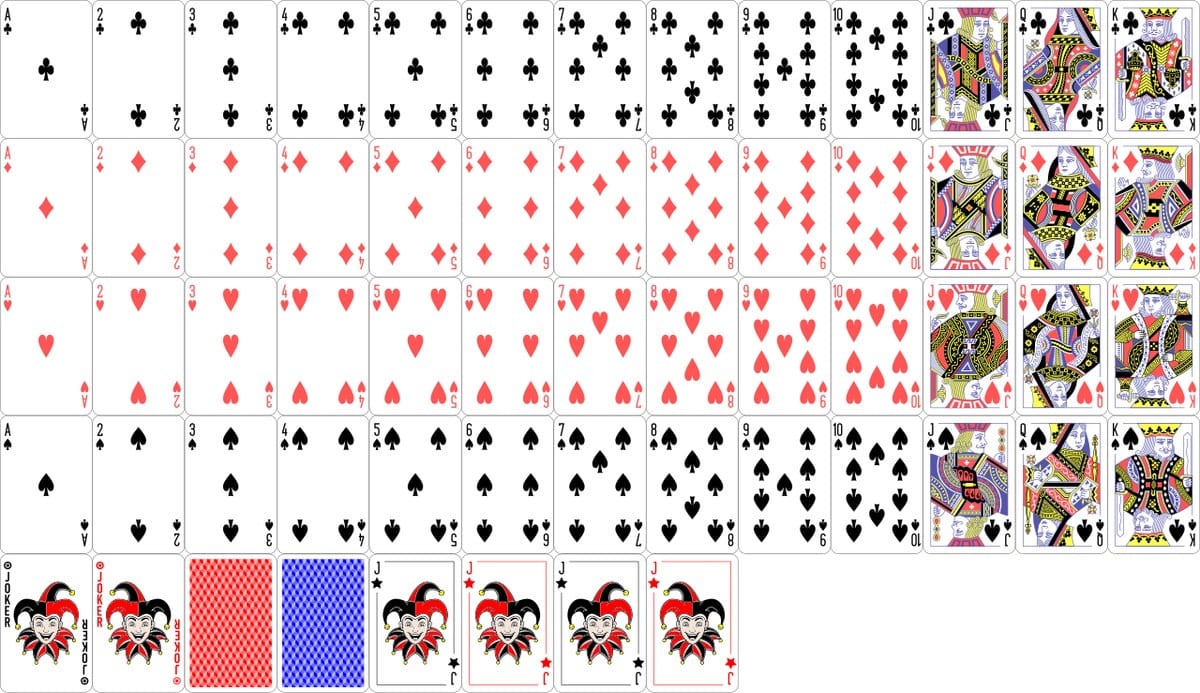
- One standard 52-card pack, no jokers. Within each suit, cards rank A (high), K, Q, J, 10, 9, 8, 7, 6, 5, 4, 3, 2 (low) for trick-taking.
- For the Game point only, cards carry pip values: Ten = 10, Ace = 4, King = 3, Queen = 2, Jack = 1. Nine down to Two score 0 pips.
- Trump is fixed for the whole deal by the card turned to start the stock; it is never chosen by a bid or announcement the way it is in Pitch.
Objective
Score more of the four available points, High, Low, Jack, and Game, than your opponent each deal, and be the first to reach the match target, commonly 10 points. Because the deal keeps refilling both hands from the face-up stock, a weak opening hand can still capture the deciding trump cards later in the same deal.
Setup and Deal
- Shuffle the deck. Cut for first deal; the loser of the cut deals first, and the deal alternates after each hand.
- Deal six cards to each player, one at a time, or in two packets of three.
- Place the remaining cards face down between the two players as the stock. Turn the top card of the stock face up and set it back on top of the pile; its suit is the trump suit for the entire deal.
- If the turned card is itself a trump Jack, the dealer may score the Jack point immediately; agree on this house option before play.
- Non-dealer leads to the first trick.
Gameplay
- Following suit: each player must follow the suit led if able. A player unable to follow suit may play a trump or discard any card; as in All Fours, a player who can follow suit may still choose to trump instead, a rule called permissive trumping.
- Winning a trick: the highest trump played wins the trick; if no trump was played, the highest card of the suit led wins. The winner gathers both cards face down into a scoring pile.
- Drawing to refill: immediately after each trick, the trick's winner draws the face-up top card of the stock, then turns the new top card of the stock face up for both players to see. The loser then draws that newly exposed card blind, meaning without seeing it until it is already in hand. Both hands return to six cards.
- Running trump: because the stock keeps exposing a single card at a time, a player can watch for a trump arriving atop the stock and decide whether the current trick is worth winning specifically to draw it first.
- Last cards: once the stock is exhausted, both players still hold six cards; these are played out trick by trick with no further drawing, exactly as in the parent game All Fours.
Scoring the Four Points
- High (1 point): awarded to whoever held or drew the single highest trump that appeared during the deal, whether or not they won the trick it was played in.
- Low (1 point): awarded to whoever held or drew the single lowest trump that appeared during the deal.
- Jack (1 point): awarded to whoever captures the trump Jack in a trick. If the trump Jack never appears, no Jack point is scored that deal.
- Game (1 point): awarded to whoever's captured cards carry the higher total pip value (Ace = 4, King = 3, Queen = 2, Jack = 1, Ten = 10, other ranks = 0). If both players tie on pip value, the Game point is not scored that deal.
- Deal total: up to four points change hands each deal; tally High, Low, Jack, and Game in that order after the last trick.
Winning
The first player to reach the agreed match target, most commonly 10 points, wins; some tables play a shorter 7-point game to match Seven-Up's pace. If both players would cross the target on the same deal, count the four points in the fixed order High, Low, Jack, Game, and whoever reaches the target first in that count wins the match.
Common Variations
- Shasta Sam: the three-handed cutthroat form of California Jack. Six cards are dealt to each of three players, and the stock and scoring rules are unchanged; only the highest individual scorer wins each match, not a fixed pair.
- Seven-Up (Old Sledge): the ancestor form with no stock at all; each player keeps a static six-card hand for the whole deal.
- Pitch: replaces the turned-trump deal with a bidding auction, so trump is chosen by the highest bidder instead of by a random turn-up card.
- Shasta Point: a house addition awarding a fifth point for capturing the trump Nine, borrowed from the related British game Don.
Tips and Strategy
- Track the exposed stock card before every draw; if it is a trump, decide whether the current trick is worth fighting for so you draw it and not your opponent.
- Do not automatically trump every trick you cannot otherwise win. Trumping burns a card from your hand that might have earned Low or Game later, and low trumps are precious for the Low point.
- Hold the trump Ace as long as it is safe; it wins High almost every deal and is only vulnerable if your opponent runs out of the led suit early.
- Count pips as you capture tricks. A single Ten (10 pips) can swing Game as decisively as two Aces, so do not discard tens carelessly when you cannot follow suit.
- Near the end of the stock, remember the last cards drawn form your closing hand with no further information advantage; spend your visible-card knowledge on tricks earlier in the deal, not the final ones.
Glossary
- Trick: one card played by each player in turn; the highest trump, or otherwise the highest card of the suit led, wins it, and both cards go to the winner's scoring pile.
- Trump: the suit set by the card turned to start the stock; a trump card beats any card of a non-trump suit regardless of rank.
- Stock: the face-down pile of undealt cards between the two players, with its top card kept face up as a shared draw indicator.
- Permissive trumping: the All Fours family rule allowing a player to play a trump even when able to follow the suit led.
- Pip value: the point weight of a captured card used only to decide the Game point (Ten = 10, Ace = 4, King = 3, Queen = 2, Jack = 1).
Tips & Strategy
Watch the exposed stock card before deciding how hard to fight for a trick: winning a trick specifically to draw a visible trump is often worth more than winning it for the trick alone. Hoard your lowest trump for the Low point rather than spending it early, and never discard a Ten if you can help it, since a single Ten is worth as much toward Game as two Aces.
Because both players see the top stock card before it is drawn, California Jack rewards forward planning more than most All Fours variants: a player willing to win or lose a trick specifically to control who draws the next exposed card is playing at a higher level than one who only thinks about the trick in front of them. Holding back low trumps for the Low point, rather than spending every trump to win tricks, is often the difference between a 1-point and a 3-point deal.
Trivia & Fun Facts
Because the top card of the stock is always visible before it is drawn, California Jack is one of the few members of the All Fours family where remembering what has already passed matters almost as much as the cards actually in hand. Its cousin Cinch dropped the visible stock entirely and instead let players discard and draw fresh hands, showing how many directions 19th-century American card players took the same English ancestor.
-
01What makes California Jack different from its ancestor Seven-Up, even though both award the same High, Low, Jack, and Game points?Answer California Jack replaces Seven-Up's fixed six-card hand with a face-up stock: after every trick both players draw a new card, and the top card of the stock is always visible before it is taken, so trump strength keeps changing throughout the deal instead of being fixed at the initial deal.
History & Culture
California Jack takes its name from the California card rooms of the late 19th century, where players adapted the older English game All Fours and its American offshoot Seven-Up by adding a visible stock so a two-handed game would not run dry after only six cards each. Foster's Hoyle and other American rule compendiums recorded it by the 1890s alongside Seven-Up and Pitch as one of the standard American descendants of All Fours. The three-handed Shasta Sam variant, named after the Northern California mountain, kept the same stock-drawing mechanic for a cutthroat table.
California Jack is a minor but well-documented branch of the All Fours family that helped popularize stock-drawing mechanics in American trick-taking games. It remains a reference point in classic Hoyle-style rule collections as the two-handed member of the Seven-Up and Pitch family, valued by card game historians for showing how a single English ancestor split into several distinctly American forms within a few decades.
Variations & House Rules
Shasta Sam extends the format to three cutthroat players scoring individually. Seven-Up removes the stock altogether for a purely fixed six-card hand. Pitch replaces the turned trump with a bidding auction. The Shasta Point house rule adds a fifth scoring point for the trump Nine, borrowed from the British variant Don.
For a quicker match, lower the target to 7 points to match Seven-Up's pace. For a livelier two-player night, add the Shasta Point house rule so the trump Nine scores an extra point, rewarding players who track and hold onto it. Groups of three should switch straight to Shasta Sam scoring, where each player's total is tracked individually rather than by partnership.


