
How to Play
A French 4-player contract-declaration trick-taking game across 28 deals. Each dealer must declare and play seven different contracts (six negative, one positive Trumps; sometimes plus Domino), with a pre-play doubling phase creating huge score swings.
Barbu is a French 4-player contract-declaration card game played with a full 52-card deck. A complete match consists of 28 deals: each player deals 7 hands in turn, and on each of their own 7 deals the dealer must declare and play each of the 7 contracts exactly once (no repeats, so by the end of their dealership they have played through the full contract menu). Six contracts are negative (avoid tricks, Hearts, Queens, the King of Hearts, or the last two tricks) and one is positive (Trumps, where tricks score positively). An eighth game, Domino / Fan Tan, is often rotated in as the final no-trick 'shedding' contract. Before each hand, the other three players each have one opportunity to double the dealer (or an opponent) on that contract, massively multiplying swings. Total scoring across all 7 contracts in a dealership is zero-sum, so across a match a good player collects both the best positive contracts and the smallest losses on the negative ones.
Quick Reference
- 4 players, 52-card deck, 13 cards each.
- Dealer declares one of 7 contracts; each must be played once per dealership.
- Non-dealers each take a doubling opportunity before play.
- Follow suit if able; winner of each trick leads the next.
- Scoring varies by contract: negative for cards captured (hearts, queens, K♥, last two) or tricks taken (No Tricks); positive for Trumps or Domino.
- No Tricks -2/trick, No Hearts -2 (A♥ -6), No Queens -6, Barbu -20, No Last Two -10/-20.
- Trumps +5/trick; Domino +45/+20/+5/-5 for finishing 1st-4th.
- Doubling multiplies individual pairings, not the whole table.
Players
Exactly 4 players; no partnerships, though temporary alliances form naturally because three players usually gang up on the dealer. The dealer of a hand is also the declarer for that hand: they choose which of their remaining contracts to play. Seats rotate clockwise after each hand. A full 28-deal match takes 2 to 3 hours.
Card Deck
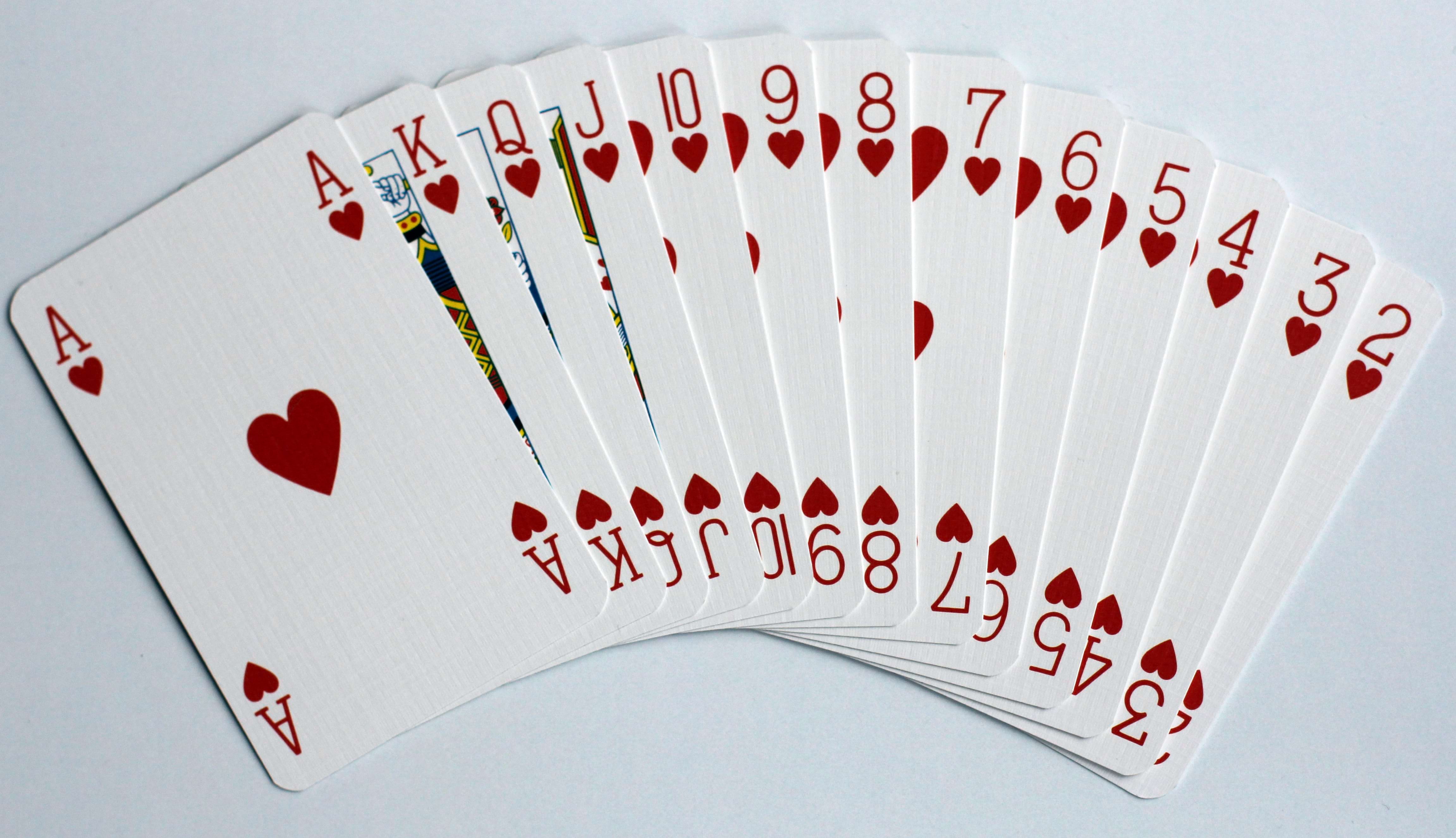
One standard 52-card French-suited pack with jokers removed. Card ranking within a suit (high to low): A, K, Q, J, 10, 9, 8, 7, 6, 5, 4, 3, 2. There is no trump suit except in the Trumps contract (where the declarer names one).
Objective
Finish the 28-deal match with the highest total score (or the least negative score, since the negative-contract scores can easily dominate). On each hand, objectives vary by contract: avoid specific cards or tricks in the six negative contracts, or win as many tricks as possible in the positive Trumps contract. Every contract's payoffs total zero across the 4 players (or a fixed zero-sum with Domino's awards), so points are redistributed rather than created.
Setup and Deal
- Cut for the first dealer. The deal rotates clockwise after each hand.
- The dealer shuffles the 52-card pack and deals all 52 cards face down one at a time clockwise, starting with the player on their left. Each player receives exactly 13 cards.
- The dealer selects one of their 7 remaining contracts (each must be played exactly once by that dealer during their dealership).
- The dealer announces the contract. In the Trumps contract only, the dealer also names the trump suit.
- Doubling phase: Starting with the player to the dealer's left and proceeding clockwise, each of the 3 non-dealers has one opportunity to double another player's score for this contract. Standard options: double the dealer (the most common target), double a 'maximum' (double every other player at once), or double a 'family' (both flanking players). The dealer may redouble any individual double against them.
- The player to the dealer's left leads the first trick.
The Seven Contracts
- No Tricks. Each trick you win scores you -2 points. All 13 tricks are played. Total distributed: -26 points across the 4 players.
- No Hearts. Each Heart you capture in a trick scores -2 points each, except the Ace of Hearts which scores -6. Hearts may not be led until a Heart has been discarded (standard 'breaking' rule). Total distributed: -30 points.
- No Queens. Each Queen you capture scores -6 points each. Total: -24 points. Play may end early when all 4 Queens have been captured.
- No King of Hearts (Barbu). Capturing the King of Hearts costs -20 points. Nothing else scores. Play may end as soon as the K♥ is taken. The contract's name gives the whole game its nickname: le Barbu, 'the bearded one', a French slang for the King of Hearts.
- No Last Two. Winning the penultimate trick scores -10 points; winning the final trick scores -20 points. Total: -30 points.
- Trumps (positive). The dealer names a trump suit at declaration. Each trick won scores +5 points. Standard follow-suit and must-overtrump-when-leading rules apply. Total: +65 points distributed.
- Domino (Fan Tan). Not a trick-taking game. Played as Fan Tan / Sevens: the holder of the 7 of Diamonds (or any 7 by agreement) leads it to start four suit layouts; players add higher or lower cards to their suit's sequence in strict order, or discard if they cannot play. Payouts: +45 for going out first, +20 for second, +5 for third, -5 for last out. Total: +65 points distributed. Not every rule set uses Domino; classic Barbu is the six negative contracts plus Trumps.
Gameplay
- Follow suit strictly: In every trick-taking contract, players must follow the suit led if able. In negative contracts with no trump, the highest card of the led suit wins. In Trumps, the highest trump (or highest led-suit card if no trumps played) wins.
- Trump overtaking: In the Trumps contract, if a player leads a trump, the next player must play a higher trump if they hold one (the must-overtrump-when-trumps-lead rule). Some house rules extend this to any hand where a trump is played later in the trick.
- Hearts-breaking: In No Hearts, a player may not lead a Heart to any trick until after a Heart has been discarded on a previous trick (i.e. Hearts have been 'broken').
- Contract termination: No Queens ends as soon as all 4 Queens are captured; Barbu (No King of Hearts) ends as soon as the K♥ is captured. Other contracts play out all 13 tricks.
- Domino progression: In Domino, play proceeds strictly by rank-sequence within suit. The 7 of Diamonds (or house-chosen starter) is led to form four independent suit-layouts; players add adjacent ranks only, passing if they cannot play.
- Scoring recorded after each hand: Each hand's scores are added to a running tally; doubling multipliers apply to the individual pairings, not to the whole table.
Scoring
- Zero-sum per hand: Barring doubling, every contract distributes a fixed total of points. Negative contracts distribute losses; Trumps and Domino distribute gains.
- Doubling multiplies individual pairings: If A doubles B on a hand, then at the end of the hand, whatever score difference emerges between A and B is doubled (or quadrupled with a redouble). Doubles do not affect scores between players who were not paired in the double.
- Obligation: Each non-dealer must double the dealer at least twice across the dealer's 7 contracts (sometimes 2 or 3 depending on house rules). Failing to fulfil your doubling quota forfeits points at end of match.
- No Tricks: -2 per trick. -26 total.
- No Hearts: -2 per Heart, A♥ = -6. -30 total.
- No Queens: -6 per Queen. -24 total.
- Barbu (No K♥): -20 for the K♥.
- No Last Two: -10 for penultimate trick, -20 for final trick. -30 total.
- Trumps: +5 per trick. +65 total.
- Domino: +45, +20, +5, -5 for finishing 1st, 2nd, 3rd, last. +65 total.
- Match scoring: Sum all hands. Highest total after 28 deals wins.
Winning
The highest cumulative score after 28 deals wins the match. Because negative-contract losses are typically larger than positive-contract gains in any single hand, match outcomes are often decided by who best minimised their losses in the Barbu and No Last Two contracts rather than by who won the most Trumps tricks. Skilful doubling usually swings the match by 50 to 200 points across the 28 deals.
Common Variations
- Six-contract Barbu: Omit Trumps and play only the six negative contracts plus Domino. Shorter match, 24 deals.
- No Domino: Play the six negative contracts plus Trumps only. Traditional French form.
- Different point values: House rules may set the K♥ at -30, Queens at -8, or adjust the A♥ from -6 to -4. Agree before play.
- Tafferan: A close cousin popular in parts of Belgium, using a slightly different contract menu.
- Salade / Salad: Adds a combined contract where all six negative scoring rules apply in one super-hand; scores added up. Optional 8th contract.
- Fixed doubling quota: Require 2 doubles or 3 doubles per non-dealer per dealership, with forfeit penalties for failing the quota.
- Diamond-7 start Domino: Some groups require Domino to start with the 7 of Diamonds rather than any 7. Standardises the opening lead.
Tips and Strategy
- Match contracts to your hand. A hand dominated by low cards is ideal for No Tricks; a hand short in Hearts is ideal for No Hearts. Save the contracts that fit your typical hands until you draw cards that support them.
- Save Trumps for a hand rich in Aces, Kings, and trump-length. Trumps is the single most profitable contract when you hit a good hand, so plan your 7 contracts to match expected hand patterns.
- Double the dealer aggressively on hands where they clearly have the wrong cards for their declared contract. If the dealer announces Barbu while holding the K♥ (observable by later play), doubling is nearly free money.
- As dealer, declare bad contracts on bad hands. Nothing feels worse than saving Trumps for a perfect hand and then being forced to declare Barbu when you hold the K♥ early.
- Track the doubling quota. If you have not yet met your required doubles and the match is ending, double the next dealer aggressively even on marginal hands.
- In Barbu, the K♥ must be dumped to an opponent. Void Hearts as quickly as possible so you can discard the K♥ on a non-Heart trick the opponent wins.
Glossary
- Declarer: The dealer of a hand, who also chooses and declares the contract.
- Barbu: (1) The name of the whole game; (2) the specific No-K♥ contract within the game; (3) the King of Hearts itself (le barbu = the bearded one in French slang).
- Domino: The shedding contract (Fan Tan); alternative to Trumps or added as an 8th contract in some rule sets.
- Double: A pre-play declaration by a non-dealer that multiplies scoring between them and the doubled player (usually the dealer) by 2.
- Redouble: A response to a double by the doubled player that further multiplies scores (usually by 2 again).
- Maximum / family doubles: Special doubles that target every other player at once (maximum) or both flanking players (family).
- Heart breaking: The convention that Hearts cannot be led until one has been discarded. Applies in No Hearts and Barbu.
- Overtrump rule: In the Trumps contract, a trump lead obligates the next player to play a higher trump if they hold one.
- Quota: The minimum number of times a non-dealer must double their dealer across the 7 contracts of that dealership; failure to meet the quota forfeits points.
Tips & Strategy
Match each contract to your hand: low-card hands play No Tricks, Heart-short hands play No Hearts, trump-rich hands play Trumps. Double the dealer aggressively when their declared contract clashes with the cards they clearly hold (obvious from early tricks). Track your doubling quota (usually 2 doubles per dealership); unmet quotas forfeit points. In Barbu, void Hearts fast so you can dump the K♥ on a non-Heart trick an opponent wins.
Barbu's defining skill is contract-to-hand matching across a 7-hand dealership. The 7 contracts must each be played exactly once, so a dealer who saves Trumps for the right hand collects maximum upside, while a dealer who plays Trumps early often regrets it when a better hand arrives later. Doubling is where expert Barbu separates from novice Barbu: timely doubles pay 2x or 4x, and the doubling quota rule means you cannot play safely by never doubling at all.
Trivia & Fun Facts
The name 'Barbu' ('the bearded one') refers to the King of Hearts, which in French tradition is depicted with a long beard and is the card whose capture triggers the game's most punitive individual contract (-20 points). The overall match is zero-sum: the sum of all players' scores at the end of 28 deals is exactly zero before doubling effects. The Domino contract is an odd inclusion in that it is a shedding game rather than a trick-taker, which makes it mechanically distinct from every other Barbu contract.
-
01In Barbu, how many deals are played in a complete match, and how is that number derived?Answer 28 deals. Each of the 4 players takes a turn as dealer for 7 consecutive hands, during which they must declare each of the 7 contracts exactly once.
-
02How much does capturing the King of Hearts cost a player in the Barbu contract, and where does the game's name come from?Answer -20 points. The name refers to the King of Hearts itself, 'le barbu' (the bearded one), from the traditional French depiction of the card.
History & Culture
Barbu originated in France and spread through European card clubs during the 20th century. It descends from the older contract-declaration tradition that includes Rosbiratschka, Spanish Tresillo, and the various Russian Preferans contracts, but Barbu's exact 7-contract menu and zero-sum doubling structure are distinctively French. The game has travelled into anglophone card circles through the bridge and rubber-club community, where it functions as an advanced-player alternative when only 4 are available and bridge is not desired.
Barbu is a staple of French card-gaming culture, particularly in university and bridge-club circles where it fills the 4-player-but-not-bridge niche. It is also well known in North American card clubs through its introduction by French expatriates in the 1960s and 1970s. The game is often cited as one of the most demanding modern trick-taking games because of its breadth of contract mechanics and the premium it places on hand evaluation.
Variations & House Rules
Six-contract Barbu drops Trumps for shorter matches. Tafferan is the Belgian variant with a slightly different contract menu. Salade adds a combined all-negative super-contract. Fixed doubling quotas tighten the strategic discipline. Some groups play 'Open Barbu' with dealer's hand revealed, which is used as a teaching format.
For learners, play with open hands during the first few deals so beginners can see how contract choices interact with typical 13-card hands. For shorter sessions, agree on 4 contracts per dealership rather than 7, for a 16-deal mini-match. For tournament play, fix the doubling quota at exactly 2 doubles per non-dealer per dealership and require a pre-declaration deadline.


