
How to Play
Tressette is the classic Italian no-trump trick-taking partnership game with the unusual rank order 3-2-A-K-C-F-7-6-5-4. Score points by capturing aces and figures, declaring accusi before play, and winning the final trick.
Tressette is one of Italy's national card games, a no-trump trick-taking partnership game for four players. Its hallmarks are an unusual card ranking in which the 3 is highest and the 4 is lowest, three legal between-partner signal calls (busso, striscio, volo), and bonus 'declarations' (accusi) of certain card combinations announced before play. Played to 21 or 31 points across several deals, Tressette rewards memory, signaling, and patient lead control.
Quick Reference
- Use a 40-card Italian deck (or 52-card pack minus 8s, 9s, 10s).
- 4 players in two fixed partnerships; deal 10 cards each.
- Eldest hand declares accusi (Napoletana, three/four of a kind in 3s/2s/As) before the first trick.
- Lead any card; others must follow suit if able.
- No trump suit; the highest card of the led suit wins.
- Card rank: 3, 2, A, K, Cavallo, Fante, 7, 6, 5, 4.
- Use only busso, striscio, volo to signal your partner.
- Each ace: 1 point; each 3, 2, K, Cavallo, Fante: 1/3 point.
- Last trick: 1 bonus point.
- Napoletana declaration: 3; three-of-a-kind: 3; four-of-a-kind: 4.
- Drop fractional remainders when totaling.
Players
Tressette is at its best with 4 players in two fixed partnerships sitting opposite each other. A 2-player form (Tressette in Due) and 3-player cutthroat form also exist. This guide describes the four-handed partnership game.
Card Deck
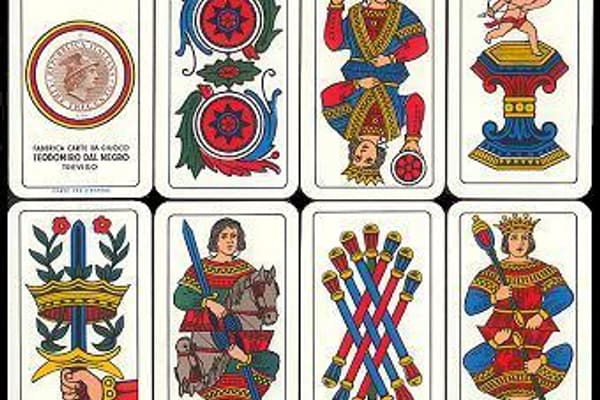
- Use the 40-card Italian deck (Coppe, Denari, Spade, Bastoni) or a standard 52-card deck with the 8s, 9s and 10s removed.
- Card rank within a suit, high to low: 3, 2, Ace, King (Re), Knight (Cavallo), Jack (Fante), 7, 6, 5, 4. The 3 is the highest card and the 4 is the lowest.
- There is no trump suit. Only cards of the suit led can win a trick.
- Card values for scoring: Ace = 1 point. Each 3, 2, King, Knight and Jack (the figure cards and the high pip cards) = 1/3 point. Cards 4 through 7 are worth nothing in points but can win tricks. Total scoring value in the deck is 10 + 2/3 points; the last-trick bonus rounds this to 11 + 2/3 per deal.
Objective
Capture tricks containing aces, threes, twos and figures (Kings, Knights, Jacks) for your partnership, and announce any declarations (accusi) you hold at the start of play. The first partnership to reach 21 points (Naples and most of Italy) or 31 points (some northern variants) at the end of a deal wins the match.
Setup and Deal
- Cut the pack to choose the first dealer; the deal then passes anti-clockwise after each hand.
- Deal 10 cards face-down to each player, anti-clockwise, traditionally in two batches of 5.
- Declarations (accusi) BEFORE the first trick: Any player holding qualifying combinations must announce them in turn (starting with the eldest, the player to the dealer's right). The combinations are: Napoletana (ace, 2 and 3 of the same suit, 3 points), Buon Gioco (three of a kind in 3s, 2s, or aces; 3 points for three, 4 points for all four). The cards do not need to be shown, only declared, but they must actually be held.
- The eldest hand (the player to the dealer's right) leads the first trick.
Gameplay
- Lead any card. The leader of a trick plays one card from their hand to the centre.
- Follow suit if possible. Each player in turn (anti-clockwise) must play a card of the suit led if they have one. If they cannot follow suit, they may play any card.
- No trumps. Off-suit cards can never win a trick. They can be discarded usefully, e.g. to hand a high-value pip to a partner who is winning the trick.
- Winning the trick. The highest card of the led suit wins the trick. The trick winner gathers it face-down into their team's capture pile and leads the next trick.
- Three legal signals (chiamate) when leading a card: (1) Busso ('I knock'): tap the table when leading; tells your partner you have at least one more card of this suit and asks them to take the trick if they can with a high card. (2) Striscio ('I slide'): drag the card; tells your partner you have a long suit but no high cards in it. (3) Volo ('I fly'): toss the card; tells your partner this is your last card of that suit. Only these three signals are permitted; any other communication is cheating.
- Continue trick by trick until all 10 hands are played out. The team that wins the final (10th) trick scores 1 extra point at the deal's end.
Scoring
- Each ace captured: 1 point. Four aces in the deck = 4 points.
- Each captured 3, 2, King (Re), Knight (Cavallo), or Jack (Fante): 1/3 point. Sixteen such cards = 5 + 1/3 points.
- Last trick bonus: 1 point. The team winning the 10th trick adds 1 to its tally.
- Declared accusi: Napoletana = 3 points; three of a kind in 3s, 2s, or aces = 3 points; all four of a kind in 3s, 2s, or aces = 4 points. These are added to the declarer's team total.
- Rounding: Each team adds whole points and divides remaining thirds by 3; remainders are dropped (NOT rounded up). So 4 + 5/3 of a point becomes 4 + 1 = 5 (with 2/3 dropped). This is why the 1/3 increments matter only when accumulated by three.
- Cumulative match total decides victory. First to 21 (Napoli) or 31 (Lombardy and some northern variants) at the end of a hand wins.
Winning
Add scores after every deal. The first partnership to reach the agreed target (usually 21 points) at the end of a deal wins the match. If both teams cross the target on the same deal, the higher final score wins; if tied, deal another hand.
Common Variations
- Tressette con la Chiamata (with the Call): Adds a bidding phase in which the auction winner calls a card; whoever holds it becomes their secret partner. Used as a five-handed game.
- Tressette in Due (two-handed): A 2-player version. Each player gets 10 cards; the remaining 20 form a stock. After every trick both players draw a card from the stock until it is empty; thereafter follow strict suit rules.
- Calabresella (Tressette a Tre): A three-handed cutthroat form with bidding for the right to play with two stock cards.
- Briscola Chiamata (called-trump variant): Closely related to but distinct from the Chiamata version above; played with bidding for the right to set a trump suit.
- Northern target of 31 points: Lombardy and the Veneto frequently play to 31 instead of 21, lengthening the match.
Tips and Strategy
- Memorise the rank order. Tressette's 3-2-A-K-C-F-7-6-5-4 ordering is non-obvious. The 3 is your strongest card; the King is only the fourth-best card in its suit.
- Count point cards as they fall. Sixteen cards (the 3s, 2s, and figures) carry 1/3 each; aces carry 1. Knowing which point cards remain decides whether to risk a low pip play late in the deal.
- Use the three signals. Busso when you have a long strong suit and want your partner to take the trick; striscio when you are long but weak; volo when you have just shed your last card of the suit. Misusing these is worse than silence.
- Lead control wins games. Whoever leads picks the suit. Hold a guaranteed-winning ace or 3 in a long suit so you can recapture the lead at will.
- Discard generously to your partner. When you cannot follow suit and your partner is winning the trick, dump a 3 or 2 of another suit on it; the points stay in your team.
- Declarations are easy points. A Napoletana is worth 3 points, a quarter of a 21-point match. Always declare before the first trick if you hold one.
Glossary
- Trick (presa): One round of play in which each player plays a card; the winner takes all four cards into their capture pile.
- Accuso / Dichiarazione: A declaration of a held combination at the start of play that earns immediate bonus points.
- Napoletana: Ace, 2 and 3 of one suit; 3 declared points.
- Busso, Striscio, Volo: The three legal silent signals for partners in Tressette.
- Cavallo: The Knight (worth 1/3 point), the Italian-deck equivalent of the Queen.
- Fante: The Jack/foot soldier (worth 1/3 point).
Tips & Strategy
Counting point cards is the heart of competitive Tressette. Sixteen cards in the deck carry 1/3 of a point each and four aces carry 1 each; knowing exactly how many point cards remain on the last few tricks tells you whether to take or duck. Use busso, striscio, and volo precisely; partners who learn the signals together routinely beat technically stronger ones who do not.
Because there is no trump suit, lead control is everything. A player holding the 3 of a long suit effectively owns the suit and can dictate when teammates discard their high pip cards safely. Skilled partnerships use the busso signal early to map out where each suit's strength is held before any decisive tricks happen.
Trivia & Fun Facts
Tressette is one of the few major partnership card games where Aces are NOT the highest cards. The 3 outranks them, which often confuses visiting players. The legal signals (busso, striscio, volo) are spoken by gesture only; verbalising them is technically cheating.
-
01In Tressette, what is the highest card in each suit, and what is its scoring value when captured?Answer The 3 is the highest card; like every figure and high pip card it scores 1/3 of a point when captured (only the ace, ranked third, scores a full point).
History & Culture
Tressette is documented as far back as 18th-century Naples; the name probably derives from 'three sevens', a winning combination in an early forerunner. It became one of Italy's national card games alongside Briscola and Scopa, and a staple of cafe and trattoria culture from Sicily to Lombardy.
Tressette is woven through Italian regional life, especially in Campania, Lazio, Puglia, Sicily and Sardinia, and is found wherever Italian emigration spread (Argentina, Brazil, the United States). Its rituals of silent signalling and declarations make it as much a piece of theatre as a game.
Variations & House Rules
Tressette con la Chiamata adds a bidding phase. Tressette in Due adapts the game for two players using a draw stock. Calabresella is the three-player cutthroat cousin. Northern Italian rules often play to 31 points instead of 21.
Beginners may find it easier to allow brief verbal coordination during their first few hands; experienced players keep silent and rely strictly on the three legal signals. Adjust the match target between 21 and 31 to suit how long an evening you want.


