
How to Play
The classic German 2-player trick-and-point-capture game that gave its name to the wider Sixty-Six family (Schnapsen, Mariage, Tausendeins). Played with 24 cards, 6-card hands, and a 66-point declaration target, with marriage bonuses, trump Nine exchange, and the pivotal stock-close decision.
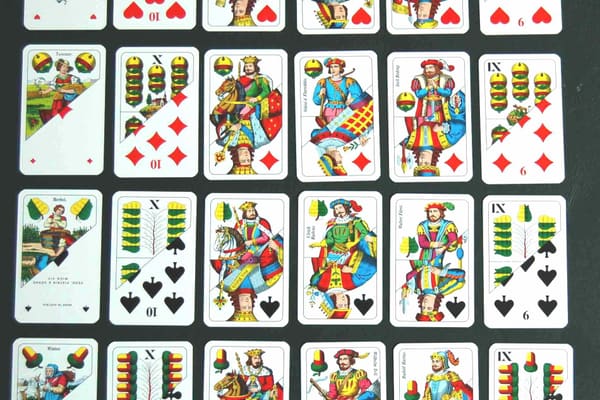
Sixty-Six (German: Sechsundsechzig) is the classic German 2-player trick-taking and point-collecting card game that gave its name to a whole family of Central European 2-hander card games (Schnapsen, Mariage, Tausendeins). Played with a 24-card stripped deck (Aces, Tens, Kings, Queens, Jacks, Nines in each suit) and 6-card hands, the goal is to be first to accumulate 66 card points through tricks, marriage declarations (King-Queen of same suit), and optional stock-closing plays. Aces score 11, Tens 10, Kings 4, Queens 3, Jacks 2, Nines 0 in the capture pile. Marriages declared on your own lead score 20 (or 40 in the trump suit). The holder of the trump Nine may exchange it for the face-up trump card under the stock. The most distinctive tactical element is the option to 'close' the stock, which triggers strict suit-following and ends card draws; closing correctly scores 1 to 3 game points, closing incorrectly scores 2 to 3 to your opponent. The first player to 7 game points (a 'Bummerl') wins the match.
Quick Reference
- 2 players, 24-card stripped deck (A, 10, K, Q, J, 9 of each suit).
- Deal 6 cards each; turn the 13th face up as the trump; remaining 11 form the stock.
- Non-dealer leads the first trick.
- Lead any card; while stock remains, suit-following is not required.
- Winner of each trick draws first from stock; both return to 6 cards.
- May exchange trump Nine for face-up trump on lead. May declare K-Q marriage on own lead (20 / 40 in trumps). May close the stock to end drawing.
- Card values: A=11, 10=10, K=4, Q=3, J=2, 9=0. Marriage: 20 (40 trump).
- Declare 66 after winning a trick to end the hand.
- Game points per hand: 1 (opp 33+), 2 (opp 1-32), 3 (opp zero tricks = Schneider). First to 7 wins the Bummerl.
Players
Exactly 2 players. Deal alternates between the two players after each hand. A complete match (a Bummerl) typically runs 15 to 30 minutes. Can be extended to 2-pair partnership play as a rare variation.
Card Deck
A 24-card stripped deck: Ace, Ten, King, Queen, Jack, and Nine in each of the four suits (removing the 2 through 8 of a standard 52-card pack). Some historical versions include the 7 and 8 (a 32-card pack) but the canonical modern form uses 24.
Objective
Each hand, be the first player to accumulate 66 or more card points through tricks and marriage declarations, and declare it before your opponent does. Each successful hand earns 1, 2, or 3 game points depending on the opponent's score at the time of declaration. The first player to 7 game points wins the Bummerl (match).
Card Values
- Ace = 11 points.
- Ten = 10 points.
- King = 4 points.
- Queen = 3 points.
- Jack = 2 points.
- Nine = 0 points (serves only as the trump-exchange card and filler).
- Total card points in the deck: 120 (60 in trumps if the trump suit includes its Ace and Ten).
- Card ranking (high to low within a suit): Ace, Ten, King, Queen, Jack, Nine.
Setup and Deal
- Determine first dealer by cutting for the highest card (or other agreed method). Deal and play alternate after each hand.
- Shuffle thoroughly. Deal 6 cards face down to each player, traditionally in two packets of 3.
- Turn the next card (the 13th card) face up and place it on the table. The suit of this card is the trump suit for the hand.
- Place the remaining 11 cards face down on top of the turned trump card (the trump is still visible at the bottom of the pile). This stack is the stock.
- The non-dealer leads the first trick.
Gameplay
- Lead any card. The leader of a trick plays any card face up; the opponent follows.
- While the stock is open (cards remain to draw): Suit-following is NOT required. Play any card, including trumps over non-trumps, at will.
- Winning a trick: The higher card of the suit led wins unless trumped; any trump beats any non-trump; a higher trump beats a lower trump. Winner takes both cards face-down into their own score pile.
- Drawing from the stock: After each trick, the trick-winner draws the top card of the stock, then the loser draws the next. Each player's hand returns to 6 cards. The final card drawn is the face-up trump card at the bottom.
- Nine-of-trumps exchange: At any time when holding the lead (before playing a card to the next trick), a player may exchange their Nine of trumps for the face-up trump card at the bottom of the stock. This is a free action and requires that the stock contains at least one more card.
- Marriage declaration (20 points / 40 in trumps): When you hold both the King and Queen of the same suit and are about to lead a trick, you may declare the marriage by showing both cards face-up and leading one of them (typically the King). You immediately add 20 points (40 if trumps) to your running total. You must have won at least one prior trick this hand (you cannot declare a marriage before your first capture).
- Closing the stock: At any time when holding the lead and before drawing, a player may close the stock by turning the face-up trump card face-down. After closing: no more cards are drawn, and both players must follow suit strictly (head the trick if able, and trump if void of the led suit).
- After stock exhaustion (unclosed): Once the stock is empty, strict suit-following begins automatically: must follow suit, must overtrump if able.
- Last trick bonus: If the hand is played out to the last trick without a 66-declaration, the player who wins the last trick scores 10 additional points (only if unclosed).
- Declaring 66: At any time after winning a trick, a player may declare that they have 66 or more card points (tricks + marriages). Play stops and the declaration is verified. If verified, the declarer wins the hand.
Scoring (Game Points per Hand)
- Opponent has 33+ card points at declaration: Declarer scores 1 game point.
- Opponent has 1 to 32 card points (with at least one trick): Declarer scores 2 game points.
- Opponent has zero tricks (Schneider): Declarer scores 3 game points.
- False declaration (declarer did not actually have 66): Opponent scores 2 game points (3 if the declarer had taken no tricks themselves).
- Closing the stock successfully: Same scoring as above based on opponent's state at the close.
- Closing and failing to reach 66 before the cards run out: Opponent scores 2 game points (or 3 if opponent took no tricks).
- Match target: first to 7 game points wins the Bummerl. Match losses are tracked across sessions.
Winning
The first player to accumulate 7 game points wins the Bummerl (match). Typical session length is 2 to 4 Bummerls. A score of 7-0 is a 'Matsch' (shutout); a score of 7-1 or 7-2 is 'tight Bummerl', and 7-6 is as close as it gets.
Common Variations
- Schnapsen (Austrian): A 20-card version with the Nines removed; the trump Jack replaces the Nine as the trump-exchange card, and several small rule differences apply. Dominant form in Austria.
- Three-hand Sixty-Six (Sechsundsechzig zu dritt): Dealer sits out each hand; the two non-dealers play normally. Rotates across the table.
- Four-hand partnership: Two teams of two play with the 24-card deck; each team shares a running total.
- Tausendeins (Tausendeins 1001): An extended variant played to 1001 points instead of 66 with contract-like bidding.
- 32-card Sixty-Six: Historical variant including 7s and 8s; rarely played today.
- Declare-only marriages on own lead: Some strict rulebooks disallow declaring a marriage after winning a trick unless you are leading it with one of the pair.
Tips and Strategy
- Memorise every card played. 24 cards is small enough that a disciplined player can reconstruct their opponent's entire hand by trick 7 or 8.
- Closing the stock is your most powerful tactical weapon and its biggest trap. Close only when you can reach 66 on the cards you hold plus any likely capture; closing when you are short turns a winnable hand into a 2-3 game-point loss.
- Prioritise the Ten of trumps in any trade. A trump Ten taken by the opponent is 10 points captured by them plus it denies you a guaranteed 10-point winner in-suit.
- Save your trump Nine for the exchange (if you also hold the Jack or Queen of trumps); trading the 0-point Nine for the face-up trump card is often worth 2-11 points immediately.
- Time marriage declarations carefully. A non-trump marriage (20 points) declared too early on a weak lead forfeits King-Queen control in that suit for the rest of the hand. A trump marriage (40 points) is almost always a big win.
- Against a closer: if the opponent closes early, they are signalling a strong hand. Duck low in your weak suits and conserve trumps to force them to fall short of 66.
Glossary
- Stock (or Talon): The face-down pile from which both players draw after each trick; the bottom card is the face-up trump.
- Marriage (Hochzeit / Paar): The King and Queen of the same suit held by one player; worth 20 points if declared in non-trumps and 40 if declared in trumps.
- Trump Nine exchange: The special action of trading your Nine of trumps for the face-up trump card at the bottom of the stock.
- Closing the stock: Voluntarily flipping the face-up trump to face-down to end drawing and force strict suit-following.
- Schneider: A hand in which the opponent takes zero tricks; earns the declarer 3 game points.
- Bummerl: The Austrian term for a complete match to 7 game points.
- False declaration: Claiming 66 without actually holding that total; forfeits 2 to 3 game points to the opponent.
Tips & Strategy
Close the stock only when you are confident of reaching 66 from your current hand plus probable captures; a failed close is a 2-3 game point loss. Save your trump Nine for the exchange if you also hold higher trumps. Time non-trump marriages carefully because declaring too early surrenders King-Queen suit control; trump marriages (40 points) almost always pay off.
Sixty-Six is a game of card counting and tempo. With only 24 cards, a disciplined player can reconstruct the opponent's hand by trick 7 or 8 and plan the remaining tricks as a small-deck endgame. The closing-the-stock decision is the game's decisive tactical lever: closing early freezes the state and denies the opponent further draws, but a mis-timed close loses 2-3 game points. Expert play involves fluent mental arithmetic (tracking card points live through every trick) and a fine sense of when the opponent's trump count has run out.
Trivia & Fun Facts
A commemorative plaque in Paderborn, Germany, claims that Sixty-Six was invented in that town in the year 1652, making it one of the very few card games with a specific founding city and date on a public monument. The game's marriage bonus (20 or 40 points) is the direct ancestor of the marriage scoring in Austrian Schnapsen and in the much larger 4-player Bavarian game Schafkopf.
-
01Where and when is Sixty-Six traditionally said to have been invented?Answer In the German town of Paderborn in 1652, according to a commemorative plaque there; first recorded in print in 1718.
-
02What bonus does a marriage (King and Queen of the same suit) score when declared, and how is it declared?Answer 20 points in a non-trump suit, 40 in the trump suit; declared by revealing both cards and leading one of them (usually the King) on your own lead, after you have won at least one prior trick.
History & Culture
Sixty-Six was first described in print in 1718 and is traditionally said to have been invented in Paderborn, Germany, in 1652 (a plaque in the town commemorates this claim). The game spread across Central Europe in the 18th and 19th centuries and is the direct ancestor of Schnapsen (Austria), Mariage (Poland), and Tausendeins (Russia and Ukraine). It remains among the most-played 2-player card games in German-speaking countries. The modern 24-card stripped deck took hold in the mid-19th century; earlier historical forms used 32 cards including 7s and 8s.
Sixty-Six is one of the great Central European 2-player card games, with a stature in Germany comparable to Schnapsen in Austria or Briscola in Italy. It has been played continuously since at least the early 18th century in pubs, homes, and card-playing clubs, and has seeded a whole family of derivative games across German-, Slavic-, and Hungarian-speaking regions. Competitive tournaments still run annually in Germany and Austria with recognised national champions.
Variations & House Rules
Schnapsen (the Austrian form with 20 cards, no Nines) is the most widespread variant and has a dedicated competitive circuit. Three-hand Sixty-Six rotates the dealer out of each hand. Four-hand partnership play uses the same deck with two teams. Tausendeins extends the target to 1001 with contract-style bidding. 32-card Sixty-Six is a historical variant including 7s and 8s.
For beginners, omit the closing rule and the Nine exchange for the first session to learn the basic trick-and-marriage mechanics. For experienced players, play Schnapsen (20 cards) or Tausendeins (1001 points) for more depth. Use a small printed scoresheet with columns for card points and marriages so beginners do not miscount.


