
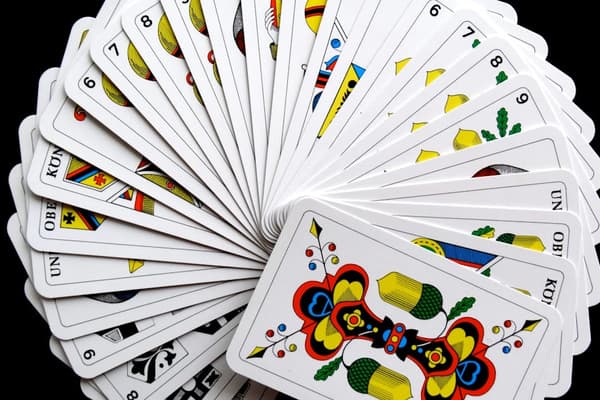
How to Play
Snapszli is the Hungarian form of Schnapsen: a two-player 20-card point-trick game where the first player to 66 card points through tricks and King + Queen marriages wins, with the signature option to 'close the talon' and force a strict endgame.
Snapszli (also Snapszer) is the Hungarian form of Schnapsen, a tight two-player point-trick game of the Marriage group descended from the German game Sixty-Six (Sechsundsechzig). Played with a 20-card deck stripped down to Ace, 10, King, Queen, and Jack of each suit, each player receives 5 cards and the top card of the talon is turned face up as the trump indicator. Points are scored in trick captures (Ace = 11, 10 = 10, King = 4, Queen = 3, Jack = 2) and by declaring King + Queen marriages when leading (20 points for plain marriages, 40 in trumps). A signature Snapszli move is the closing of the talon: a player who believes they can reach 66 card points without further draws may turn the trump indicator face down, ending all further drawing and forcing a strict follow-suit and head-trick endgame. The first player to reach 66 points in card-captures-plus-marriages and claim '66!' wins the deal; the winner scores 1, 2, or 3 game points depending on the opponent's margin (1 normal, 2 for opponent below 33 / 'Schneider', 3 for opponent with zero tricks / 'Schwarz'). The match is typically played to 7 game points (a 'Bummerl').
Quick Reference
- 2 players, 20-card deck (A, 10, K, Q, J per suit).
- Deal 5 cards each; top of talon face up as trump indicator.
- Ace = 11, 10 = 10, King = 4, Queen = 3, Jack = 2.
- Open phase: no follow-suit obligation; winner draws first.
- Declare K + Q marriage when leading: 20 (plain) / 40 (trump).
- Close talon to commit to 66; enters strict follow-suit + head-trick phase.
- Normal: 1 game point. Schneider (opp < 33): 2. Schwarz (opp 0 tricks): 3.
- Failed close: lose 2 or 3 game points to opponent.
- Match: first to 7 game points wins a Bummerl.
Players
Exactly 2 players. Each plays for themselves. The non-dealer leads the first trick. Deal alternates each hand. Snapszli is a pure two-handed game; a four-player partnership form exists (Négyes Snapszli) but is rare compared to the two-handed version described here.
Card Deck
A 20-card deck. Traditional Hungarian play uses the Tell-pattern deck (Acorns, Leaves, Hearts, Bells) with ranks Ász (Ace), 10, Király (King), Felső (Queen), Alsó (Jack). A French-suited 32-card pack substitutes perfectly: keep only the A, 10, K, Q, J of each suit and discard the rest. Card rank in trick-play, high to low: Ace, 10, King, Queen, Jack. Card point values: Ace = 11, 10 = 10, King = 4, Queen = 3, Jack = 2. Total card points across the deck: 4 × (11 + 10 + 4 + 3 + 2) = 120 points. Plus up to 40 + 20 + 20 + 20 = 100 points of potential marriage bonuses, so the deal can yield more than 200 points in total.
Objective
Be the first player to accumulate 66 or more card points (tricks + marriages) in a single deal and claim '66!'. The first player to 7 game points (a Bummerl) wins the match. A game-point per deal is awarded normally; 2 if the opponent stayed below 33 ('Schneider'); 3 if the opponent won zero tricks ('Schwarz'). Failed closes or incorrect 66-claims often lose extra game points.
Setup and Deal
- Cut for first dealer; the deal alternates each hand.
- Shuffle the 20-card deck. Dealer deals 3 cards, then 1 face-up trump card (placed half-under the stock), then 2 more cards face down to each player, so each player has 5 cards and the top of the stock (the trump card) is face up as the trump indicator.
- The remaining 10 cards (minus the trump indicator) are the talon. When a player draws, they take the top face-down card; the trump indicator is taken as the very last card of the talon.
- The non-dealer (forehand) leads to the first trick.
Gameplay
- Open talon phase (before closing or exhaustion): Players are not obliged to follow suit; any card may be played to any trick. The trick is won by the highest trump if any trump was played, otherwise by the highest card of the led suit. After each trick, the winner draws first from the talon, then the loser draws.
- Declaring marriages: When leading a trick, a player holding both the King and Queen of a suit may declare the marriage by playing one of the pair and announcing the marriage. Plain marriage = 20 points, trump marriage = 40 points. The points are added immediately to the declarer's running total. The second card of the marriage pair stays in hand until played.
- Trump-Jack exchange: A player holding the Jack of trumps may, before leading any trick while the talon is not closed, swap their Jack for the face-up trump indicator (keeping the Jack visible is forbidden; the swap is a declaration). This gains access to the potentially-higher trump indicator card.
- Closing the talon: On their turn, a player may close the talon by turning the face-up trump indicator face down. From that moment: no more draws occur, strict follow-suit + head-trick rules apply (see closed phase), and the closer has committed to reaching 66 from their current position. The closer's opponent continues playing with their current hand until both hands are exhausted.
- Closed phase / talon exhausted: Once the talon is closed or exhausted, follow-suit rules become strict. A player must follow the led suit if able. If unable, they must trump if they hold a trump. If unable to follow and holding no trump, they may discard any card. Additionally: when following suit or trumping, they must play higher than the current highest card in the trick if possible (head-trick obligation).
- Claiming 66: At any point after any trick, a player who believes they have reached 66 points may stop play and claim '66!'. Their total is verified: if correct they win the deal; if incorrect they lose the deal (and their opponent scores as if they had closed successfully). An accurate running count is essential.
- Last trick bonus: If neither player has claimed 66 by the time the final trick is played, the last trick winner scores an extra 10 points; if that pushes them to 66, they win the deal.
Scoring
- Card capture values: Ace = 11, 10 = 10, King = 4, Queen = 3, Jack = 2. Deck total = 120.
- Marriages (K + Q of one suit declared when leading): Plain = 20, trump = 40.
- Claim '66!': Win the deal at 66+ points; cannot go above 66 without claiming. If you claim and verify, you win; if you miscount, you lose automatically.
- Normal win: 1 game point if the opponent finished with 33-65 points.
- Schneider (2 game points): Opponent finished below 33 points.
- Schwarz (3 game points): Opponent won zero tricks at all.
- Failed close: If a player closed the talon and then failed to reach 66 by the final trick, they lose 2 game points (3 if they had zero tricks). Closing is a commitment with consequences.
- Match target: First to 7 game points wins the Bummerl (the match).
Winning
Each deal is won by the first player to reach 66 card points and claim correctly, by closing successfully, or by winning more points than the opponent if the last trick is reached without a claim. Over a Bummerl (match to 7 game points), the player accumulating 7 first wins; the loser of a Bummerl is said to 'have a Bummerl' and a running tally of Bummerls is often kept across a session.
Common Variations
- Austrian Schnapsen: Identical rules, used as the regional variant in Austria. The name 'Snapszli' is the Hungarian spelling and pronunciation of the same game.
- Hungarian Snapszer: Some older sources distinguish a slightly looser Hungarian form with more permissive marriage declarations.
- 24-card Snapszli: Adds the 9 of each suit for a 24-card game; 6-card hands instead of 5. Less common.
- Bummerl series: Standard competitive format; first to 7 game points wins each Bummerl, best of 3 Bummerls wins the session.
- Négyes Snapszli (4-player Snapszli): Regional partnership variant for 4 players; partners opposite, longer talon, modified marriages.
- Knock-Snapszli: Some pub versions let a player knock the table to declare 'I will reach 66 this trick' in lieu of formally closing; similar to Toepen's knock.
Tips and Strategy
- Memorise every played card. With only 20 cards in the deck, perfect card counting is achievable and expected of competent players; a trick-by-trick running total of points captured plus opponent's likely holdings decides most deals.
- Close only when you can mathematically guarantee 66. Count your card points plus foreseeable marriages and captures; if you cannot project reaching 66 without the talon, do not close (the penalty for a failed close is severe).
- Save your Ace-10 combo for late captures. The Ace (11) and 10 (10) of any suit are 21 points together; opponents will try to capture them with trumps. Hold them back until you have trumped out the opponent's trump supply.
- Declare marriages as soon as leading becomes safe. A plain 20-point marriage is one-third of the 66 target; declare immediately when leading a trick, even if your King is later captured.
- Swap the trump Jack for the indicator. If the indicator is a 10, Ace, King, or Queen, swap your Jack for it; the upgrade usually yields 9+ extra points across the deal.
- Defensive play against a close: If your opponent closes, count backward from 66 minus their current total; if the math shows they cannot reach 66 even with all remaining trumps, play defensively to run out the deal and claim the 2-game-point windfall.
Glossary
- Marriage (hlášení / királypár): King + Queen of one suit declared when leading; 20 plain, 40 trump.
- Talon (stock): The face-down 10-card pile from which players draw between tricks.
- Trump indicator: The face-up card beneath the talon; determines trump suit.
- Closing: Turning the trump indicator face down to stop drawing and commit to 66 from current position.
- Open phase: Phase while the talon is still face up; no obligation to follow suit.
- Closed phase: Phase after closing or talon exhaustion; strict follow-suit + head-trick rules apply.
- Claim 66 / announce: A player stopping play to claim they have reached 66 points.
- Schneider: Opponent finishes below 33 points; winner scores 2 game points.
- Schwarz: Opponent wins zero tricks; winner scores 3 game points.
- Bummerl: A 7-game-point match; the match unit of Snapszli competition.
Tips & Strategy
Count every card played; with only 20 cards in the deck, perfect memory is achievable and expected. Close the talon only when you can guarantee 66 from your current position (including foreseeable marriages and captures); the penalty for a failed close is severe (2-3 game points).
Snapszli distils two-handed point-trick play to its purest form. The 20-card deck enables full information reconstruction after only 3-4 tricks; expert play is essentially chess-like. The closing decision is the game's defining tension: close too early and the talon's remaining marriages and high-cards go to your opponent; close too late and the opponent claims 66 from the open phase first. Central European coaching traditions compare Snapszli expertise to speed chess for its demand of rapid computation under pressure.
Trivia & Fun Facts
The 20-card Snapszli deck is small enough that every deal is fully within a player's mental reach; expert Snapszli players can recite every card that has been played, estimate the opponent's exact hand, and calculate the remaining possible 66 routes in a few seconds. The traditional Hungarian Tell-pattern deck used for Snapszli depicts characters from the William Tell legend rather than Kings, Queens, and Jacks, but the game-mechanic roles are identical.
-
01What is the point target for winning a deal of Snapszli, and how are the points accumulated?Answer 66 points; accumulated from trick captures (Ace = 11, 10 = 10, King = 4, Queen = 3, Jack = 2) and marriage declarations (20 plain, 40 trump) when leading.
-
02What happens if a player 'closes the talon' but fails to reach 66 by deal's end?Answer They lose 2 game points (or 3 if the opponent won zero tricks), a severe penalty that makes premature closing strategically risky.
History & Culture
Snapszli descends from the German Sechsundsechzig (Sixty-Six), which migrated into the Austro-Hungarian Empire in the 19th century as Schnapsen. The Hungarian-language name 'Snapszli' formalised the same game in Hungary with local Tell-pattern decks; it became a fixture of Budapest café culture from the 1880s onward and remains the dominant two-handed card game in Hungarian pub settings today, alongside Ulti (the three-handed contract game).
Snapszli is a fixture of Hungarian café culture, historically associated with the intellectual and literary life of Budapest. The game is so embedded in Hungarian life that the verb 'snapszlizni' (to play Snapszli) is a well-known idiom for sharpening one's wits. National tournaments are held annually, and the game's lineage to Austrian Schnapsen makes it a shared heritage across the former Habsburg lands.
Variations & House Rules
Austrian Schnapsen is essentially the same game with minor regional rule variations. Hungarian Snapszer is a slightly looser older form. 24-card Snapszli adds 9s for 6-card hands. Bummerl series play first-to-7 matches as the competitive standard. Négyes Snapszli scales to 4 players in partnerships.
For beginners, disable the 'failed close' penalty; players still learn when to close but without severe punishment. Use a 24-card deck (adding 9s) for a slightly more forgiving game. Track running Bummerls over a session of 3-5 matches for an evening-long contest.


