
How to Play
Russian Bank (Crapette, Tunj) is a strict two-player competitive patience. Each player works a personal tableau, reserve, stock, and waste while cooperating on a shared set of 8 foundations; a mandatory-play hierarchy forces specific move orders, and violations let the opponent call 'Stop!' to end your turn.
Russian Bank (also Crapette in French, Tunj in Russian) is a strict two-player competitive patience game in which each player works their own tableau, reserve, stock, and waste piles while cooperating on a shared set of foundations. The twist is a mandatory-play hierarchy: you must take the highest-priority play available to you before making any other move, and your opponent can call 'Stop!' (Tunj / Crapette) the moment you slip up, ending your turn and forfeiting the opportunity. The first player to empty their reserve and stock wins.
Quick Reference
- Two players, two decks with different backs. Each player deals 13 cards as a face-down reserve (top card face-up) and sets the rest as a face-down stock.
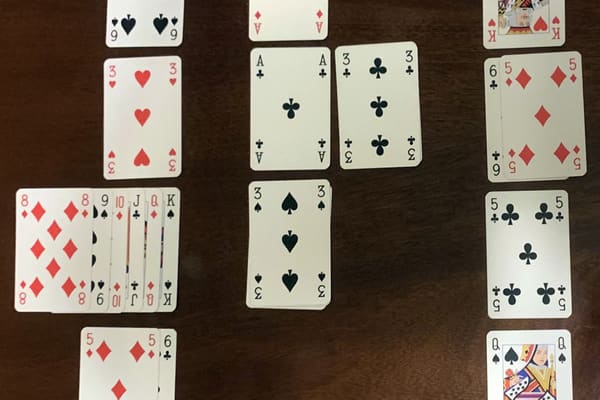
- Deal 4 shared auxiliary columns face-up in the centre, one card per column, alternating from the players' decks.
- High cut decides who plays first; each turn continues until you cannot make a legal play.
- Priority order: (1) reserve top to foundation, (2) any card to foundation, (3) reserve top to auxiliary, (4) auxiliary moves, (5) stock to auxiliary, (6) stock to waste.
- Auxiliary columns build down in alternating colours; foundations build up by suit from Ace to King.
- Play onto the opponent's reserve or waste with a same-suit, adjacent-rank card; an aggressive dump that adds to their pile.
- Opponent can call Stop! if you skip a mandatory play; if correct, your turn ends immediately.
- First to clear reserve and stock wins; waste may still hold cards.
- Sessions commonly play best-of-three or best-of-five.
Players
Exactly 2 players sitting across from each other. Russian Bank has no partnership or larger-table variant. Each player uses their own 52-card deck (with distinguishable backs so contributions can be separated for scoring, if a session total is kept).
Card Deck
Two standard 52-card decks (one per player), no jokers. Decks must have visibly different backs so cards can be sorted after a hand. All four suits and all thirteen ranks are used. Ranks within each suit: Ace (low for foundations) 2 3 4 5 6 7 8 9 10 Jack Queen King (high). There is no trump suit.
Objective
Be the first player to empty your own reserve (a 13-card personal pile) and stock (remaining undealt cards) by playing their cards to the shared foundations, the shared tableau columns, or to your opponent's reserve and waste. The first player to clear both their reserve and stock wins the game.
Setup and Deal
- Each player shuffles their own 52-card deck and lets the opponent cut it. The higher drawn card decides who plays first.
- Each player sets up an identical personal layout: a reserve of 13 cards dealt face-down with the top card turned face-up (placed to the left in front of them), and a stock of 35 face-down cards at the right edge of their side of the table. A waste pile starts empty on top of the stock.
- Between the two players, deal a shared tableau of 4 auxiliary columns in the centre: each column is a single face-up card at the start, dealt one at a time alternating from the players' decks. These four centre cards form the tableau that both players build onto.
- Leave 8 empty foundation slots between the two tableau rows; foundations are shared (either player can build onto any foundation). Foundations are started with Aces and built up Ace through King by suit.
- The winner of the cut makes the first move. Each player's turn continues until they are unable to make a legal play, or until the opponent correctly calls 'Stop!'.
Mandatory Play Hierarchy
- 1. Foundation from reserve: If the top card of your reserve can be played to a foundation, it must be played there before anything else.
- 2. Foundation from anywhere: Any other available card (waste top, auxiliary column bottom, or a just-turned stock card) that can go to a foundation must be played there next.
- 3. Reserve to auxiliary: If the top card of your reserve can be placed on a tableau column (one rank lower, opposite colour), it must go there.
- 4. Auxiliary to auxiliary: Rearranging tableau columns is allowed only when it enables one of the higher-priority plays.
- 5. Stock to auxiliary: Turning a new stock card and placing it on a tableau or foundation.
- 6. Stock to waste: A stock card that cannot be played elsewhere becomes the new waste-pile top.
- The priority rule: at every instant during your turn, if a higher-priority play is legal, you must take it. A lower-priority move while a higher one is available is an error; your opponent may call Stop! and your turn ends immediately.
Gameplay
- Turn structure: A player's turn continues as long as they can make at least one legal play. When no play is legal, the player turns one card from their stock to their waste (a legal play in itself); if the newly turned card cannot be played elsewhere and lands on the waste, the turn ends and the opponent begins.
- Foundation building: Foundations build upward by suit from Ace to King (... on one slot, same for clubs, diamonds, hearts, and the second-deck copies on separate slots). Any available card (top of reserve, top of waste, top of a just-turned stock card, or bottom card of an auxiliary column) can be played to an appropriate foundation. Foundations are shared; either player may play to any foundation.
- Auxiliary (tableau) building: Each of the four auxiliary columns builds down in alternating colour (red on black, black on red). Only one card moves at a time. Any available card may play to an auxiliary column.
- Playing onto opponent's piles: A powerful aggressive move. You may place an available card onto the top of your opponent's reserve or waste pile if it matches by suit and is adjacent in rank (one higher or one lower). Example: if the top of your opponent's waste is the , you may play a or an from your available cards there. This puts the card onto your opponent's pile, effectively giving it to them to deal with later.
- Reserve replenishment: When you play the top card of your reserve, the next card in the pile flips face-up automatically. Your reserve shrinks by one each time you play from it.
- Empty auxiliary columns: When a tableau column is cleared, any single available card may fill it (no King-only restriction in the standard Russian Bank rules).
- Stop! / Tunj! call: The opponent watches your turn. The moment they see you make a lower-priority move while a higher-priority play was legal, or play an illegal move, they call 'Stop!' (or 'Tunj!' or 'Crapette!'). If their call is correct, your illegal or out-of-order move is reversed and your turn ends immediately; play passes to them. If the call is wrong (no violation actually occurred), your turn continues.
- Illegal play: Any card placed out of sequence on a foundation or auxiliary, a non-adjacent-rank card placed on the opponent's piles, or skipping a mandatory play is illegal. Illegal plays must be reversed when caught; play then continues.
Winning
- Game winner: The first player to have an empty reserve and an empty stock simultaneously wins the game. The waste pile may still contain cards; what matters is the reserve and the stock being cleared.
- No tie: Because both conditions cannot complete simultaneously (turns alternate), there is no tie outcome.
- Session format: Groups often play first-to-three-wins or first-to-five-wins; no running card-count score is typically kept within a single game.
Common Variations
- Crapette (French): Essentially identical to Russian Bank; slight differences in priority ordering (some houses require foundation-from-waste before foundation-from-reserve).
- Lenient Russian Bank: Skip the Stop! / call mechanism; players simply correct each other's mistakes conversationally. Recommended for new players.
- Friendly hall: Allow tableau columns to accept any single card into empty slots (standard). Strict variants require only a King or a sequence starting with a King, Klondike-style.
- Personal reserve size variants: Some houses use 12 or 10 reserve cards; changes the game's pace but not the mandatory-play logic.
- Spite and Malice family: Related two-player competitive solitaire with different mechanics; sometimes taught together.
- Speed Russian Bank: No Stop! call; both players act simultaneously, racing on the shared foundations. Chaotic but fast.
Tips and Strategy
- Memorise the priority list. Knowing the rules better than your opponent is worth entire turns when they make ordering errors you can catch.
- Playing onto your opponent's reserve or waste is the single most aggressive tactic. Any adjacent-same-suit card from your hand that you place there adds to their workload; a stack of cards on their reserve is a major obstacle.
- Empty your reserve before your stock. The reserve is the 'endgame clog' that prevents winning; stock cards keep flowing until the reserve is gone.
- Watch your opponent's priorities when they play. The moment they skip a mandatory play, call Stop! immediately; hesitating and then calling Stop! on a later move is often ruled invalid.
- Build tableau columns aggressively to create placement opportunities on the opponent's piles; a fresh auxiliary row position often unlocks a cascade of dumps onto the opponent.
- Save high-value foundation plays (Aces, 2s) until they serve the current priority; do not cash them in carelessly if a higher-priority play is queued.
Glossary
- Reserve: Each player's personal 13-card pile, started face-down with the top card face-up. Emptying your reserve is a win condition.
- Stock: Each player's personal 35-card face-down draw pile.
- Waste: Each player's personal face-up pile fed by stock cards that could not be played elsewhere; only the top is available.
- Auxiliary columns / tableau: The four shared centre columns that build down in alternating colours.
- Foundation: One of eight shared foundation piles, built up by suit from Ace to King.
- Available card: A card currently playable: top of your reserve, top of your waste, bottom card of any auxiliary column, or a just-turned stock card.
- Mandatory play: A move required by the priority hierarchy; failing to make it exposes you to a Stop! call.
- Stop! / Tunj! / Crapette!: The opponent's call when you skip a mandatory play or make an illegal move; ends your turn immediately if correct.
- Adjacent-rank opponent's pile: The rule that you may play onto your opponent's reserve or waste top with a same-suit card one rank higher or one rank lower; offensive tactic.
Tips & Strategy
Memorise the priority list; knowing the rules better than your opponent is worth whole turns via Stop! calls. Playing cards onto the opponent's reserve or waste is the most aggressive tactic.
Building tableau columns aggressively creates placement opportunities on the opponent's piles; a fresh auxiliary column position often unlocks a cascade of dumps onto the opponent's waste.
Trivia & Fun Facts
One of the few card games where in-game rule enforcement is a competitive advantage: a player who can identify every legal mandatory play before their opponent systematically gains tempo.
-
01What happens if your opponent catches you making a move out of the mandatory play order in Russian Bank?Answer They call 'Stop!' (or Tunj! / Crapette!) and your turn ends immediately; the illegal or out-of-order move is reversed.
History & Culture
Russian Bank has been popular across Europe since the 19th century, especially in France (where it is called Crapette) and Germany. The rule-catching mechanism is one of the earliest examples of 'lawyering' as a card-game strategy.
A distinctive rule-heavy two-player patience that sits between friendly solitaire and cut-throat competition; a favourite in European card clubs with a strong tradition of strict enforcement.
Variations & House Rules
Crapette (the French version) tweaks the priority order. Lenient Russian Bank drops the Stop! mechanism for casual play. Spite and Malice is a related two-player competitive solitaire with different mechanics.
Give new players a warning before enforcing the Stop! call; competitive play enforces it strictly. Some houses cap the game at a time limit to prevent deadlocks.


