
How to Play
A casino banking game where players bet that a third card will fall between two opening cards, with payouts scaled inversely to the spread.
Red Dog (also called Yablon, In-Between, or Acey-Deucey) is a casino banking game played one hand at a time between each player and the house. Every hand, the dealer turns two cards face up. The gap between their ranks is called the spread; the player bets that a third card will fall strictly inside the gap. Payouts get shorter as the spread widens, because wider gaps are easier to hit, and the initial bet may be doubled once the spread is revealed. The whole game lasts about twenty seconds per hand and is almost pure chance, with the small amount of skill coming from knowing exactly when to raise.
Quick Reference
- 1 to 6 players, each against the house.
- One or six standard decks shuffled together.
- Place your ante before any cards are shown.
- Dealer turns two cards face up; announce the spread.
- Consecutive cards push; pairs trigger an immediate third card for a potential 11:1.
- On any real spread, stand or raise (up to the original ante).
- Third card drawn: inside the spread wins, on or outside loses.
- Spread 1 pays 5:1; 2 pays 4:1; 3 pays 2:1; 4 or more pays 1:1.
- Pair plus matching third card pays 11:1.
- Consecutive cards and unmatched pairs push.
Players
One to six players, each playing an independent hand against the house dealer. Players do not compete with one another; each wager is settled separately.
Card Deck
- One standard 52-card deck, though most casinos use six decks shuffled together to resist card counting.
- Ranks (low to high): A, 2, 3, 4, 5, 6, 7, 8, 9, 10, J, Q, K. Aces are always low in Red Dog.
- Suits are irrelevant for payouts.
Objective
Win your wager by betting that a third card, dealt after two opening cards, will fall strictly between the ranks of those two cards.
Setup and Deal
- Each player places an initial wager (the ante) inside the betting box before any cards are shown.
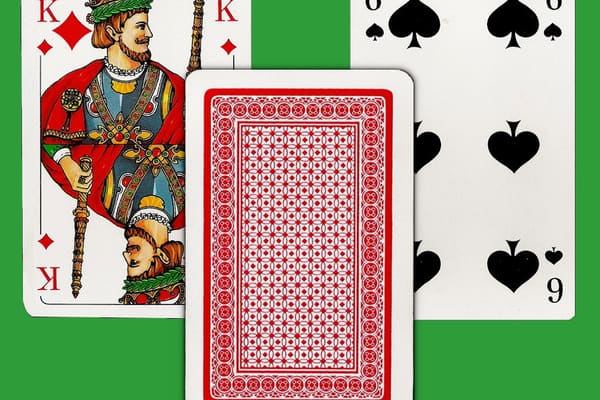
- The dealer turns two cards face up side by side in front of each player.
- The dealer announces the spread: the number of ranks strictly between the two cards. For example, a 4 and a 9 give a spread of 4, because 5, 6, 7, and 8 all fall between.
- No cards are burned; after the hand is resolved, cards go to the discard tray.
Gameplay
- Consecutive cards (spread 0): If the two cards are ranked next to each other (for example 7 and 8), the hand is an automatic push: the wager is returned and no third card is drawn.
- Pair (spread 0, equal ranks): If both cards have the same rank, the dealer immediately deals a third card. If that third card matches the pair for three of a kind, the player wins 11 to 1. Otherwise the hand pushes and the wager is returned.
- Spread of 1 or more: The player chooses to either stand on the initial wager or raise by placing an additional bet equal to, but not greater than, the initial wager.
- Third card dealt: The dealer turns a third card face up between the first two. If its rank falls strictly between them, the player wins according to the spread paytable. If the third card equals or sits outside either boundary card, the player loses the entire bet (initial plus any raise).
- Settle and repeat: The dealer pays winners, collects losers, and starts a new hand. There is no continuing state between hands.
Paytable
- Spread of 1: Pays 5 to 1 on the winning bet.
- Spread of 2: Pays 4 to 1.
- Spread of 3: Pays 2 to 1.
- Spread of 4 through 11: Pays 1 to 1 (even money).
- Pair followed by a matching third card (three of a kind): Pays 11 to 1.
- Consecutive cards: Push, no payout.
- Pair with non-matching third card: Push, no payout.
Winning
Each hand is won or lost independently. A player who hits the spread earns the posted payout on both the initial bet and any raise; a miss forfeits both. Because every hand resolves in seconds, a session usually plays many rounds to a preset loss limit or time cap rather than a fixed score target.
Common Variations
- Single-deck Red Dog: Uses one deck, tightening the house edge slightly and rewarding card tracking; now rare on casino floors.
- Multi-deck Red Dog: Uses six to eight decks shuffled together, the standard modern casino format. Probabilities shift only marginally per spread.
- Acey-Deucey (home version): Each player antes into a communal pot. On each turn a player receives the two boundary cards and bets any amount up to the current pot. Hits are paid from the pot; misses are added to it, so the pot can balloon until a lucky raise cleans it out.
- No raise rule: Some home variants skip the raise option entirely, so every bet is simply the ante. This makes the game faster but removes the only decision point.
Tips and Strategy
- Only raise when the spread is 7 or more. Below that, the probability of the third card falling inside the gap is under 50 percent, so raising increases your long-run loss.
- Remember that a pair cannot pay on a simple spread bet; the only winning outcome on a pair is three of a kind, paying 11 to 1.
- The house edge varies sharply with the number of decks. A single-deck game runs around 3.2 percent, while a six-deck game is closer to 2.8 percent; pick the table with the most decks if you want the smallest edge.
- Set a strict loss limit before sitting down. Red Dog looks gentle because most hands are even-money, but the spread distribution is skewed toward narrow (losing) gaps.
- Never treat a streak of hits or misses as predictive. Shuffled decks reset the probabilities after every shoe; outcomes are independent.
Glossary
- Spread: The number of ranks strictly between the two opening cards.
- Push: A neutral result where the wager is returned with no win or loss.
- Raise: An optional extra bet, capped at the original wager, placed after the spread is announced.
- Yablon: An older name for Red Dog used in parts of Europe.
- Acey-Deucey: A home variant that uses a shared pot instead of a casino bank.
- Three of a kind: The only winning outcome when the opening cards are a pair; pays 11 to 1.
Tips & Strategy
Only raise when the spread between the two opening cards is 7 or more, because anything narrower gives the house the mathematical edge on the extra bet.
The only decision that affects long-run expectation is whether to raise after the spread is announced. Probabilities become favourable only from a spread of 7 upward; memorize this line and never deviate.
Trivia & Fun Facts
Despite the label Red Dog Poker, the game involves no five-card hand and shares none of poker's rankings. The name simply carried over from an older unrelated poker side-bet where a player tried to beat the top card of the deck with a card from their hand.
-
01What happens in Red Dog when the first two cards dealt are consecutive in rank?Answer The hand is an automatic push, the wager is returned, and no third card is drawn.
History & Culture
Red Dog grew out of 19th-century home gambling circles in the United States and reached peak casino popularity in the 1980s and early 1990s. It has since become uncommon on casino floors, surviving mainly as an online game and as the home variant Acey-Deucey.
Red Dog represents the category of simple banking games that dominated American casino floors before blackjack and poker variants took over. Its Old West roots are still celebrated by enthusiasts of vintage gambling.
Variations & House Rules
The home game Acey-Deucey uses a shared pot that grows on every miss and empties when a player hits a narrow spread, producing much larger swings than the casino version's fixed paytable.
For a home game, combine Red Dog with a shared pot so every miss contributes to future jackpots, and consider capping the pot to keep rounds moving at a lively pace.


