
How to Play
Marriage is a fast-paced, multi-deck rummy game, immensely popular in Nepal and widely played across India and Bangladesh, especially during the Dashain and Tihar festival seasons. Each of 4 to 6 players is dealt a large hand of 21 cards from 3 combined standard decks and races to arrange every card into sequences and sets, needing at least 1 pure sequence, or 'life', before declaring 'show' to end the round. Its signature features are a wild joker rank redetermined every deal and 2 bonus melds unique to using 3 decks at once: the dublee, a held pair of identical cards, and the tunnela, all 3 identical copies of one card grouped together. Sessions run for several rounds, with players accumulating penalty points for unmatched cards left in hand whenever an opponent shows first, and the lowest cumulative score across the session wins.
Marriage is a multi-deck rummy game, hugely popular in Nepal and widely played across India and Bangladesh, in which each player is dealt a large hand of 21 cards from 3 shuffled-together standard decks and races to arrange every card into valid melds before anyone else. It is unrelated to the older European card game also called Mariage; this Marriage belongs to the rummy family, alongside Indian Rummy and Gin Rummy, but stands apart through its use of 3 full decks, a randomly determined wild joker rank that changes every deal, and 2 signature bonus melds, the dublee and the tunnela, that reward holding duplicate cards. Especially popular during the Dashain and Tihar festival seasons, when extended families gather to play for small stakes late into the night, Marriage combines the sequence-and-set logic of Rummy with the higher variance and social energy of a bigger, noisier table.
Quick Reference
- Combine 3 standard 52-card decks with all 3 printed jokers (159 cards) and deal 21 cards to each of 3 to 6 players.
- Turn 1 card face up from the stock; the card 1 rank higher in the same suit becomes the wild joker for the round.
- Turn the next stock card face up to start the discard pile; the player to the dealer's left goes first.
- Draw 1 card from the face-down stock or the face-up discard pile.
- Arrange your hand into sequences (3+ consecutive same-suit cards) and sets (3+ cards of the same rank), using wild jokers to fill gaps where needed.
- Discard 1 card face up, or declare 'show' instead if your entire hand is already validly arranged with at least 1 life.
- The player who shows validly scores 0 penalty points for the round.
- Every other player counts unmatched cards at face value (2 to 10), 10 points for King/Queen/Jack, and 1 or 10 for Ace.
- An unmatched wild joker or printed joker scores the highest penalty, commonly around 20 points; totals accumulate across the whole session, and the lowest sum after the agreed number of rounds wins.
Players
Marriage is best with 4 to 6 players, though it is commonly played with as few as 3 or as many as 6 at a single table. Play proceeds clockwise. A single round typically takes 20 to 40 minutes depending on table size, and a full session usually runs several rounds in a row, often 1.5 to 3 hours in total, since groups agree in advance on a fixed number of deals or a target score rather than stopping after just 1 hand.
Card Deck
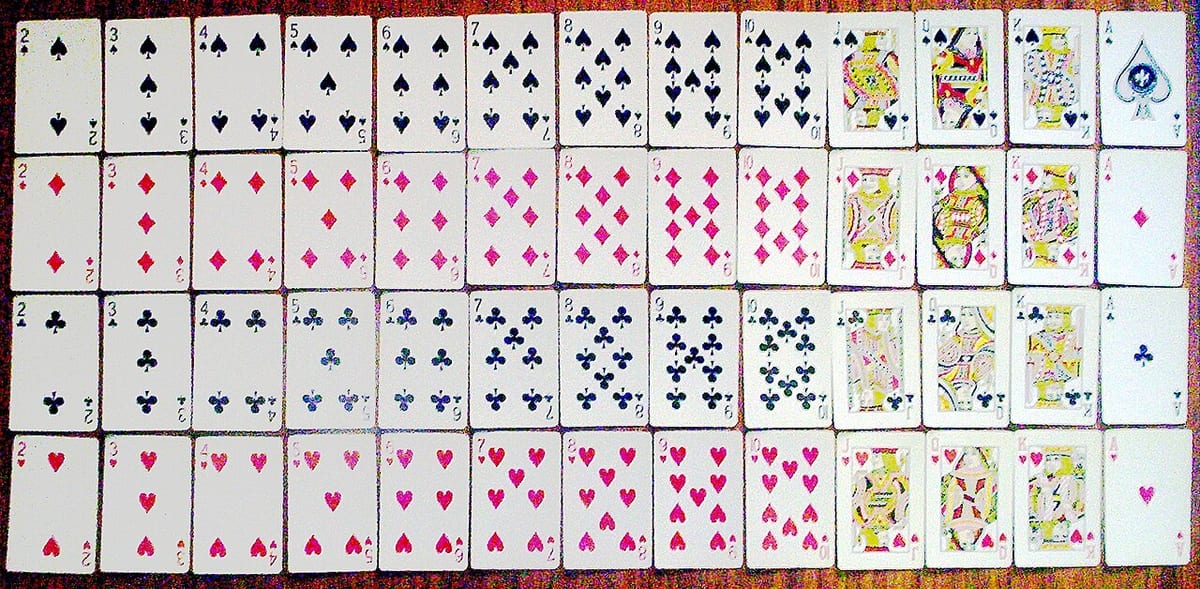
- 3 standard 52-card decks shuffled together, plus all 3 printed jokers, for 159 cards total. Card ranks run Ace (low or high, see Melds), King, Queen, Jack, 10 down to 2 in each of the 4 suits, with 3 identical copies of every card available because 3 decks are combined.
- With only 3 or 4 players at the table, some groups prefer 2 combined decks plus 2 printed jokers (106 cards) and deal a slightly smaller hand instead of the full 21 cards; the 3-deck, 21-card version described here is the standard used for 5 or 6 players.
- Because 3 identical decks are mixed together, every rank and suit combination exists in triplicate, for example there are 3 separate cards in play at once; this is what makes the tunnela meld (3 identical cards played as one group) possible.
Objective
Be the first player to organize your entire hand into valid melds, sequences of 3 or more consecutive same-suit cards or sets of 3 or more cards of the same rank, with no leftover unmatched cards, and then declare 'show' to end the round. At least 1 of your sequences must be a pure sequence (a life), 3 or more consecutive same-suit cards containing no wild joker or printed joker. Across a full session, whoever accumulates the fewest total penalty points over the agreed number of rounds wins the match.
Setup
- Combine 3 standard 52-card decks with all 3 printed jokers and shuffle thoroughly. The player to the dealer's right cuts the pack.
- Deal 21 cards to each player, one at a time going clockwise, starting with the player to the dealer's left. Place the remaining cards face down in the center as the stock.
- Determine the wild joker: turn the top card of the stock face up. The card ranked 1 higher than that card, in the same suit, is the wild joker for this round; all 4 copies of that rank across every suit (12 cards in a 3-deck game, since each rank has 3 copies per suit) act as wild jokers, in addition to the 3 printed jokers. For example, if the turned card is , every , , , and becomes wild for the round. If a King is turned, the Ace of that suit becomes the wild rank instead, since ranks wrap around.
- Turn the next card from the stock face up beside it to start the discard pile. The player to the dealer's left takes the first turn.
Melds
- Sequence: 3 or more consecutive cards of the same suit, for example . A sequence built without using any wild joker or printed joker is a pure sequence, called a life.
- Set: 3 or more cards of the same rank, from at least 2 different suits or decks, such as . Wild jokers may substitute for any missing card in a set or in an impure sequence.
- Dublee: 2 identical cards, same rank and same suit from 2 of the 3 decks, such as a pair of cards, held together in hand. A dublee does not count as a finished meld on its own, but many groups let a player exchange a completed dublee for 1 wild joker card drawn face down from the stock, since a matched pair signals that a matching wild card would complete a stronger meld.
- Tunnela: 3 identical cards, same rank and same suit, using all 3 copies from all 3 decks, such as . A tunnela counts as a completed set on its own and, at many tables, scores bonus points if it is still on display when another player shows, since assembling all 3 copies of one exact card is considered a rare achievement.
- A finished hand ready to show needs every one of the 21 cards placed into melds, with at least 1 life among them and no isolated, unmatched cards left over.
Gameplay
- On your turn, draw 1 card, either the top card of the face-down stock or the top card of the face-up discard pile, then discard 1 card from your hand face up onto the discard pile.
- Arrange and rearrange your hand privately between turns, grouping cards into candidate sequences and sets as you draw closer to a complete hand.
- If the stock runs out before anyone shows, the discard pile (except its top card) is reshuffled to form a new stock and play continues.
- When your entire 21-card hand is arranged into valid melds, including at least 1 life, declare 'show' instead of discarding, and lay your melds face up for the other players to verify.
- If the show is valid, the round ends immediately. If it is challenged and found invalid, for example missing a life or containing an unmatched card, the player who showed incorrectly takes a heavy penalty and play continues for the remaining players.
Scoring
- The player who shows a valid hand scores 0 penalty points for that round.
- Every other player counts the value of any cards left unmatched in their hand: number cards (2 to 10) score their face value, King, Queen, and Jack each score 10, and Ace scores 1 or 10 depending on the house rule agreed before play.
- An unmatched wild joker or printed joker held at the end of a round is the costliest card to be caught with, commonly scored at double the normal maximum (around 20 points), since it represents a wasted opportunity to complete a meld.
- A player whose hand is almost fully arranged but cannot legally show, for example because they have no life yet, still counts every card in hand as unmatched for scoring purposes that round.
- Add each round's penalty total to a running score sheet for every player across the whole session.
Winning
A single round is won outright by whoever shows a valid hand first. Across a full session, play continues for an agreed number of rounds, commonly enough for the deal to pass around the table 2 or 3 times, and the player with the lowest cumulative penalty score when the session ends is the overall winner. If 2 or more players are tied for the lowest total after the agreed number of rounds, most groups play 1 additional tie-breaking round and award the win to whoever scores the fewest penalty points in that extra round.
Variations
- Marriage with 2 decks: for 3 or 4 players, using 2 decks plus 2 jokers (106 cards) and a slightly smaller hand, commonly 13 or 16 cards instead of 21.
- Point Marriage: instead of tracking cumulative penalty points across a session, players agree on a fixed stake per point and settle up in cash after every single round.
- No-dublee variant: removes the dublee exchange rule entirely, keeping only sequences, sets, and the tunnela, for a simpler game aimed at newer players.
- Two-life variant: raises the minimum requirement to show from 1 life to 2 pure sequences, making a valid show considerably harder to complete and lengthening the average round.
Tips and Strategy
- Identify your likely life sequence early and prioritize drawing toward it before chasing sets, since a hand with no pure sequence can never legally show no matter how well the rest is arranged.
- Track discarded cards by rank to judge how many copies of a card you need are still live in the stock; with 3 decks in play, a card discarded once may still have 2 more copies available.
- Hold a dublee only if you are genuinely likely to complete a matching meld or exchange it for a wild joker, since a dublee that never resolves into a finished meld still counts as 2 unmatched cards against you if another player shows first.
- Watch how many wild jokers your opponents discard. A player discarding wild jokers late in a round is very close to a valid show, since they would only give one up once every remaining gap in their hand is filled another way.
- Weigh the risk of chasing a tunnela. Collecting all 3 copies of one card is not a formal requirement, and getting drawn into hunting one can leave your other melds unfinished when an opponent shows first.
Glossary
- Life: a pure sequence, 3 or more consecutive same-suit cards containing no wild joker or printed joker; at least 1 is required in every valid show.
- Wild joker: the card rank randomly determined at the start of each round (plus the 3 printed jokers) that can substitute for any missing card in a set or an impure sequence.
- Dublee: 2 identical cards (same rank and suit) held together, which some tables let a player trade for 1 wild joker card from the stock.
- Tunnela: all 3 identical copies of one card (same rank and suit) held together as a completed set.
- Show: the declaration that ends a round, made once a player's entire hand is arranged into valid melds including at least 1 life.
- Stock: the face-down pile of undealt cards that players draw from on their turn.
Tips & Strategy
Identify a realistic life sequence as early as possible and prioritize drawing toward completing it before chasing sets, since no hand can legally show without at least 1 pure sequence no matter how well the rest of the hand is arranged. Track which ranks and suits have already been discarded, remembering that with 3 decks in play a card you need may still have 1 or 2 more live copies in the stock even after 1 copy has appeared in the discard pile. Only hold onto a dublee, a matched pair of identical cards, if you have a realistic path to completing it into a meld or trading it for a wild joker, since an unresolved dublee still counts as 2 unmatched cards against you if an opponent shows first. Pay close attention to which wild jokers your opponents discard late in a round, since a player who discards a wild joker deep into the hand is usually very close to a valid show. Finally, weigh the appeal of a tunnela, all 3 copies of one card, against the real risk of neglecting your other melds while chasing it, since it is a bonus opportunity rather than a requirement for showing.
Marriage rewards players who manage 2 competing priorities at once: securing at least 1 pure sequence early, since no hand can show without one, and staying flexible enough to redirect cards toward sets or a dublee exchange as the wild joker and discard pile reveal new information. Because 3 identical decks are in play, card counting works differently than in single-deck Rummy: a card discarded once still likely has 1 or 2 more live copies somewhere in the stock or in opponents' hands, so players should track ranks rather than assuming a single discard rules a card out. The wild joker's random rank, redetermined every round, also means that no fixed strategy for which cards to hoard ever holds across multiple rounds, rewarding players who adapt quickly to whichever rank has, by chance, become valuable this time. Reading opponents' discards for information, especially late discards of a wild joker that suggest an imminent show, is often more valuable in Marriage than in smaller, single-deck rummy games simply because the larger 21-card hands take longer to read from a player's overall discard pattern.
Trivia & Fun Facts
Because Marriage combines 3 full decks, every single card exists in exactly 3 copies at the table, which is what makes the tunnela, collecting all 3 identical copies of 1 card, possible in the first place; no ordinary single-deck card game can offer that meld. The wild joker rank is redetermined at the start of every single round by turning up a card and looking 1 rank higher in the same suit, so a card that was completely ordinary in 1 round can suddenly become the most valuable rank in the deck in the very next round. Despite being one of the most popular card games in Nepal, where it is a fixture of the Dashain and Tihar festival season, Marriage remains relatively unknown outside South Asia and its diaspora communities, making it one of the least globally recognized big-hand rummy games despite its huge regional popularity. The game's name has nothing to do with weddings or the older European card game Mariage; it is simply the traditional South Asian name that has stuck for generations of players.
-
01How many standard decks, and how many total cards, does a full 6-player game of Marriage use?Answer 3 standard 52-card decks plus all 3 printed jokers, for 159 cards total.
-
02What is the name of the bonus meld formed by holding all 3 identical copies of one card in a 3-deck game?Answer The tunnela.
History & Culture
Marriage descends from the broader Rummy family that spread across South Asia in the 20th century, most directly from Indian Rummy, but developed its own distinct identity by scaling the game up to 3 combined decks and adding the wild joker, dublee, and tunnela mechanics that reward the extra duplication those decks provide. The game is often described as Nepal's unofficial national card game, closely tied to the Dashain and Tihar festival calendar, when extended families and communities gather for days of celebration and traditionally play cards, Marriage prominent among them, for both socializing and small-stakes betting. Its name is unrelated to the older, unrelated European card game called Mariage, a 2-player, 32-card trick game built around declaring King-Queen pairs; the South Asian Marriage instead borrows only the general 'melding' logic of Rummy and applies it at a larger, noisier, multiplayer scale. In recent decades, Marriage has also become one of the most downloaded card games on Nepali and Indian mobile app stores, carrying the physical festival game into a digital, always-available form for the diaspora.
Marriage occupies a place in Nepali culture roughly comparable to what Rummy or Bridge hold in other traditions: a card game so deeply woven into festival life that it is often simply what families play when they gather. During Dashain and Tihar, Nepal's 2 largest festival seasons, Marriage tables spring up in living rooms and courtyards across the country, often running for hours at a stretch as extended family members rotate in and out. Its scale, 3 decks, big 21-card hands, and a constantly shifting wild joker, mirrors the festive, high-energy atmosphere of the season itself, in contrast to the quieter, more contemplative pace of many 2-player trick-taking games. The game's continued popularity on Nepali and Indian mobile app stores shows how a distinctly regional, festival-rooted pastime can carry its social character into digital form without losing the melding logic and multiplayer energy that made it a household fixture in the first place.
Variations & House Rules
The 2-deck variant scales Marriage down for 3 or 4 players, using 106 cards (2 decks plus 2 jokers) and a smaller hand of 13 or 16 cards instead of the full 21-card deal used with 3 decks. Point Marriage replaces cumulative session scoring with a fixed cash stake per penalty point, settled immediately after each individual round rather than tallied across a longer session. A no-dublee variant removes the dublee exchange rule entirely, leaving only sequences, sets, and the tunnela, which many groups use to teach new players the core melding logic before introducing the full rule set. A two-life variant raises the minimum requirement for a valid show from 1 pure sequence to 2, which meaningfully lengthens the average round and rewards more patient, structured play.
Groups new to Marriage often start with the no-dublee variant, keeping only sequences, sets, and the tunnela, so new players can learn the core melding logic before adding the extra dublee-exchange rule. Tables that find 21-card hands overwhelming can switch to the 2-deck, smaller-hand version even with 5 or 6 players, trading some of the game's signature chaos for a faster, more manageable round. Fixing a lower cash stake per penalty point, or removing stakes entirely and simply tracking a running score for bragging rights, keeps the game equally fun for casual family sessions and competitive friend groups alike. Groups that want shorter sessions can also agree in advance to end the match after a fixed number of rounds, commonly 1 full pass of the deal around the table, rather than playing until 1 player reaches a target score.


