Get the full experience in CardRules+
300+ games with text-to-speech, game night planner, quick reference cards, and offline access.
Download on Google Play- Use a standard 52-card deck.
- Deal the entire deck face-down as evenly as possible.
- Players do not look at their cards.
- Flip the top card of your pile onto the central pile.
- Face cards/Aces require the next player to pay tribute: A=4, K=3, Q=2, J=1 cards.
- If a face card appears during tribute, payment stops and the next player pays instead.
- Win the pile when tribute is completed with all number cards.
- The player holding all 52 cards wins the game.
Rules
Beggar-My-Neighbor is a simple game of pure chance where players flip cards onto a shared pile. When a face card or Ace appears, the next player must pay tribute cards, creating dramatic swings of fortune that delight younger players.
Objective
Win all 52 cards by forcing opponents to pay tribute when you play face cards and Aces.
Setup
- Players: 2 to 6 players.
- Deck: Standard 52-card deck.
- Deal: Deal the entire deck face-down as evenly as possible. Players do not look at their cards.
Gameplay
- Playing Cards: Players take turns flipping the top card of their pile onto a central pile.
- Number Cards: If a number card (2-10) is played, the next player takes their turn normally.
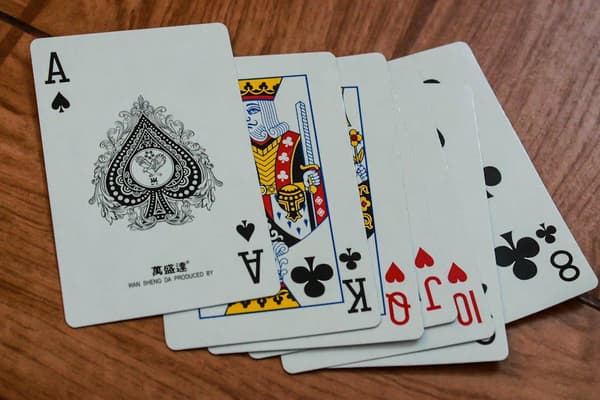
- Face Cards and Aces: When a face card or Ace is played, the next player must 'pay' a certain number of cards: Ace = 4 cards, King = 3 cards, Queen = 2 cards, Jack = 1 card.
- Paying Tribute: The paying player flips cards one at a time. If all tribute cards are number cards, the player who played the face card/Ace wins the entire pile.
- Counter: If a face card or Ace appears during tribute payment, the payment stops and the next player must now pay tribute to that new face card/Ace.
- Winning the Pile: When a tribute payment is completed entirely with number cards, the player who played the last face card/Ace collects the pile and places it at the bottom of their stack.
Winning
The game continues until one player holds all the cards. That player wins.
Tips and Strategies
- This is a game of pure luck — no strategy is involved, making it perfect for young children.
- The excitement comes from the dramatic reversals when face cards appear during tribute.
- Games can be surprisingly long or short depending on card distribution.
Tips & Strategy
Since the game is entirely luck-based, focus on the fun of the dramatic swings rather than any attempt at strategy. It is a great game for teaching young children card game basics.
There is genuinely no strategy in this game — it is one of the few card games that is completely deterministic once the cards are dealt.
Trivia & Fun Facts
Mathematicians have not yet proven whether Beggar-My-Neighbor can end in an infinite loop. It is an unsolved problem in combinatorial mathematics.
In Beggar-My-Neighbor, how many tribute cards must be paid when an Ace is played?
History & Culture
Beggar-My-Neighbor has been played since at least the 19th century and was popular among British children. It has been studied by mathematicians investigating whether it can loop infinitely.
Beggar-My-Neighbor holds a cherished place as one of the first card games many British and Commonwealth children learn, alongside Snap and War.
Variations & House Rules
Strip Jack Naked is the same game under a different name common in parts of Britain. Some versions add rules for jokers as super-face cards requiring 5 tribute cards.
For younger children, remove some number cards to increase the frequency of face card appearances and speed up the game.