
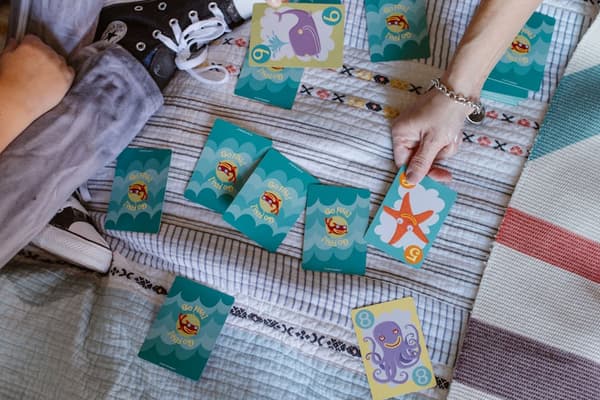
How to Play
Stealing Bundles is a children's fishing card game for 2 to 4 players where you capture table cards by matching ranks and can steal an opponent's whole bundle by matching its top card. Highest card count at the end of the deck wins.
Stealing Bundles (also Steal the Old Man's Bundle, Steal Pile, or in Spanish Casita Robada) is a children's fishing card game for 2 to 4 players using a standard 52-card deck. Each player builds a face-up bundle of captured cards, with only the topmost card visible. On your turn you play a card from your hand and try to match the rank of either a card on the table or the top card of an opponent's bundle: matching the table captures one card, but matching an opponent's bundle steals the whole pile. When all hands are empty, the dealer deals 4 more to each player and play continues until the deck runs out. Whoever ends with the most cards wins.
Quick Reference
- 2 to 4 players, standard 52-card deck.
- Deal 4 cards to each player; deal 4 face-up to the table.
- Player left of dealer plays first.
- Play one card. Match an opponent's bundle top card to steal their whole bundle, or match a table card to capture it (or several matching cards).
- If no match, leave the card face-up on the table (trail).
- When hands are empty, deal 4 more cards each from the stock; no new table cards.
- Count cards in each bundle at end of deck. Most cards wins.
- Cards left on the table are unawarded (or use the optional last-capture house rule).
Players
2 to 4 players, each playing for themselves (no partnerships). Best for ages 5 and up. Choose the first dealer at random; the deal rotates clockwise after the deck has been exhausted (usually a single 'game' uses the whole deck once). The minimum age for this game is younger than most fishing games because the only required arithmetic is rank-matching, with no addition.
Card Deck
One standard 52-card pack, no jokers. Suits are ignored for the purpose of capturing: a King matches a King regardless of suit. Standard ranks A through K (Aces are not high or low; they only match other Aces). All 52 cards will be played out across multiple deals from the same shuffled pack.
Objective
Be the player with the most cards in your bundle when the deck is exhausted and the last hand has been played. Each captured card is worth 1, so a single steal of a 10-card bundle is worth 10 captures. The objective is purely volume: there are no scoring cards or bonus cards.
Setup and Deal
- Shuffle the 52-card deck and cut.
- Deal 4 cards face-down to each player.
- Deal 4 cards face-up to the centre of the table (the 'table cards' or 'pool').
- Place the remainder of the deck face-down beside the dealer as the stock, used for re-dealing when hands are empty.
- The player to the dealer's left plays first; play proceeds clockwise.
- Misdeal: if any player has the wrong number of cards or a face-up table card is exposed during the deal of hands, reshuffle and redeal.
Gameplay
- Play one card per turn: Lay one card from your hand face-up on the table.
- Steal a bundle (highest priority): If your played card matches the rank of the top card of any opponent's bundle, you take that entire bundle and place it on top of your own. Your played card goes on top, becoming your new visible top card.
- Capture from the table: If no bundle can be stolen but your card matches the rank of one or more face-up table cards, you capture all matching table cards together with your played card; place them face-up on top of your bundle (your played card on top).
- Trail: If your card does not match anything, leave it face-up on the table to grow the pool of table cards.
- Suits ignored: A 7 captures any other 7 regardless of suit. There is no trump or special card.
- Hand exhaustion: When all four players' hands are empty, the dealer deals 4 more cards from the stock to each player (no new table cards are dealt at this point). Play continues from the player who would have played next.
- Last deal and end of game: When the stock is exhausted and the last hands have been played out, count the bundles. Cards left on the table are not awarded to anyone in standard rules (some house rules give them to the last player to capture; agree before play).
Scoring
- Count all cards in your bundle at the end. Each card is worth 1.
- Highest count wins. A complete sweep of the deck (52 cards) is theoretically possible but extremely unlikely.
- Optional house rule (last-capture bonus): Award unclaimed table cards to the player who made the most recent capture. Use only when playing with older children for a strategic twist.
- No partial credit: There is no trick-counting, no special-card bonus, just total card volume.
Winning
- Game winner: The player with the most cards in their bundle when the deck is exhausted and the final hand has been played.
- Ties: If two players are level, deal a single tiebreaker hand of 4 cards each (with 4 table cards) and play one short round; whoever captures more in that round wins.
- Match version: For a longer match, play multiple games and count games won, or sum total cards across games.
Common Variations
- Friendly Bundles (no stealing): Remove the bundle-stealing rule entirely; players only capture from the table. Recommended for the youngest players (under 6).
- Casita Robada (Argentine version): Uses a 40-card Spanish pack and counter-clockwise play; mechanics are otherwise identical.
- Rubamazzo (Italian version): Uses a 40-card Italian pack with the same rules; played widely in Italy as a children's game.
- Double Bundles: Each player maintains two separate bundles and may add captures to either; opponents may only steal one at a time. Adds defensive choice.
- Wild Jacks: Jacks may be played to steal any bundle regardless of its top card. A small power-up for older players.
- Sweep Bonus (optional): Capturing every face-up table card in one play earns the right to take an extra card from the stock.
Tips and Strategy
- Always prefer a bundle steal over a table capture. A bundle of 6 cards is six times the score of a single 1-card table capture.
- Watch the tops of all bundles. Memorise (or eyeball) the top card on every opponent's bundle so you know when a steal becomes possible.
- End your turn on a 'safe' top card. When you must play onto your bundle, choose a card whose rank is unlikely to be in opponents' hands; for example, a rank you have already seen captured several times is safer than a fresh rank.
- Don't trail high-value matches. If you have a Jack and the table holds a Jack, capture it now rather than trailing the Jack and giving opponents a chance to capture both.
- Track the deck. Older children can count which ranks have been fully captured; once all four 9s are accounted for, sitting on a 9 is perfectly safe.
- Defend against the leader. When ahead, play safer tops; when behind, play boldly to attract bundle-steal opportunities into your reach.
Glossary
- Bundle: A player's face-up capture pile, with only the top card visible to opponents.
- Table card / Pool: A face-up card in the centre, available for capture by rank-matching.
- Capture: Taking one or more table cards by matching rank; the played card and captures all go on your bundle.
- Steal: Taking an opponent's entire bundle by matching the rank of its top card.
- Trail: Adding your played card face-up to the table when no capture or steal is possible.
- Stock: The remainder of the deck used to redeal hands when they empty.
- Top card: The most recently added card on a bundle; the only card on the bundle that can be matched for a steal.
Tips & Strategy
Bundle-steals always beat table captures: a 10-card steal is worth 10 captures. Remember the top card of every bundle and end your own turn on a 'safe' rank that has already mostly been captured. Older players can track the deck to know which ranks are dead.
The defensive layer is more interesting than the offensive layer: every card you place on top of your bundle is an invitation to be stolen. Tracking which ranks have been captured tells you which ranks are safe to expose.
Trivia & Fun Facts
Because a single steal can transfer 10 or more cards in one play, Stealing Bundles can produce dramatic last-turn reversals: a player who has been losing the entire game can win the moment they steal the leader's bundle.
-
01In standard Stealing Bundles, when you can both steal an opponent's bundle and capture a table card with the same played card, which takes priority?Answer The bundle-steal takes priority; only steal one bundle, but you may not also capture from the table on the same turn (the played card lands on top of the stolen bundle).
History & Culture
Stealing Bundles has been played in English-speaking households for well over a century and remains the canonical children's introduction to the fishing-game family. Its Spanish cousin Casita Robada is widely played in Argentina, and the Italian equivalent Rubamazzo is common across Italy.
Stealing Bundles is a fixture of family card play across the English-speaking world, taught early as a stepping stone to richer fishing games like Cassino and Scopa. The Spanish and Italian versions hold equivalent status in Latin American and Italian households.
Variations & House Rules
Friendly Bundles drops the steal rule for very young players. Casita Robada and Rubamazzo are the Spanish and Italian counterparts. Double Bundles adds defensive choice. Wild Jacks adds a power-up. Sweep Bonus rewards clearing the table.
For 4-year-olds, drop the steal rule entirely (Friendly Bundles) and use a half-deck to keep the game short. For mixed-age tables, give younger players a 1-card head start in their bundle.


