
How to Play
Speed is a frantic two-player card game played with no turns: both players race simultaneously to empty their hand and draw pile onto two shared centre piles by matching cards one rank higher or lower (Ace wraps to King). Rounds last under two minutes.
Speed (also called Spit or Slam in regional variants) is a fast, simultaneous-action card game for 2 players where both participants play at the same time with no turns at all. Both players build up or down on two shared central piles, matching their played card to a rank one higher or lower than the top card (Ace wraps around to King). The first player to empty both their hand and their personal draw pile wins. A round typically lasts 30 seconds to 2 minutes and is a test of reflex, pattern recognition, and single-handed card fanning. Speed is one of the world's most widely taught school-and-camp card games and is a staple of competitive casual play between siblings and friends.
Quick Reference
- 2 players; split a 52-card deck in half.
- Each: 15-card draw pile left, 5-card hand in front, 5-card side pile between players.
- Flip the 2 face-down centre starter cards to begin.
- No turns: play simultaneously and continuously.
- Play any card one rank above or below either centre top; Ace wraps to King.
- Refill hand from your draw pile to 5.
- Both stuck? Each flips a side card to the centre at the same time.
- First to empty hand and draw pile wins the round.
- If both run out of side cards, fewest cards remaining wins.
- Match: best of 3, 5, or 7 rounds.
Players
Speed is strictly a 2-player game. The speed-matching race does not balance with more than two simultaneous players; 3 or 4 player variants are called Spit or Nerts, not Speed. There is no dealer role and no turn-taking during play; both players act continuously and simultaneously.
Card Deck
One standard 52-card French-suited deck, no Jokers. Suits are ignored: only the rank matters for matching. Rank order, forming a wrap-around circle: A-2-3-4-5-6-7-8-9-10-J-Q-K-A. So an Ace can be played on a 2 or on a King; a King can be played on a Queen or on an Ace. This circular ranking is what distinguishes Speed from its linear cousin Spit.
Objective
Be the first player to empty both your hand and your personal draw pile. The winner declares 'Speed!' (or slams the table) to confirm the win. A match is usually best-of-three or best-of-five rounds.
Setup and Deal
- Shuffle the 52-card deck thoroughly. Either player may shuffle; the non-shuffler cuts.
- Split the deck exactly in half; each player takes 26 cards. Each player shuffles their own 26 cards.
- Each player deals 15 cards face-down to their left as their personal draw pile, and 5 cards face-down in front of them as their starting hand. The remaining 6 cards of each player go face-down between the two players as replacement piles: each player places 1 card face-down on top of a small stack, and 5 cards face-down to the side as their personal side pile (total: 2 small stacks in the centre and 2 side piles of 5 cards each flanking them).
- The four face-down centre cards form two replacement pairs: two cards per player, alternating. In the most common layout: two face-down piles of 1 card each in the centre (the 'starter cards'), and one side pile of 5 cards beside each player.
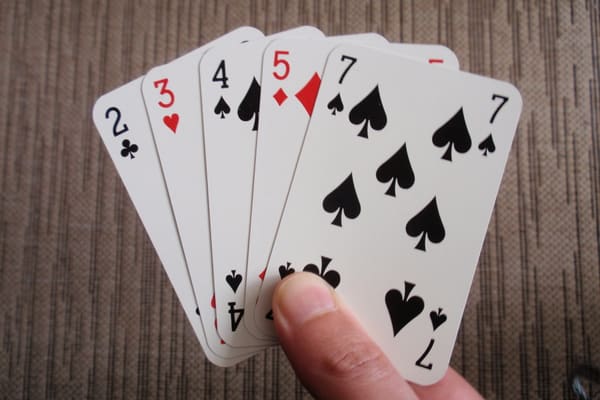
- Both players pick up their 5-card hand. Fan the cards so you can see all five at once.
- Start signal: Both players, on a synchronized count of three, flip the two face-down starter cards in the centre face-up simultaneously. Play begins immediately.
Gameplay
- No turns. Both players play simultaneously at all times. Speed is a game of reflex; whoever reaches a legal play first plays it, regardless of who played last.
- Legal play: Place any card from your hand face-up on top of either of the two centre piles, if its rank is exactly one higher or one lower than the current top of that pile. Suit does not matter. Ace wraps: A plays on 2 or on K; K plays on Q or on A.
- Refill your hand: Whenever your hand has fewer than 5 cards, immediately draw the top card of your personal 15-card draw pile. You may only refill up to 5 cards; you may not refill above 5.
- You must hold no more than 5 cards at a time. If you somehow end up with 6 (for example by drawing too early), return one to the top of your draw pile.
- Stuck position: If neither player has any legal play (neither can match either centre pile), both players silently nod and, simultaneously, each player flips the top card of their own side pile (the 5-card stack) onto one of the centre piles, replacing the top card. Play resumes immediately using the two new centre tops.
- Side pile exhausted: If a player's side pile runs out and the players become stuck again, reshuffle any unplayed centre-pile cards (except the current tops) and redistribute five to each side. Some house rules end the round at this point; agree before play.
- Ending a round: When you have played the last card of your hand and your draw pile is empty, slap the nearest centre pile (or shout 'Speed!') to win. If the opponent plays their winning card at the same instant, the player whose card landed first wins (visual judgment; when in doubt, replay the hand).
Scoring
- Speed is traditionally scored per round (win or lose), not by points.
- Round winner: The player who empties both their hand and draw pile first wins the round.
- Stuck with no side cards left: If both players are permanently stuck and have exhausted their side piles, the player with fewer remaining cards across hand and draw pile wins; ties are replayed.
- Match formats: Best-of-3 rounds is standard for casual play; best-of-5 or best-of-7 for competitive play. Some groups also play 'points': 1 point per round win, plus 1 bonus point for winning while the opponent still holds 10 or more cards (a 'clean sweep').
- Penalty rule (strict groups): Playing an illegal card (a non-matching rank) means the opponent gets a free play while you spend 2 seconds watching; a rare rule and only enforced in formal competitive play.
Winning
The first player to empty both their hand and their draw pile wins the round. In tournament play, the match is won by the first to 3 round wins in best-of-5 or 4 wins in best-of-7. If a round is declared a draw by mutual agreement (for example, both players exhausted all piles without either finishing), replay the round. There is no tiebreaker rule inside a round; a clean win requires an empty hand and draw pile.
Common Variations
- California Speed: Match cards by rank (not sequence). Lay cards face-up in a grid; any matching-rank card can be played.
- Double-deck Speed: Use two shuffled 52-card decks for a longer, higher-draw-pile game; each player gets 15 in the draw pile, 5 in hand, and 32 in the side pile.
- Speed with Jokers: Add two Jokers as wild cards; a Joker can be played on anything and the next card can match the card it was placed upon or be any rank the player announces.
- Three-hand Speed (informal): Three players, three centre piles, three side piles; each player has 17 cards in the draw pile and 5 in hand. Not a standard rule but common at summer camps.
- One-handed Speed: Players must use only one hand to play. Dramatically slows down strong players and evens the contest.
- Speed Spit hybrid: Uses Spit's 5-card grid instead of a 5-card fan; a transitional variant used to teach younger children.
- No-wrap Speed: Remove the Ace-King wrap; the Ace is the lowest card and a King is the highest, and they cannot be played on each other. Creates more stuck positions and rewards conservative play.
Tips and Strategy
- Fan your hand to see all five cards. You cannot play what you cannot see; a fanned hand lets you scan for any 8, 6, J, or K in one glance when the centre shows a 7.
- Scan both centre piles, always. A common beginner mistake is to fixate on one pile; the second pile often offers a faster legal play that wins the reflex race.
- Refill proactively. As soon as your hand drops to 4, grab from your draw pile; never play a card and then refill slowly. Practise the play-then-draw motion as a single fluid action.
- Do not hold middle ranks long. A 7 or 8 in your hand is the most playable card (it can go on a 6-7-8 or 7-8-9 pile); play it early to reduce your hand and speed up refills.
- Save one wrap-around card. Holding an Ace or a King is useful late in a round because the centre piles tend to drift into the middle ranks; a surprise Ace on a 2 or K on a Q can break a near-stuck position.
- Stay calm when stuck. A shared stuck position resolves simultaneously by flipping side cards. Panicking slows you down more than pausing for one second to plan the reopening play.
- Draw pile order matters. Since you cannot see your draw pile cards, there is nothing to do about them; but the top of the side pile is face-down too, and when you flip it to the centre, you want to flip it onto a pile that gives you more options.
Glossary
- Draw pile: Your personal face-down pile of 15 cards from which you refill your hand.
- Hand: The 5 cards you hold, fanned, and may play from.
- Centre piles: The two shared face-up piles in the middle of the table, to which both players play cards.
- Side pile: Each player's face-down flanking pile of 5 cards used to break a stuck position.
- Starter cards: The two face-down cards flipped at the start of the round to seed the two centre piles.
- Stuck: A position in which neither player has a legal play; resolved by flipping side-pile cards onto the centre.
- Wrap: The rule that Ace can be played on a King (and vice-versa), making the rank order circular.
- Clean sweep: A decisive round win in which the opponent still holds 10 or more cards.
Tips & Strategy
Fan your five-card hand so you can see every card at once, and train the play-then-draw motion into a single reflex. The fastest players also plan two plays ahead: while placing one card, they are already eyeing which card in hand will match the next top, regardless of which pile they just played on.
Because there are no turns, Speed is a game of reflex plus anticipation. The deepest skill is 'pre-loading': as you reach to play a card, your mind already identifies which card in your hand can match the expected next top on the opposite centre pile. Players who can predict both piles one move ahead consistently out-race opponents by 20-30% on total round time.
Trivia & Fun Facts
Competitive Speed rounds between matched players often last 15-20 seconds. The world's fastest reported single-round Speed game was under 9 seconds (anecdotal summer-camp folklore); at that pace, each player plays roughly 26 cards per 9 seconds, or about one card every 0.35 seconds for both hands combined.
-
01In Speed, which single rank can be played on either an Ace or a Queen due to the wrap-around rule?Answer The King; K plays on Q (one lower) or on A (one higher, wrapping around the rank circle).
History & Culture
Speed is a 20th-century American descendant of the older Spit family, which itself evolved from Nerts (an American multi-player patience game). It spread rapidly through US schools and summer camps in the 1960s-80s and became one of the most taught-by-a-sibling card games in the English-speaking world. The wrap-around Ace-King rule is the single design choice that distinguishes Speed from Spit.
Speed is arguably the most universal casual card game taught between children in the English-speaking world; it is a near-mandatory rite of passage at summer camps, slumber parties, and long car trips. Its simplicity, short round length, and tactile satisfaction of slapping cards make it a lifelong childhood memory for millions.
Variations & House Rules
California Speed matches by rank. Double-deck Speed extends a round. Speed with Jokers adds wild cards. Three-hand Speed adds a third player and centre pile. One-handed Speed equalizes unequal players. No-wrap Speed removes the Ace-King rule for more stuck positions.
For younger children, drop the wrap-around rule and use only ranks 2-10 (removing face cards and Aces) for a 36-card Speed Junior. For adults, add the penalty rule (illegal play costs two seconds of inactivity) and play best-of-7 rounds for a competitive evening.


