
How to Play
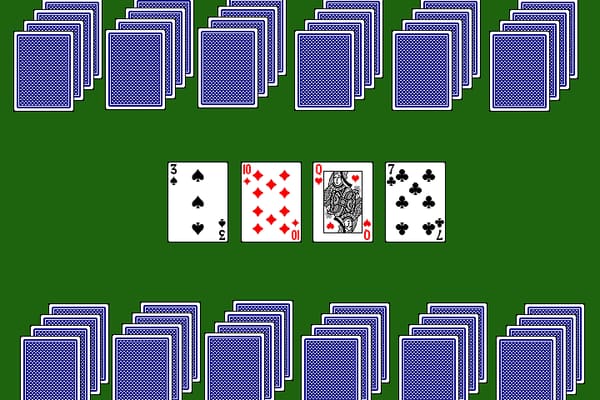
James Bond is a no-turns speed card game for 2 or 3 players. Twelve 4-card piles are dealt face-down (split between players), with 4 cards face-up in the centre. Players simultaneously swap cards between their piles and the centre; first to lock every pile as a four-of-a-kind and shout 'James Bond!' wins.
James Bond (also Chanhassen, Atlantis) is a fast real-time card game for 2 or 3 players with no turns. A standard 52-card deck is dealt into twelve face-down piles of 4 cards each (6 piles per player for 2 players, 4 piles per player for 3 players), with the final 4 cards laid face-up in the centre as the shared pool. All players play simultaneously as fast as possible: pick up any one of the 4 centre cards, swap it with any one card from any of your piles, and replace a centre card in the process. The piles stay face-down while you work on them (you may look at the cards in a pile but must return them immediately). When a pile contains four cards of the same rank, flip it face-up to 'lock' it. The first player to have ALL their piles locked as four-of-a-kind sets slaps the table, shouts 'James Bond!', and wins. If their call is wrong (any pile not actually a four-of-a-kind), they lose on the spot. The whole game usually runs 2 to 5 minutes per round.
Quick Reference
- 2 or 3 players, standard 52-card deck.
- Deal 12 piles of 4 cards face-down (6 per player for 2 players, 4 per player for 3 players).
- Place the final 4 cards face-up in the centre as the shared pool.
- No turns. All players act simultaneously.
- Take one centre card and swap it with one card from any one of your piles.
- Lock a pile (turn it face-up) when it contains four cards of the same rank.
- When all your piles are locked, slap and shout 'James Bond!' to claim the win.
- No points. First correct 'James Bond!' call wins the round.
- A false call (any pile not actually four-of-a-kind) loses the round instantly.
Players
2 or 3 players. The canonical game is 2-player head-to-head; the 3-player variant splits the 12 piles into 4 per player. With 4+ players use multiple decks or switch to a turn-based version. No partnerships exist; every player is racing individually. A single game runs 2 to 10 minutes; players often play best-of-5 or best-of-7 for a session.
Card Deck
- Standard 52-card French-suited pack, no jokers.
- Suits are irrelevant; only rank matters for completing four-of-a-kind sets.
- Card values do not matter; any four cards of the same rank (for example four 7s) complete a pile regardless of suits involved.
Objective
Convert each of your piles into a four-of-a-kind set (four cards of the same rank), faster than any other player, by swapping single cards between your piles and the 4-card centre pool. When every one of your piles is a valid four-of-a-kind, slap the table and shout 'James Bond!' to win.
Setup and Deal
- Shuffle the 52-card pack thoroughly.
- Deal out 12 piles of 4 cards each, face-down in a grid or simply lined up on the table (48 cards total).
- Place the remaining 4 cards face-up in a row between the players; this is the SHARED centre pool.
- 2 players: each player takes 6 piles (arranged in front of them) and works only on their own piles. 6 × 4 + 6 × 4 + 4 centre = 52.
- 3 players: each player takes 4 piles (4 × 3 × 4 = 48) plus the 4 centre cards = 52.
- Players do not peek before the game starts. On a 'Go!' signal, everyone begins simultaneously.
The Swap Mechanic (Real-Time)
- Pick up any ONE of the 4 face-up centre cards with one hand.
- At the same time, with your other hand, pick up any ONE card from any ONE of YOUR piles (you may briefly look at a pile's contents to choose which card to swap).
- Place the card you took from your pile face-up in the centre (where the centre card you took had been).
- Place the card you took from the centre into the pile you just pulled a card from.
- Return the pile to face-down position.
- Repeat as fast as possible. You may only hold ONE centre card and ONE pile card at a time (no hoarding).
- You may only work on ONE pile at a time; you cannot peek at multiple piles simultaneously.
- There is no turn order; all players swap at their own pace.
Locking a Pile and the Winning Call
- When one of your piles contains four cards of the same rank (for example four 9s), turn the whole pile face-up to 'lock' it. A locked pile cannot be touched again.
- Continue swapping on your remaining face-down piles.
- When ALL of your piles are face-up four-of-a-kind sets, immediately slap the table and shout 'James Bond!' to claim the win.
- Verification: opponents immediately inspect your face-up piles. If ALL piles are valid four-of-a-kind sets, you win. If ANY pile is not a four-of-a-kind (you miscounted or mis-sorted), you LOSE the game instantly and the remaining players continue to decide 2nd place.
- Simultaneous calls: if two players call at exactly the same moment, verify both; if both are valid, the player whose slap was technically first wins, or declare a draw if genuinely indistinguishable.
Winning
The first player to correctly lock every one of their piles as four-of-a-kind and make the winning call wins the round. A false call (any pile not actually four-of-a-kind) loses instantly. In best-of-N session play, tally round wins; first to the agreed target wins the match.
Common Variations
- Turn-based: players alternate swaps one at a time; removes the real-time pressure, good for young children or players who need accessibility accommodation.
- Jokers as wild: add 2 Jokers to the deck (54 cards) and redistribute so each pile still has 4 and centre has 4; Jokers can stand for any rank when completing a pile.
- 3 players, 4 piles each: the standard multi-player form; each player has 4 piles and the pace is faster because the centre is the same size.
- Team variant for 4: two teams of two, each team claims half the piles and shares information and swaps.
- Ranking restrictions: some rulebooks ban using a locked pile's rank in another pile (you cannot have two piles of 9s), forcing rank spread across piles. Standard rules do not enforce this; players agree before starting.
- Fixed stake: play for pennies or a round of drinks on each round.
- Chanhassen: a Minnesota regional name; rules identical.
Tips and Strategy
- Focus on ONE pile at a time until it is locked. Spreading attention across multiple piles wastes time re-remembering what each pile needs.
- On your first inspection of a pile, mentally tag the most-common rank. That rank becomes the target for that pile.
- If a pile has two 7s, a 9, and a K: you need two more 7s. Every swap on that pile should bring a 7 in and send out a non-7.
- Match-memory matters: when you send a card BACK to the centre, remember what it was so you can mentally map which centre cards have been through your hands.
- Watch the centre for cards that match piles you have not yet locked; a single peripheral glance between swaps can save seconds.
- Speed trumps elegance. A slightly suboptimal swap executed in 1 second beats the perfect swap executed in 3.
- For 3 players: the centre turns over faster (three swappers feed it), so cards you want may flash through quickly; reaction speed matters more than with 2 players.
Glossary
- Pile: one of your face-down stacks of 4 cards; the goal is to make each a four-of-a-kind.
- Centre pool: the 4 face-up cards in the middle of the table, shared by all players.
- Swap: exchanging exactly one card from a pile with exactly one centre card.
- Lock / locked pile: a pile turned face-up because it contains four of the same rank; locked piles cannot be touched again.
- Call ('James Bond!'): the winning shout and slap, made when every one of your piles is locked.
- False call: a call made when at least one pile is NOT a four-of-a-kind; loses the round immediately.
Tips & Strategy
Commit to one pile at a time and lock it before moving on; multitasking kills your swap rate. On first pile inspection, pick the most common rank as that pile's target and swap toward it single-mindedly. Peripheral vision on the centre matters because useful cards flash through; a quick glance between swaps can catch an Ace you need. Speed beats elegance: a slightly suboptimal swap done now beats the perfect swap done three seconds from now. Most importantly, count twice before calling 'James Bond!' because a false call loses the game instantly.
The hidden skills are pile prioritisation and peripheral vision. Expert players commit to the easiest-to-complete pile first (the one with the strongest majority rank on first inspection), lock it, then move on. They also maintain a live model of the centre pool's 4 cards at any moment and the last 4 cards they placed there, so they can capitalise on the moment a useful card flashes through. Counting the ranks you have seen (across your piles plus the centre) gives a probabilistic edge in knowing which piles are completable with remaining stock.
Trivia & Fun Facts
The shout 'James Bond!' at the moment of winning is pure theatre and has nothing to do with Fleming's 007. The game is one of the very few no-turns card games, which makes it ideal for loud, competitive family occasions because it has no downtime. Some families allow table-talk to taunt opponents during play, turning it into a raucous social event.
-
01In a standard 2-player game of James Bond, how many piles does each player have, and how many cards are in the face-up centre pool?Answer Each player has 6 piles of 4 cards (12 piles total across the table), and 4 cards sit face-up in the shared centre pool. That gives 6 × 4 × 2 players + 4 centre = 52 cards, using the full standard pack.
-
02What happens if a player calls 'James Bond!' but one of their piles is not actually a four-of-a-kind?Answer They lose the round immediately. The false call is the only way to lose instantly, so experienced players take a second to double-check each locked pile before calling.
History & Culture
James Bond the card game has no connection to Ian Fleming's fictional spy; the name is simply a fun shout. It emerged in mid-20th-century North American family card play and remains a fixture of school camps, youth groups, and family game nights. The regional name Chanhassen comes from the Minnesota suburb where one popularising group of players lived, and Atlantis shows up occasionally in New England households.
James Bond is a fixture of North American family and camp card culture, prized for its no-downtime simultaneous play and the theatrical shout that crowns the winner. It is one of the very few non-turn-based card games and therefore occupies a distinctive niche between card games and speed dexterity games.
Variations & House Rules
The turn-based slow version removes the real-time pressure for children or mixed-speed groups. Jokers-as-wild adds flexibility. The 3-player 4-piles-each variant changes the pacing because three hands compete for the same 4 centre cards. Team-of-two for 4 players works but is uncommon. Some house rules forbid using the same rank for two piles, forcing rank diversity.
Play best-of-5 rounds for a short session or best-of-9 for a longer one. For children, use the turn-based version and reduce pile count (play with 32 cards, 8 piles of 4). For adults, add Jokers as wilds or ban same-rank double-piles for a harder challenge. For parties, pair it with a round of drinks for the loser of each round.


