Get the full experience in CardRules+
300+ games with text-to-speech, game night planner, quick reference cards, and offline access.
Download on Google Play- Use two decks with Jokers.
- Deal 11 cards to each player.
- Draw from stock or take top discard (others may buy it if you pass).
- Lay down contract when complete; lay off cards on existing melds.
- Discard one card.
- Penalty points for cards left in hand each round.
- Number cards = 5, face cards = 10, Aces = 15, Jokers = 20.
Rules
Shanghai Rummy is a contract rummy variant that introduces a buying mechanic allowing players to purchase cards from the discard pile out of turn. Played over 10 rounds with escalating contracts, each round requires specific combinations of sets and runs. The buying rule creates intense competition for key cards and adds an extra layer of strategy beyond standard contract rummy.
Objective
Complete the contract for each round and minimize penalty points from cards remaining in hand. The player with the lowest total score after all 10 rounds wins.
Setup
- Players: 3-5
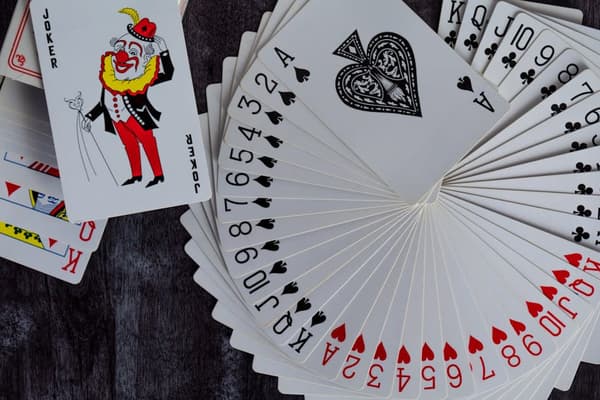
- Deck: Two standard 52-card decks with 4 Jokers (108 cards)
- Deal: 11 cards to each player. Place the rest as a stock pile and flip one card to start the discard pile.
Gameplay
- Contracts: Each round has a specific contract, typically starting with 2 sets of 3 and escalating to combinations like 3 runs of 4.
- Draw: Draw from the stock pile or take the top discard.
- Buying: If the active player does not want the top discard, other players (in clockwise order) may buy it by also drawing a penalty card from the stock. Each player is limited to a set number of buys per round (usually 2-3).
- Meld: Once you have the required contract, lay it down on your turn. After your contract is down, you may lay off cards onto any melds on the table.
- Discard: End your turn by discarding one card.
Scoring
- Number cards (2-9): 5 points each.
- 10s, Jacks, Queens, Kings: 10 points each.
- Aces: 15 points each.
- Jokers: 20 points each.
- Round penalty: Sum of card values remaining in hand.
- Winner: Lowest total score after all rounds.
Variations
- Limited buys: Some versions allow only 1 buy per round to speed up play.
- Shanghai with wilds: Deuces can be used as additional wild cards alongside Jokers.
- Short Shanghai: Reduce to 7 rounds for a quicker game.
Tips and Strategies
- Use your buys wisely and save them for cards that directly complete part of your contract.
- Pay attention to what other players buy, as it reveals what they need for their contracts.
- Try to complete your contract early so you can begin laying off cards to reduce your hand.
- In later rounds with harder contracts, do not be afraid to take penalty cards through buying if the card is critical.
Tips & Strategy
Be selective with your buys since each one adds a penalty card to your hand. Focus on completing the contract before trying to reduce your hand. Watch what others buy to track their progress.
The buying mechanic creates a cost-benefit analysis: each buy gives you a needed card but also adds to your hand size. Only buy when the card significantly advances your contract.
Trivia & Fun Facts
The name Shanghai Rummy likely comes from the idea of shanghaing or snatching cards that other players wanted. Despite the name, the game has no known connection to the Chinese city of Shanghai.
What is buying in Shanghai Rummy? Answer: Taking a discarded card out of turn, but you must also draw an extra penalty card from the stock pile.
History & Culture
Shanghai Rummy developed as a regional variant of Contract Rummy, primarily popular in the American Midwest. The buying mechanic was an innovation that added competitive tension to the otherwise orderly turn-based structure of contract games.
Shanghai Rummy is a beloved regional card game in many American communities, often played at family gatherings and social clubs. Its buying mechanic has influenced other card games and remains its most distinctive feature.
Variations & House Rules
Some groups play with 7 rounds instead of 10. The number of allowed buys per round varies from 1 to 3 depending on house rules. Some versions require natural melds (no wild cards) for the first contract.
Adjust the number of buys allowed per round to control game pace. Reduce rounds for shorter sessions. Add house rules about when Jokers in melds can be reclaimed.