
How to Play
Koi-Koi is a two-player Japanese matching and capturing game played with a 48-card hanafuda deck, where players pair cards by month to build scoring combinations called yaku and decide each turn whether to bank their points or gamble on more by calling Koi-Koi.
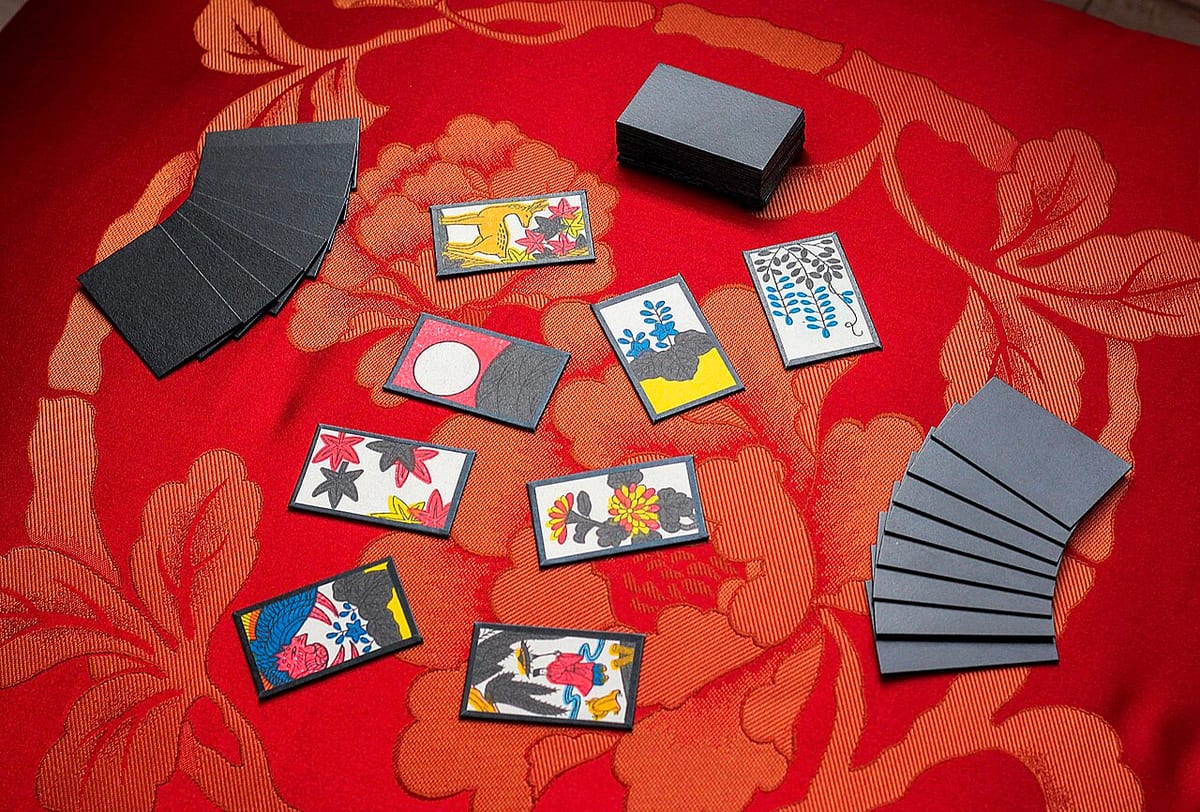
Koi-Koi is a fast-paced two-player matching and capturing game played with a 48-card Japanese hanafuda ('flower card') deck instead of a standard Western pack. Each of the deck's twelve suits represents a month of the year and carries its own flower or plant, and every card belongs to one of four value categories, bright, animal, ribbon, or plain, that combine into scoring combinations called yaku. On your turn you match a card from your hand to a card of the same month on the table to capture both, then draw a card from the deck and try to capture again; the moment you complete a new yaku you must choose to bank your points and end the hand, or call 'Koi-Koi' and keep playing for a bigger score at the risk of your opponent finishing the hand first.
Quick Reference
- Deal 8 cards face-down to each of the two players and 8 cards face-up to the shared field.
- Place the remaining 24 cards face-down as the draw pile.
- Decide who deals first; the dealer role passes to the other player after every hand.
- Play a card from your hand onto a field card of the same month to capture both, or add it to the field if nothing matches.
- Draw the top card of the deck and repeat the same matching process against the field.
- If a capture completes a new yaku, choose to stop and bank the points or call Koi-Koi and keep playing.
- Only the player who ends the hand while holding a completed yaku scores that hand.
- The hand's total is doubled if its winner called Koi-Koi earlier in that same hand.
- A hand where neither player ever completes a yaku ends in a scoreless draw.
Players
Koi-Koi is built for exactly two players, one acting as the dealer for the hand and the other as the non-dealer; the two roles alternate each subsequent hand. There are no partnerships and no fixed betting stakes in the traditional game, although many households and casual groups play for small points or tokens. A single hand usually runs 5 to 10 minutes, and a full match is traditionally played over 12 hands, one loosely tied to each month represented on the cards, so a complete session typically takes 45 minutes to an hour.
Card Deck
- The deck is a 48-card hanafuda ('flower card') pack: 12 suits, one for each month of the year, each suit made of exactly 4 cards. There are no numbers or Western suit symbols; every card is identified purely by its month and its picture.
- Every card falls into one of four value categories: 5 bright cards worth 20 points each (the Crane and Pine for January, the Curtain and Cherry Blossom for March, the Full Moon and Silver Grass for August, the Rain Man for November, and the Phoenix and Paulownia for December), 9 animal cards worth 10 points each, including the Boar, Deer, and Butterflies used in the Ino-Shika-Cho combination, 10 ribbon cards worth 5 points each, and 24 plain cards worth 1 point each.
- Of the 10 ribbon cards, 3 carry a poem and are known together as the red poetry ribbons, 3 are plain blue ribbons, and 4 are plain red ribbons; these three ribbon groups feed different scoring combinations.
- Matching is done purely by month: any two cards sharing one of the twelve suits can capture each other, regardless of their point value or picture.
Objective
The goal of each hand is to capture cards from the table and assemble them into one or more yaku, fixed scoring combinations built from specific brights, animals, ribbons, or plain-card counts. Whoever forms a yaku first may stop the hand immediately to bank its point value, or gamble on a bigger score by calling Koi-Koi and continuing to play; the winner of the hand is whichever player is the one to finally end it while holding at least one completed yaku, and the match winner is whoever has the higher running total after all hands are played.
Setup
- Shuffle the 48-card hanafuda deck thoroughly.
- Deal 8 cards face-down to each player, then deal 8 cards face-up to the table between them; these form the shared field.
- Place the remaining 24 cards face-down as the draw pile.
- The dealer for the hand is decided by agreement or by a preliminary draw, and dealing rotates to the other player for the next hand.
Gameplay
- On your turn, play one card from your hand face-up next to a table card of the same month to capture both cards into your own personal scoring pile, setting them aside face-up in front of you.
- If your played card matches exactly one field card, that pair is captured automatically; if it matches two field cards at once, you choose which one to take; if all three remaining cards of that month are already on the table, playing the fourth captures all three at once.
- If your played card matches nothing on the table, it simply joins the field face-up instead of being captured.
- After playing from your hand, draw the top card of the deck and repeat the same matching process against the field; a card drawn this way can capture, or if it matches nothing, it is added to the field.
- The instant a capture completes a new yaku you have not already scored this hand, you must choose: call 'Koi-Koi' to continue playing for additional yaku and a bigger final score, or stop the hand right there and bank the points for every yaku you currently hold.
- Turns alternate between the two players until either someone stops the hand, or both hands run out of cards after 8 turns each, at which point the hand ends automatically.
Scoring
- A hand is scored only if the player who ends it holds at least one completed yaku; the value of every yaku that player has formed is added together for that hand's score.
- If the eventual winner called Koi-Koi at any point during the hand, the hand's total score is doubled before being added to the match.
- If neither player ever completes a yaku before both hands are exhausted, the hand ends in a draw and is worth no points to either side.
- In the rare case both players finish the match with the same cumulative score, the match is recorded as a tie and replayed or split according to whatever the group agreed on before starting.
Winning
A hand ends the moment its eventual winner declines to call Koi-Koi after completing a yaku, banking that hand's score, doubled if they called Koi-Koi earlier in the same hand, onto their match total. Play then moves to the next hand with the dealer role passed to the other player. After the agreed number of hands, traditionally 12, the player with the higher cumulative score wins the match; if scores are level, the two players are considered tied for that session.
Common Variations
- Three-player Koi-Koi: an adapted deal splits the deck differently and drops or reshapes a few three-player-specific yaku, letting the game seat an extra player at the cost of some of the two-player scoring table.
- Mekuri-koi: a livelier regional variant that changes some point values and adds house-specific bonus yaku on top of the standard table.
- Capped Koi-Koi: many casual and digital versions cap how many times the score can double in a single hand, since an unbroken streak of Koi-Koi calls can otherwise produce an enormous final score.
- Money and token play: some groups replace cumulative match points with a small stake per hand, paid immediately when a hand ends rather than tracked across a full 12-hand match.
Tips and Strategy
- Watch what you leave on the field. Playing a card that does not immediately get captured hands your opponent a free target on their very next turn, so prefer captures over safe-looking discards whenever one is available.
- Weigh every Koi-Koi call against your opponent's visible progress. Calling Koi-Koi with a small lead in captured cards while your opponent is close to their own yaku can hand them the whole hand instead of doubling yours.
- Prioritize brights and the Boar-Deer-Butterflies animals early. These cards feed the highest-value yaku, so contesting them in the first few turns is usually worth more than chasing plain cards.
- Track the poetry and blue ribbons separately. Since the red poetry ribbons and blue ribbons combine into a large bonus together, holding even one of the wrong-colored ribbons can quietly kill a plan built around collecting all three of one color.
- Remember the deck is finite. With only 48 cards and 8 already visible on the field, counting which months have already been captured tells you exactly what is left to fight over in the draw pile.
Glossary
- Hanafuda: the 48-card 'flower card' deck used for Koi-Koi, divided into 12 monthly suits of 4 cards each.
- Yaku: a fixed scoring combination of specific captured cards; completing one lets a player choose to stop the hand or call Koi-Koi.
- Koi-Koi: the declaration made after completing a yaku to keep playing for a bigger score instead of stopping immediately.
- Field: the shared row of face-up cards on the table that both players draw from and capture into.
- Bright, animal, ribbon, plain: the four value categories every hanafuda card belongs to, worth 20, 10, 5, and 1 point respectively when counted toward certain yaku.
- Ino-Shika-Cho: the yaku formed by capturing the Boar, Deer, and Butterflies animal cards together.
Tips & Strategy
Favor captures over cards that will simply sit on the field for your opponent, and prioritize the brights and the Boar-Deer-Butterflies animals early since they anchor the highest-value yaku. Track which ribbon colors you and your opponent are collecting, since the red poetry ribbons and the blue ribbons only pay their full combined value when all six matching ribbons end up in the same hand. Before calling Koi-Koi, weigh your own score against how close your opponent looks to a yaku of their own, since a call that lets them finish first hands them the entire hand instead of doubling yours. With only 48 cards in play, keeping a running count of which months are already captured tells you exactly what remains to be won from the draw pile.
Because every hanafuda card matches by month alone, Koi-Koi's real decisions are about timing and risk rather than raw card ranking: which capturable card to leave for later, when a small lead is safe to bank, and when the visible field makes calling Koi-Koi worth the risk of handing the hand to your opponent. Reading the field for which of the twelve months are already fully captured narrows down what is left in the 24-card draw pile far more than most players realize, turning a seemingly luck-driven draw into a partially countable one. Because the doubling from Koi-Koi rewards aggression but punishes being caught out, the strongest players treat every completed yaku as a live decision rather than an automatic continue.
Trivia & Fun Facts
The Yakuza and Like a Dragon video game series has included a fully playable Koi-Koi minigame in numerous entries, introducing the traditional game to a global audience that had never handled a hanafuda deck before. The word 'yakuza' itself is sometimes said to trace back to a losing hand in the related game Oicho-Kabu (8-9-3, ya-ku-za), a coincidence often mentioned alongside Koi-Koi because both games share the same hanafuda deck. Each hanafuda suit's flower also marks a specific month on the traditional Japanese lunar calendar, so a skilled player is effectively reading a miniature calendar every time they scan the table.
-
01Which two animal-value cards, when captured along with the Boar, complete the Ino-Shika-Cho yaku?Answer The Deer card and the Butterflies card; together with the Boar they form the Boar-Deer-Butterflies combination worth 5 points.
History & Culture
Hanafuda cards descend from Portuguese playing cards introduced to Japan in the 16th century; when the ruling Tokugawa shogunate repeatedly banned foreign-style gambling decks, Japanese card makers redesigned them around flowers, plants, and animals so the new decks no longer resembled anything the bans named directly. Koi-Koi itself crystallized into roughly its modern form during the Meiji era of the late 19th century, spreading as a household game once hanafuda production was industrialized. One of the earliest hanafuda manufacturers, founded in 1889 to hand-paint these very cards, was Nintendo, which only moved into electronic entertainment decades later; the company still sells hanafuda decks in Japan today.
Koi-Koi and its hanafuda deck are a fixture of Japanese New Year gatherings and casual family game nights, occupying roughly the cultural space that a deck of standard playing cards holds in much of the West. The flower-and-month theme of the cards ties the game to the traditional Japanese poetic calendar, giving every suit a seasonal association well beyond its role in scoring. Its global visibility has grown substantially through video games and stylized digital adaptations, introducing hanafuda's distinctive art and Koi-Koi's push-your-luck scoring to players who have never held a physical deck.
Variations & House Rules
Three-player Koi-Koi reshapes the deal and adjusts several yaku so a third player can be seated, trading some of the tight two-player math for a livelier table. Mekuri-koi and other regional house variants adjust individual yaku values and sometimes add local bonus combinations on top of the standard scoring table. Many casual and digital adaptations cap the number of times a single hand's score can double from repeated Koi-Koi calls, since an uncapped streak can otherwise snowball into a lopsided result. Token or small-stakes versions settle a payment at the end of every hand instead of tracking cumulative points across a full match.
New players often shorten the traditional 12-hand match to 4 or 6 hands so a full session fits into a shorter sitting without losing the back-and-forth of dealer rotation. Capping Koi-Koi doubling at once per hand keeps scores from spiraling out of reach for a losing player and is an easy adjustment for family play. Playing purely for bragging rights instead of any stake removes the pressure of the doubling risk while keeping every other rule intact, which suits players who are still memorizing the yaku table.


