
How to Play
Fast social card game for 4 to 10 players in fixed pairs. Players swap cards with a 4-card centre pile trying to collect four-of-a-kind; when you have it, signal your partner silently, who shouts 'Kemps!' to win. Opponents may counter-call 'Cut!' to steal the win.
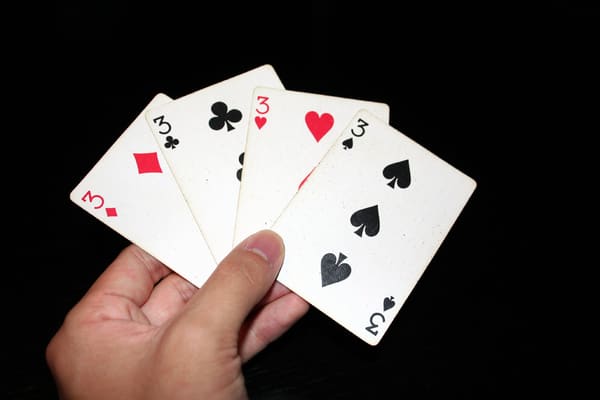
Kemps (also Kent, Cash, Canhão, Coke-and-Pepsi, Peanut Butter, Schwimmen) is a fast social card game for 4 to 10 players in fixed pairs. The dramatic appeal is not in the cards themselves but in the secret signals each pair must agree on before the hand: when a player collects four of a kind in their hand, they must silently signal this to their partner, who then shouts 'Kemps!' to win the hand for their team. Opponents who spot the signal may instead shout 'Cut!' (or 'Stop Kemps!' or 'Counter!') to steal the win by correctly calling out the opposing team's four of a kind. Each mistake or missed call gives the losing team a letter toward the penalty word K-E-M-P-S; the first pair to spell all 5 letters loses the match. Gameplay is simultaneous rather than turn-based: the dealer flips 4 cards face-up in the centre, and every player can swap one card at a time between their hand and the centre pile freely. When the centre is stale (nobody wants any card), the dealer scoops it and flips 4 new cards. The blend of cooperation, deception, rapid card-counting, and theatrical misdirection makes Kemps a mainstay of summer camps, college parties, and family gatherings.
Quick Reference
- 4 to 10 players in pairs. Teammates sit opposite, not adjacent.
- Agree on a secret partner signal before the hand.
- Deal 4 cards each; flip 4 cards face-up in the centre.
- All players simultaneously swap one card at a time between hand and centre.
- If the centre is stale, dealer discards and flips 4 new cards.
- On four-of-a-kind: signal your partner, who shouts 'Kemps!' to win.
- Spot an opponent's signal and shout 'Cut!' to steal the win.
- Losing team adds a letter to K-E-M-P-S per lost hand.
- Wrong calls (miscall Kemps or Cut): calling team takes the letter.
- First team to complete K-E-M-P-S loses the match.
Players
4 to 10 players, always in pairs: 2 teams of 2, 3 teams of 2, up to 5 teams of 2. Teammates must sit ACROSS from each other or at least not side-by-side, so signals must cross the table (making concealment harder and more fun). One standard 52-card deck works for up to 6 players; add a second deck for 8 or 10 players. A match of a single letter-race takes 10 to 25 minutes.
Card Deck
One standard 52-card French-suited pack, jokers removed, for up to 6 players. For 8 or 10 players, shuffle in a second 52-card deck (so a 'four of a kind' may mean four cards of the same rank from possibly-different decks, depending on house rule). Suits are irrelevant; only card rank matters for forming a Kemps. No trumps, no suit hierarchy.
Objective
Be the first team to NOT have the 5-letter word 'KEMPS' (or 'C-U-T' or 'C-A-S-H' in variants) spelled against you. Letters accumulate against teams through failed calls, missed signals, and being caught with a Kemps. The other team wins the moment your side adds the final letter to complete the penalty word.
Setup and Deal
- Pair up. Partners must decide privately on their secret signal for 'I have a Kemps' before the hand begins. Signals can be anything physical or behavioural: a slight eyebrow raise, a finger tap on the table, a specific cough, touching your ear, adjusting your glasses. The signal must be visible across the table but should NOT be obviously a signal (so that opponents cannot easily spot it).
- Some pairs also agree on a decoy signal (something they do often but that does NOT mean Kemps) to mislead opponents, and a secondary signal for 'I suspect the opponents are close to Kemps' to coordinate counter-calls.
- Choose a dealer. Deal 4 cards face down to each player, one at a time clockwise. Each player picks up their hand but keeps it private from other players including their partner.
- The dealer flips 4 cards face-up in the centre of the table. These form the communal market.
- The remaining deck stays face-down next to the dealer as the reserve.
- All players are now ready to play simultaneously. No turn order.
Gameplay
- Simultaneous swapping: Any player at any time may take one card from the face-up centre pile and replace it with one card from their hand. This is a 1-for-1 swap; you never hold more than 4 cards.
- Multiple players may swap at once. If two players reach for the same centre card, the first to grab it typically wins (house rule on disputes). Most groups play with a pacing implicit rule: swap one card, then wait a moment before swapping again, so everyone gets a chance.
- Reset (stale centre): if all 4 players agree nobody wants any of the 4 centre cards, the dealer sweeps them into a discard pile and flips 4 new cards from the reserve. If the reserve runs out, shuffle the discard pile to form a new reserve.
- Forming a Kemps: A 'Kemps' is four cards of the same rank in a player's 4-card hand (e.g., four Aces, four 7s, four Jacks). As soon as a player completes a Kemps, they should signal their partner using the agreed-upon signal.
- Calling Kemps: The partner (not the player who has the Kemps) must notice the signal and shout 'Kemps!' This wins the hand for their team. A player may NOT call Kemps on their own hand; the rule requires the partner to see and call.
- Counter-call (Cut / Stop Kemps / Counter): Any opposing player who believes a specific opponent has a Kemps may shout 'Cut!' (or 'Stop Kemps!' or 'Counter!' by house rule) and name the player they suspect. If correct (the named opponent really has a Kemps), the opposing team wins the hand.
- Resolving calls: When either 'Kemps!' or 'Cut!' is called, all hands are revealed. If the call was correct, the calling team wins the hand; if incorrect, the calling team LOSES the hand and takes a letter.
Scoring (The Letter Race)
- Teams track penalty letters spelling 'K-E-M-P-S' (or 'C-U-T' in some groups) on a scratch pad or whiteboard.
- Losing team adds one letter per lost hand: K first, then E, then M, then P, then S.
- Correct Kemps call (partner had the four): the opposing team adds a letter.
- Incorrect Kemps call (partner did NOT have the four): the calling team adds a letter. This is the most common misfire: impatient players miscall their partner's unrelated behaviour as a signal.
- Correct Cut call (opponent had the four): the team that was caught (and failed to call first) adds a letter.
- Incorrect Cut call (the accused opponent did NOT have four of a kind): the cutting team adds a letter.
- Missed Kemps (partner had Kemps but you did not call, and the opposing team cut first): your team adds a letter.
- Match end: the first team to complete the word K-E-M-P-S loses the match. All other teams are winners (in 3+ team games) or the surviving team wins (in 2-team games).
- Start of each new hand: collect all cards, reshuffle, redeal. Letters accumulate across hands for the whole match.
Winning
The last team standing (the team that has NOT completed the word K-E-M-P-S) wins the match. In a 2-team game, this means the first team to 5 letters loses and the other team wins. In 3+ team games, play continues until only one team has fewer than 5 letters; that team is the overall winner. Some groups play short matches with a shorter penalty word (C-U-T = 3 letters, C-A-S-H = 4 letters) for faster sessions.
Common Variations
- Kent / Cash / Canhão / Schwimmen: same game, different regional names. 'Coke and Pepsi' is common in the northeastern US and uses that phrase as the pair-name signal.
- Signal changes between hands: pairs must agree on a NEW signal each hand. Keeps opponents from learning long-term tells.
- Verbal 'tell' variant: pairs may agree on a verbal signal (a specific phrase like 'Nice weather') in addition to physical signals. Adds misdirection potential.
- 3-card Kemps: change the target to three of a kind instead of four. Makes Kemps easier to achieve; speeds up the game.
- 5-card deal: deal 5 cards each but still require four of a kind, so one card is always a dead spot. Increases strategic depth.
- C-U-T short match: penalty word is just 'C-U-T' (3 letters). Useful for quick sessions.
- Cash variant: penalty word is 'C-A-S-H'; same game, 4-letter race.
- No-counter variant: only 'Kemps!' calls are allowed; opponents cannot cut. Simpler for young children.
- Silent Kemps: no voices allowed during swaps; only the two shouted calls break the silence. Adds theatrical tension.
Tips and Strategy
- Agree on a subtle, high-frequency signal. A signal that only works once in a blue moon is useless; pick something that fits the natural tempo of the game (a finger tap every few seconds) but has a specific context trigger that means Kemps.
- Plant decoys. Do your signal on unrelated hands to muddy the opponents' read. If opponents come to expect your signal, mix in random executions with no Kemps in hand to waste their Cuts.
- Watch both opponents simultaneously. You can only call Cut if you spot the signal; divide attention so both your eyes and your partner's eyes cover the full table.
- Swap aggressively. The faster you cycle cards, the more likely you are to hit four of a kind. A cautious hand that barely swaps will rarely collect a Kemps.
- Target high-demand ranks. Several opponents are often chasing the same ranks (Aces, Kings); if you spot that two opponents are cycling Aces, the rank is a dead end for a Kemps. Switch your target to a quieter rank.
- Partner awareness. Your partner's face is your scoreboard; glance up between swaps to see if they are signalling without letting opponents see the direction of your gaze.
- Miscall judgement. 'Cut!' is riskier than 'Kemps!' because you are claiming certainty about your opponent's hand. Only Cut when you have seen a clear signal and have swap-evidence that your target has stopped cycling (suggesting their hand is complete).
- Avoid over-signalling. If your partner must signal 4 times before you notice, opponents will certainly have spotted it on signal 1. Land the signal subtly, hold it for a beat, then disguise it immediately.
Glossary
- Kemps: the target combination: 4 cards of the same rank in one player's hand. Also the name of the game and the 5-letter penalty word.
- Signal: the pair's agreed-upon secret gesture or behaviour that means 'I have four of a kind'. Pairs must agree before each match.
- Cut: the counter-call used by opponents who have spotted a Kemps signal. Also: 'Stop Kemps!' or 'Counter Kemps!' or 'Canhão!' by house rule.
- Centre / Market: the 4 face-up cards players swap with.
- Letter: a penalty mark toward the 5-letter loss word K-E-M-P-S. First team to all 5 letters loses.
- Decoy: a deliberate fake signal meant to mislead opponents.
- Stale centre: a market state where no player wants any of the 4 face-up cards. Dealer discards and flips 4 new cards.
- Partner seat: the team arrangement where teammates cannot sit side-by-side; must face each other across the table.
Tips & Strategy
Agree with your partner on a subtle, high-frequency signal that fits the natural tempo of card-swapping (a casual finger-tap, a glasses-adjust) rather than a rare gesture that opponents will quickly notice. Plant decoy signals on hands where you do not have Kemps to waste opponents' Cut calls. Swap aggressively: a cautious hand rarely reaches four-of-a-kind. Watch opponents' cycling to identify which ranks are in high demand and pivot to quieter ranks where your chances are better. Only call 'Cut!' when you have both seen a clear signal AND noticed the target stop swapping; miscalling Cut is the most common way teams lose letters. Never call Kemps on your own hand; the rule requires the partner to see and announce.
Kemps rewards observation, discipline, and misdirection over card skill. The game's card-play is almost trivial; the difficulty lives entirely in the signal-and-spot layer. Skilled pairs agree on signals that are both subtle (to evade opponents) and reliable (so the partner actually notices), plant decoys to burn opposing Cut calls, and coordinate their visual attention so one partner watches for signals while the other scans for opposing signals to Cut. The highest-EV move is often NOT to call Kemps immediately on completion but to hold for a beat, ensuring the partner has noticed cleanly, before committing.
Trivia & Fun Facts
Kemps has dozens of regional names and no single official rulebook; variations in signal rules, call phrases, and penalty words proliferate in almost every region where the game is played. The penalty word is usually K-E-M-P-S (5 letters, 5 losses), but C-U-T (3 letters, fastest match), C-A-S-H (4 letters), and even P-E-P-S-I (5 letters, used in the Coke-and-Pepsi variant) are all common. The game is a staple of summer camps, youth groups, and intensive college orientation weeks, where its combination of silent signalling and raucous calling breaks the ice between strangers quickly.
-
01In Kemps, who calls 'Kemps!' when a player has completed four of a kind, and why does the rule require this specific player to make the call?Answer The partner (not the player who holds the four-of-a-kind) must call 'Kemps!'. The rule requires this because the whole game is built on silent signalling: the holder of the Kemps must signal their partner without being spotted by opponents, and the partner must notice and call out loud to win the hand.
-
02What penalty does a team receive for calling 'Kemps!' when their partner does NOT actually have four of a kind?Answer The calling team adds a letter toward the penalty word K-E-M-P-S; the first team to complete all 5 letters loses the match.
History & Culture
The origins of Kemps are unclear, but the game is documented in North American camp and college tradition from at least the 1950s, with regional variants spreading under names like Kent (Midwestern US), Cash (Northeast), Canhão (Brazilian Portuguese communities), Schwimmen (German-American), and Coke and Pepsi (New England and Ontario). The signal-based cooperative mechanic likely evolved from older European games of the Brag family; the combination of silent partner-signalling with explosive voiced calls is the game's defining feature.
Kemps is one of the defining social card games of North American camp, church-group, and college culture. Its low barrier to entry (literally any 52-card deck) and high social energy (shouting and laughter) make it a reliable choice for large informal gatherings. The game's many regional names (Kent, Cash, Coke and Pepsi, Schwimmen, Canhão) reflect its spread through diasporic and migrant communities, and its signal-based cooperation mechanic anticipates the mainstream rise of cooperative-deduction games like The Mind and Hanabi.
Variations & House Rules
Regional names include Kent, Cash, Coke and Pepsi, Schwimmen, and Canhão; all describe essentially the same game. Signal-change variants force pairs to agree on a new signal each hand. Penalty-word variants include C-U-T (3 letters), C-A-S-H (4 letters), and K-E-M-P-S (5 letters, standard). 3-card Kemps targets three-of-a-kind instead of four. Silent Kemps bans all non-call speech. No-counter variants remove the Cut mechanic for simpler children's play.
For children, use 3-card Kemps (three of a kind) and the shorter C-U-T penalty word. For parties, use the standard 4-of-a-kind rules with K-E-M-P-S and add a wildcard jokers-in-the-deck rule (joker = wild for any rank). For competitive teams, require pairs to change their signal each hand and track bonus letters for double-Kemps (both partners completing four-of-a-kind simultaneously is worth 2 letters for opponents).


