
How to Play
An Italian 3-player no-trump trick-taking card game with an escalating 5-contract auction (Chiamo, Solo, Solissimo, Solissimo dividete, Solissimo scegliete), unusual 3-2-A-K-C-F-7-6-5-4 ranking, and fractional-point scoring capped at 6 of 11 points for the soloist to win.
Calabresella (also Terziglio in northern Italy) is a classical Italian three-player trick-taking game using the 40-card Italian deck, distinguished by its unusual card ranking (3 is highest, 4 is lowest) and its escalating auction of five contracts that each change how the 4-card stock (monte) is handled. The soloist plays alone against the other two (who form a temporary partnership); no-trump play means only cards of the led suit can win a trick. The soloist's target is to capture 6 or more of the 11 available card points (Ace = 1 point, each 3, 2, King, Knight, Jack = 1/3 point after dropping remainders) plus the last trick. Game points awarded for each successful contract scale from 1 (Chiamo) up to 16 (Solissimo scegliete); the first player or partnership to 21 game points wins the match.
Quick Reference
- 3 players, 40-card Italian deck (or 52-card stripped to A-7 + J/Q/K).
- Deal 12 cards each; 4 cards go to the stock (monte).
- Auction for contract: Chiamo (1), Solo (2), Solissimo (4), dividete (8), or scegliete (16).
- No trumps. Follow suit if able; otherwise play any card.
- Card ranking: 3, 2, A, K, Knight, Jack, 7, 6, 5, 4 (within a suit).
- Highest of led suit wins. Winner of last trick gets the set-aside stock.
- Aces = 1 pt each; 3/2/K/Knight/Jack = 1/3 pt each; last trick = 1 pt.
- Drop fractional remainders when totalling each side's score.
- Soloist needs 6+ points to claim the contract's game-point payout.
Players
3 active players, or 4 players with a rotating idle dealer (who deals but does not play that hand). Play runs counter-clockwise. The dealer changes counter-clockwise after every deal. A session typically lasts 30 to 60 minutes and ends when one side reaches 21 game points.
Card Deck
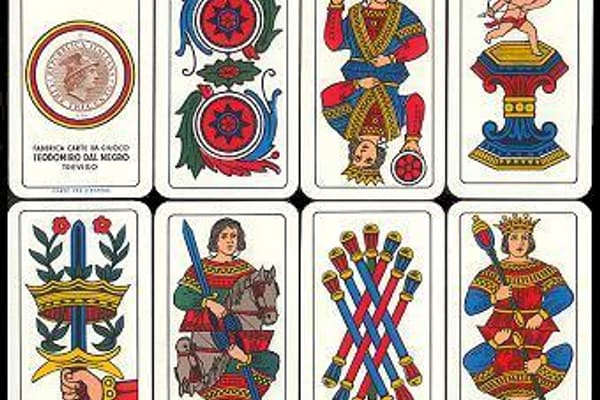
A 40-card Italian deck with four suits (Bastoni / Batons, Spade / Swords, Coppe / Cups, Denari / Coins). Each suit has King (Re), Knight (Cavallo), Knave/Jack (Fante), and pip cards 7, 6, 5, 4, 3, 2, Ace. A 52-card French pack substitutes by removing all 8s, 9s, and 10s. Card ranking (high to low within a suit): 3, 2, Ace, King, Knight (Cavallo / Queen), Jack (Fante), 7, 6, 5, 4. The 3 is the highest card, the 4 the lowest.
Objective
As the soloist, capture at least 6 of the 11 card points plus the last trick. As a defender, deny the soloist those 6 points. Across hands, first player or partnership to 21 cumulative game points wins the match. (Some groups play to 31 game points for a longer match.)
Setup and Deal
- Cut for first dealer (highest card). Deal and play pass counter-clockwise after each hand.
- Shuffle the 40-card deck. Deal 12 cards face down to each of the 3 active players (in 3 packets of 4 each).
- Place the remaining 4 cards face down on the table as the stock (or 'monte').
- The player to the dealer's right (eldest hand) opens the auction.
Auction
- Starting with eldest hand and proceeding counter-clockwise, each player may pass or declare one of five ascending contracts. A higher contract outbids a lower one; each player has one chance to outbid.
- Chiamo (Call) - 1 game point: The lowest contract. The soloist names one specific card they want (e.g., 'I call the Ace of Coins'). Whichever player holds that card passes it to the soloist face-down; the soloist gives one card of their choice face-down in return. Then the soloist picks up the 4 stock cards, adds them to their hand, and discards 4 cards face-down back to the stock (those 4 cards are set aside and will go to the winner of the last trick as captured cards).
- Solo - 2 game points: The soloist picks up the 4 stock cards and discards 4 back, without calling a specific card.
- Solissimo - 4 game points: The soloist plays with only their 12 cards; the stock is not exchanged. The 4 stock cards are set aside face-down and will go to the winner of the last trick.
- Solissimo dividete - 8 game points: Solissimo escalation. The soloist commits to playing without the stock, and each defender must exchange exactly 2 cards with the stock (face-down). Defenders coordinate silently; the soloist does not see the exchanges.
- Solissimo scegliete - 16 game points: The highest contract. The stock is turned face-up for all to see; the two defenders together decide how to split the 4 stock cards between them (typically 2-2, 3-1, or 4-0), and each discards the same number back face-down. The defenders see all 4 stock cards before committing.
- If all 3 players pass, the deal is void and the cards are re-shuffled by the same dealer.
Gameplay
- The player to the dealer's right leads the first trick.
- Follow suit if possible. Each subsequent player must play a card of the suit led if they hold one. If they cannot, they may play any card.
- No trump. No trumping is allowed; only cards of the suit led can win a trick.
- Winning a trick: The highest card of the suit led wins (using the 3-2-A-K-C-F-7-6-5-4 ranking). The trick winner leads the next trick.
- Capture piles: The soloist collects their own tricks; the two defenders share a joint capture pile.
- Last trick: After 12 tricks are played (or fewer, after stock-exchange contracts reduce hand sizes proportionally), the winner of the last trick additionally receives all 4 stock-cards-set-aside as captured cards.
Scoring
- Card point values (Italian fishing-score tradition): Each Ace = 1 point. Each 3, 2, King, Knight (Cavallo), Jack (Fante) = 1/3 point. There are 4 Aces (4 points) and 20 court/high cards at 1/3 each (6 + 2/3 points); plus 1 point for the last trick. Each side counts its captured cards, adds 1 per Ace and 1/3 per court, then DROPS any remainder fractions. Last trick bonus is 1 point for the trick-winner's side.
- Total available per deal: approximately 11 points (4 aces + 6+2/3 courts with rounding + 1 last trick).
- Soloist win condition: Soloist must capture at least 6 card points (after drop-fraction rounding) including the last-trick point to make the contract.
- Game-point payout for successful contract: Chiamo 1 point, Solo 2 points, Solissimo 4 points, Solissimo dividete 8 points, Solissimo scegliete 16 points.
- Soloist failure: If soloist fails to reach 6 card points, each defender scores the contract's value (so a failed Solo loses 2 game points to each defender, totalling -4 for the soloist across both opponents).
- Cappotto (all tricks to one side): Multiply the game-point payout by 2 if one side wins every trick.
- Stramazzo: Multiply by 3 if one side captures all the card points without winning all tricks (or conversely wins all tricks but not all points).
- Match target: First side to 21 game points (or 31 for longer sessions) wins the match.
Winning
Play continues deal by deal until one player (the soloist scoring individually) or the defender partnership as a whole reaches 21 game points. Because the defender partnership shifts (whoever is not the soloist that deal), each defender's individual running total is tracked separately and summed when they share a defending role. If both sides cross 21 on the same deal, the higher total wins; a tie is broken by one more deal.
Common Variations
- Terziglio (Northern Italian): Functionally identical but uses the name Terziglio, with slightly different contract names and a 31-game-point target.
- Calabresella a due (2-player): Played by 2 players with one playing the soloist role each deal; the partnership side is represented by dummy hands.
- Open defender play (Calabresella Aperta): Defenders reveal their hands to each other after the first trick, facilitating perfect coordination. Adjusts scoring down.
- No-stramazzo: Removes the 3x bonus for the stramazzo condition; simpler scoring for beginners.
- Chiamata-only: Novice variant playing only the Chiamo contract without the higher Solo/Solissimo options.
Tips and Strategy
- As soloist, target the 3 and 2 of your long suits. Each is a 1/3-point capture and an almost-certain winner given the 3-2-A-K-C-F-7-6-5-4 order.
- Chiamo (calling a specific card) is usually called for a missing Ace or 3 that completes a dominant holding; think of it as filling a critical gap rather than a blind strengthening.
- As a defender, lead your own weak suits into the soloist if you think your partner has a stopper; the soloist's long suit will eventually be exhausted.
- Remember that only Aces are worth a full point. Captures of 3s and 2s are individually small (1/3 each) but cumulative; a defender who gathers 3 such cards effectively captures a whole point (fractions are dropped, not accumulated with Aces).
- When bidding Solissimo scegliete (16 points), be very confident: a failed Solissimo scegliete is a 16-point swing to each defender (32 total). The only sane justifications are a 7-card solid suit with the 3 or a hand with 4 Aces plus top trumps in one suit.
- Soloists on Solo or Chiamo should void a weak suit via the discard; playing a void-suit card on an opponent's late trick is the primary way to dump losers.
Glossary
- Soloist (chiamante): The player who wins the auction and plays alone against the other two.
- Stock (monte): The 4 cards set aside after the initial deal; handled differently by each contract.
- Chiamo: The 1-point contract; soloist calls a specific card from opponents and exchanges with the stock.
- Solo: The 2-point contract; soloist exchanges with the stock without calling.
- Solissimo: The 4-point contract; soloist plays without the stock.
- Solissimo dividete: The 8-point contract; defenders each exchange 2 cards with the stock.
- Solissimo scegliete: The 16-point contract; defenders see the stock face-up and divide it between them.
- Cappotto: A sweep of all tricks by one side; doubles the game-point payout.
- Stramazzo: Winning all card points without all tricks (or vice versa); triples the game-point payout.
- Cavallo / Fante / Re: The three Italian court cards (Knight, Jack, King), each worth 1/3 point.
Tips & Strategy
As soloist, target the 3 and 2 of your long suits; they sit above the Ace in Calabresella's unusual ranking and almost always win. Choose Chiamo (1 point) to fill a specific missing card; choose Solissimo (4 points) only with a self-contained hand that does not need the stock. As a defender, coordinate silently with your partner by leading your weak suits to let your partner play their stoppers.
Calabresella's strategic depth comes from its asymmetric 1-vs-2 structure plus the huge payout gap between contracts. Chiamo is routine and low-risk; Solissimo scegliete is a rare committed play. The 'must decide which contract before play' constraint forces the soloist to evaluate not just card strength but also what information the defenders will gain from the stock exchange. Defenders face an analogous problem: is the soloist's Solo based on a solid 12-card hand, or are they hoping to improve from the stock?
Trivia & Fun Facts
Calabresella is one of the few traditional card games whose scoring explicitly uses fractions (1/3 points per court or high pip), with dropped-remainder rounding that turns simple arithmetic into a subtle scoring puzzle. The game's ranking (3 highest, 4 lowest) shares DNA with Tressette and Briscola and reflects a pre-modern Italian card tradition in which small pips held high values; the 4 being lowest is a vestige of this inverted-pip logic.
-
01In Calabresella, what is the rank order of cards within a suit from highest to lowest?Answer 3, 2, Ace, King, Knight (Cavallo), Jack (Fante), 7, 6, 5, 4. The 3 is the highest card and the 4 is the lowest.
-
02How many card points total are available in a deal of Calabresella, and how many does the soloist need to win?Answer Approximately 11 points total (4 Aces at 1 point each, 20 courts/high-pips at 1/3 each, plus 1 for the last trick); the soloist must capture at least 6 of them to succeed.
History & Culture
Calabresella originated in the Calabria region of southern Italy (hence its name, 'little Calabrian'), documented since at least the 18th century and once among the most widely played games in Italy. It is the three-handed member of the Tressette family alongside Tressette in Due (two-player) and Tressette a Quattro (partnership four-player). The escalating Chiamo-Solissimo auction structure became the template for several later European three-handed bidding games, and the game's scoring peculiarities (Aces worth more than 3s despite the 3 ranking higher) encode a compromise between older pip-ranked and point-ranked card traditions.
Calabresella carries significant cultural weight in Calabria and southern Italy, where it rivals Scopa and Briscola as a traditional pastime; the game has remained closely tied to regional identity and is played in Calabrian cafés and family gatherings to this day. Its influence on Italian and Mediterranean card-game tradition extends to the wider Tressette family and to the broader pattern of Italian 40-card-deck trick-taking games.
Variations & House Rules
Terziglio is the northern Italian name and variant with a 31-point match target. Calabresella a due is a two-player variant with dummy hands. Calabresella Aperta lets defenders reveal hands to each other after the first trick. No-stramazzo removes the 3x triple bonus. Chiamata-only is a beginner version that plays only the lowest contract (Chiamo).
For beginners, start with Chiamo-only play and introduce higher contracts once the 3-2-A-K-C-F-7-6-5-4 ranking is internalised. Play to 11 game points for a short match, 21 for standard, or 31 for tournament-length. Keep a printed contract payout card visible so players do not have to remember that Solissimo scegliete pays 16 while Chiamo pays 1.


