
How to Play
Gnav is a traditional Scandinavian (Danish/Norwegian) swap-and-bluff card game using a specialised 42-card deck (or wooden pieces from a bag) with 21 distinct ranks: Cuckoo, Dragoon, Cat, Horse, House, XII down to I, Pot, Owl, and Fool (Gnav). Each player gets one card; in turn, you stand or swap with your left neighbour. Matadors have special responses. Lowest card loses the round.
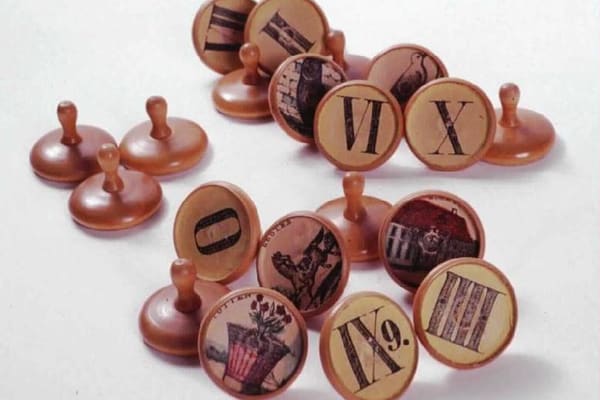
Gnav is a traditional Scandinavian one-card-at-a-time swap game played in Denmark and Norway with a specialised 42-card deck (two identical sets of 21 distinct named cards) or, equivalently, with wooden pieces drawn from a bag. Each player receives one card (or piece); the game proceeds round the table with each player in turn deciding to 'stand' (keep their card) or 'swap' with the player to their left. Some cards are 'matadors' (high-ranking special cards, such as Cuckoo, Dragoon, Cat, Horse, House) that respond to swap attempts in distinctive ways: a Cuckoo ends the round instantly, a Dragoon penalises the challenger, a Cat penalises and reverses all prior swaps, a Horse or House forces the challenger to swap with the next player instead. When every player has acted, all cards are revealed; the player with the lowest-ranked card loses the round and pays a counter (or is marked with a penalty letter toward the word GNAV). Losing four times in a row eliminates a player; the last survivor wins. Gnav is a party game of nerve and bluff, short enough that tables of 10-20 players are common, and is one of the oldest continuously-played card games in Scandinavia. It is a descendant of the Italian Cuccù and is closely related to Swedish Kille and Icelandic Hypp.
Quick Reference
- 3-20+ players; 42-card Gnav deck (21 unique cards, 2 copies each).
- Deal one card face-down to each player; remaining form the stock.
- On your turn, stand (keep your card) or swap with the player on your left.
- Matadors respond to swap attempts: Cuckoo ends the round; Dragoon penalises; Cat penalises and reverses; Horse/House redirect to next player.
- Dealer may swap with the stock instead of a neighbour.
- Lowest card at the reveal loses the round and pays 1 counter.
- Out of counters = eliminated.
- Last player remaining wins.
Players
3 to 20+ players, best at 6 to 12. Gnav works particularly well with a large table because the one-card-each deal scales with almost no effort. A minimum of 3 players is required to allow meaningful swap chains. The dealer is chosen by any agreed method; the deal rotates clockwise after each round.
Card Deck
A specialised 42-card Gnav deck consisting of two identical copies of 21 distinct named cards (so 84 total pieces in some large games). The 21 cards, ranked from highest to lowest: Cuckoo (Gjøken), Dragoon (Dragonen), Cat (Katten), Horse (Hesten), House (Huset), XII (12), XI (11), X (10), IX (9), VIII (8), VII (7), VI (6), V (5), IV (4), III (3), II (2), I (1), Pot / Flowerpot (Potten), Owl (Uglen), Fool / Gnav (Narren / Gnaven), with the Fool / Gnav as the lowest-ranked card. The five matadors (Cuckoo, Dragoon, Cat, Horse, House) are the top five and have special powers during swap attempts. The alternative wooden-piece set contains the same 21 named pieces in duplicate, drawn from a bag instead of dealt. A rough substitute can be made with a standard 52-card deck by assigning roles (e.g., Joker = Cuckoo, Kings = Dragoon, Queens = Cat, Jacks = Horse, 10s = House, 9s down to 2s as XII down to II), but the dedicated deck is traditional.
Objective
Avoid ending the round with the lowest-ranked card at the table. The loser each round pays one counter into the pool (or gains a penalty letter toward 'GNAV'); running out of counters (or completing the spelling of GNAV) eliminates you. The last remaining player wins the match.
Setup and Deal
- Each player is given an agreed number of counters (commonly 3 or 4) or a blank score area for penalty letters.
- The dealer shuffles the 42-card Gnav deck (or the wooden pieces are mixed in the bag).
- Deal exactly one card face-down to each player, clockwise from the dealer's left. If using pieces, each player draws one from the bag and keeps it hidden.
- Any remaining cards (42 minus players) form the stock, placed face-down beside the dealer.
- The player to the dealer's left begins; play proceeds clockwise.
Gameplay
- On your turn, after looking at your single card, you choose one of two actions: 'Stand' (keep your card; announce 'I stand' and pass the turn to the next player) or 'Swap' (attempt to exchange your card with the player on your left, who must accept the swap unless they hold a matador or a special card).
- Matador responses to swap attempts: If the player you try to swap with holds a matador, they reveal it and a special effect occurs, without exchanging cards. Cuckoo (highest): the round ends immediately; all players reveal their cards and the lowest loses. Dragoon: the challenger pays one counter as a penalty; no swap happens. Cat: the challenger pays one counter and all swaps made so far in this round are reversed (cards return to their original holders). Horse: the challenger must swap with the next player clockwise instead. House: same as Horse (challenger redirects to the next player).
- Dealer's special rule: The dealer, on their own turn, may exchange their card with the top card of the stock instead of swapping with a neighbour. If the dealer's swap attempt reveals a Horse or House from the stock, they may draw additional cards until they get a non-Horse/House card; unused cards go back to the stock.
- Ending the round: The round ends when either (a) every player has taken their turn (one stand or one swap attempt each), or (b) a Cuckoo is revealed during a swap attempt (which ends the round instantly). All players then reveal their cards.
- Penalty: The player(s) with the lowest-ranked card at revelation each pay one counter to the pool (or take one penalty letter: G, then N, then A, then V). If two players tie for lowest, both pay.
- Elimination: A player who runs out of counters (or completes the spelling of GNAV, i.e., 4 losses) is out of the game.
Scoring
- Each lost round costs one counter (or one penalty letter toward G-N-A-V).
- A player is eliminated when they run out of counters or complete the word GNAV.
- The last player remaining is the winner.
- Alternative scoring (counters to a pool): Winners and non-losers receive no counters; losers pay into the central pool. The winner at the end claims the entire pool.
- Cat-penalty accounting: A challenger who hits a Cat pays one counter to the Cat-holder immediately, in addition to the reversal of prior swaps.
- Dragoon-penalty accounting: A challenger who hits a Dragoon pays one counter to the Dragoon-holder.
Winning
The last player not yet eliminated is the winner. In a short session, play a fixed number of rounds (e.g., 10) and the player with the most counters / fewest penalty letters wins. The large-table variant (15-20+ players) often plays to last-standing elimination, which can take 30-60 rounds.
Common Variations
- Hypp (Swedish / Icelandic): Uses a single 21-card set instead of a 42-card duplicated deck; otherwise identical. Simpler for small groups.
- Kille (Swedish): The Swedish version; uses a slightly different card set but the same swap-mechanic core.
- Cuccù (Italian ancestor): The 40-card Italian original from the 16th-17th century; similar rules with slightly different named cards.
- Wooden-piece Gnav: Drawn from a bag rather than dealt as cards; the tradition in rural Norway.
- Counter-pool Gnav: Losers pay into a central pool, and the winner at session end claims the pool. Adds a gambling element.
- Stand-only-after-matador rule: Players may only stand if they hold a matador; otherwise they must attempt a swap. Increases tension and round-length.
- Joker-as-Fool: When using a standard 52-card deck substitute, the Joker is the lowest card (Fool / Gnav).
- Silent Gnav: No verbal announcements; players simply slide cards or refuse silently. Harder to read but shorter.
Tips and Strategy
- Stand with any matador. The five matadors (Cuckoo, Dragoon, Cat, Horse, House) are all certainties to survive. Standing immediately with a matador is the clearest win-condition play.
- Swap with any 0 through III. A I, II, or III is almost certain to lose the round; always attempt a swap to improve. The downside is a potential matador response, but the expected value of the swap is better than standing on a near-certain loser.
- Stand with IX-XII. A middle-to-high numbered card is a genuine favourite; swap only if you see clear information (e.g., an early matador reveal shows you what you can trade for).
- Hold the Cuckoo for timing. If you hold the Cuckoo and want the round to end on the current distribution, wait until the swap would hurt you; reveal Cuckoo on someone else's swap attempt at the right moment.
- Swap into Horse / House deliberately. As the third or fourth swapper, if you suspect the Horse or House is behind you, attempt a swap: the redirect gives you a second attempt at an even-better improvement.
- Track matador reveals. Each round's revealed matadors are known; in a long session you can count which matadors have appeared and still remain to be seen.
- Dealer's advantage. The dealer's stock-swap option is the single strongest position in Gnav. Always keep track of whose turn is the dealer and what they might have picked up.
- Do not tip your hand. In silent Gnav, body language leaks information. Breathe steadily whether you hold a Fool or the Cuckoo.
- Late-round Fool holders: If the turn order has passed and you are stuck with the Fool (or Gnav), you have already lost unless the Cuckoo appears. Accept the penalty gracefully.
Glossary
- Gnav: The game name; also the name of the lowest card (the Fool/Narren); also the penalty-letter word GNAV.
- Matador: Any of the five top-ranked special cards (Cuckoo, Dragoon, Cat, Horse, House).
- Gjøken (Cuckoo): Highest card; reveals to end the round instantly on a swap attempt.
- Dragonen (Dragoon): Second-highest; penalises a challenger by one counter.
- Katten (Cat): Third-highest; penalises a challenger and reverses all prior swaps.
- Hesten (Horse) / Huset (House): Fourth and fifth; redirect a challenger to the next player.
- Narren (Fool / Gnav): Lowest card; automatic loser if revealed.
- Stand: Keeping your card on your turn.
- Swap: Exchanging your card with the next player's (your left) on your turn.
- Counter (marker): The token paid by losers; running out means elimination.
- Hypp / Kille / Cuccù: Cognate Scandinavian, Swedish, and Italian versions of the game.
Tips & Strategy
Always stand with a matador (Cuckoo, Dragoon, Cat, Horse, or House). Always try to swap when holding a I, II, III or similarly low number. The dealer's stock-swap option is the strongest position in the game. Track which matadors have appeared in the current session; the Cuckoo is worth watching for the timing of a round-ending reveal. Keep your face neutral to deny opponents body-language tells.
Gnav is a short-horizon decision game with a distinctive strategic geometry: each player gets exactly one decision per round (stand or swap), but that decision involves reading the probable hands of other players and the known matador distribution. Expert players track matador appearances across a session to bias their stand-or-swap calculations: if two Cuckoos have already appeared, the remaining cards are lower on average and standing is safer. The dealer's privileged stock-swap option is the single most powerful move in the game; rotating the deal evenly across players is essential for fairness.
Trivia & Fun Facts
The name Gnav in Norwegian means 'grumpy' or 'sulky', reflecting the mood of the round's loser. In traditional Norwegian cabin play, the loser is sometimes made to wear a paper hat (the 'Gnav hat') for the next round as a mild social embarrassment. The wooden-piece version is often family-owned, with pieces carved by a relative and passed down generations; each family's piece-set becomes a minor heirloom. Gnav is also one of the few card games where the deck has its own named characters rather than suits and ranks, placing it alongside Tarot and Kabufuda as a 'named-card' game.
-
01In Gnav, what happens when a player attempts to swap with another player who holds the Cuckoo (the highest-ranked card)?Answer The round ends immediately. The Cuckoo holder reveals the Cuckoo, and all players immediately show their cards; the player with the lowest-ranked card at that moment loses the round and pays a counter (or gains a penalty letter). The Cuckoo is both the highest card and the round-ending matador, making timing its reveal a key strategic decision: a savvy Cuckoo holder waits until the distribution of other cards looks favourable to them before triggering the reveal.
History & Culture
Gnav is one of the oldest continuously-played card games in Scandinavia, descending from the Italian Cuccù of the 16th or 17th century (which itself may come from even older French or Spanish swap games). It took hold in Denmark and Norway by the 18th century, often played with hand-carved wooden pieces that gave the game a folk-art character alongside its card form. Over the next two centuries it became a staple of farmhouse evenings, winter-cabin entertainment, and family Christmas gatherings. The Swedish version (Kille) and Icelandic version (Hypp) are direct cousins with minor variations. Gnav remains a party-favourite and is produced today by several Scandinavian publishers with artisanal decks.
Gnav is a centuries-old Scandinavian social game that has outlasted most of its contemporaries. It survives as a cultural anchor in Danish and Norwegian family traditions, often played at Christmas gatherings, summer cabins, and family reunions. The wooden-piece version carries folk-craft weight; many regional museums in Norway (especially the folk museums of Gudbrandsdalen and Hallingdal) display historical Gnav sets alongside rosemaling and bunad traditions. It is a living link to pre-industrial Scandinavian rural culture and is taught to new generations as a share-the-evening party game.
Variations & House Rules
Hypp (Icelandic, 21 cards) and Kille (Swedish) are direct cousins. Cuccù is the Italian ancestor. Wooden-piece Gnav is the rural Norwegian tradition. Counter-pool Gnav adds a gambling element. Stand-only-after-matador raises tension. Joker-as-Fool lets standard decks substitute. Silent Gnav removes verbal announcements.
For a family evening, use 3 counters per player for short rounds (10-15 minutes). For a long party, use 5 counters and the counter-pool scoring. For small groups (3-4 players), use a single 21-card set (Hypp rules). For mixed ages, drop the Cat-penalty (reversal is confusing for young children) and play a simple stand-or-swap game.


