Get the full experience in CardRules+
300+ games with text-to-speech, game night planner, quick reference cards, and offline access.
Download on Google Play- Any number of players against the banker.
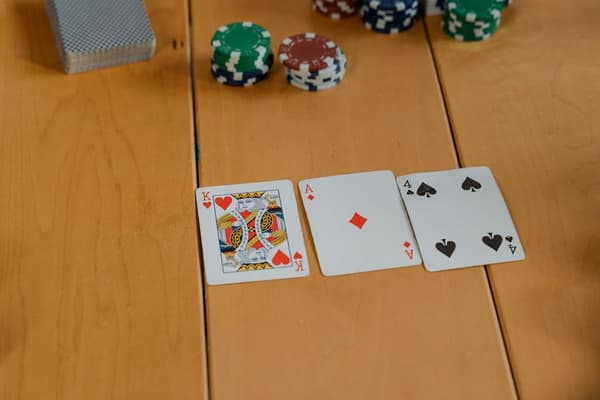
- 52-card deck dealt from a dealing box.
- A layout board showing all 13 ranks for placing bets.
- Place chips on one or more ranks on the layout.
- Dealer draws two cards: first card loses, second card wins.
- Winning bets pay even money; losing bets are collected.
- Winning bets pay 1:1.
- Splits (both cards same rank) cost half the bet.
- Calling the last turn correctly pays 4:1.
Rules
Faro is a historic banking card game that was the most popular gambling game in America from the Civil War through the early 20th century. Players bet on which rank of card will appear next by placing chips on a board displaying all thirteen ranks. The game is notable for its near-even odds and its rich place in Old West gambling history.
Objective
Correctly predict whether cards of your chosen rank will appear as the winning or losing card in each turn, placing bets on a layout board showing all thirteen card ranks.
Setup
- Players: Any number of players against the banker.
- Deck: Standard 52-card deck dealt from a dealing box.
- Layout: A board displaying all 13 card ranks (Ace through King) where players place their bets.
- Equipment: A dealing box (shoe), a casekeep (abacus-like device to track dealt cards), and betting chips.
Gameplay
- Placing bets: Players place chips on any card rank on the layout to bet that rank will win. Placing a copper token on top of the chips reverses the bet (betting to lose).
- The turn: The dealer draws two cards from the box. The first card is the losing card (banker wins bets on that rank). The second card is the winning card (players with bets on that rank win).
- Resolution: Winning bets pay even money. Losing bets are collected by the banker. Bets on ranks that did not appear remain for the next turn.
- Splits: If both cards in a turn are the same rank, the banker takes half of all bets on that rank.
- Calling the turn: When only three cards remain, players may bet on the exact order they will appear, paying 4:1 (or 1:1 for a pair).
Scoring
- Winning bets: Pay even money (1:1).
- Splits: The banker takes half of bets when both cards match the same rank.
- Calling the turn: Correctly predicting the order of the last three cards pays 4:1.
- House edge: The only house advantage comes from splits, making Faro one of the fairest casino games ever devised.
Variations
- Stuss (Jewish Faro): A simplified version where the dealer deals from hand instead of a box, with a higher house edge.
- Mexican Faro: Uses a Spanish deck without 8s, 9s, and 10s.
Tips and Strategies
- Track dealt cards using the casekeep to know which ranks still have cards in the deck.
- Avoid betting on ranks where splits are likely (two or more cards of that rank remain).
- Calling the turn on the last three cards is the most strategic moment in the game.
Tips & Strategy
Use the casekeep to track which cards have been dealt and focus your bets on ranks where all four cards are still live. Avoid ranks with split potential.
Faro is one of the most mathematically fair casino games ever created, with a house edge coming only from splits. Card tracking through the casekeep is the primary strategic tool.
Trivia & Fun Facts
The phrase 'bucking the tiger' comes from Faro, as many Faro parlors displayed a Bengal tiger on their sign. To play Faro was to 'buck the tiger.'
What popular American expression meaning 'to gamble' originated from the game of Faro?
History & Culture
Faro was brought to America by French settlers in New Orleans and became the dominant gambling game of the 19th century. Virtually every Old West saloon and gambling hall ran a Faro table.
Faro shaped American gambling culture for over a century and was featured in countless tales of the Wild West. Legends like Doc Holliday and Wyatt Earp were known Faro dealers.
Variations & House Rules
Stuss (Jewish Faro) simplified the game by removing the dealing box, but increased the house edge. Mexican Faro used a reduced Spanish deck for faster play.
Create a simple Faro layout with a printed card rank board and use a standard deck dealt from a shoe. Track cards with pen and paper instead of a casekeep.