Ottieni l'esperienza completa con CardRules+
Oltre 300 giochi con lettura vocale, pianificatore serate di gioco e accesso offline.
Scarica su Google Play- Distribuisci 10 carte a ciascun giocatore.
- Scopri una carta per la pila degli scarti.
- Pesca dal mazzo o dalla pila degli scarti.
- Scarta una carta.
- Bussa (Knock) con ≤10 punti non combinati, o dichiara Gin.
- Gin (zero non combinati) = 25 punti bonus + punti dell'avversario.
- Knock: se il chiamante ha meno punti dell'avversario, vince la differenza.
- Undercut: se l'avversario ha punti uguali o inferiori, vince 25 punti bonus.
Regole
Gin Rummy è un popolare gioco di carte per 2 giocatori in cui si mirano a formare combinazioni valide (tris e scale) e ridurre al minimo i punti non combinati.
Obiettivo
Formare combinazioni di carte (tris di valore uguale o scale dello stesso seme) e ridurre al minimo i punti delle carte non combinate.
- The game continues until one player reaches the agreed-upon point threshold, typically 100 points or another predetermined value.
- The player with the lower total score at the end of the game is declared the winner.
Preparazione
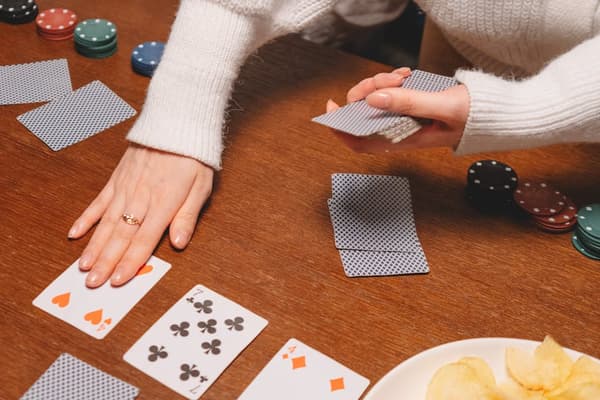
Si usa un mazzo standard da 52 carte. Distribuisci 10 carte a ciascun giocatore. Scopri una carta per la pila degli scarti.
- Shuffle the deck thoroughly.
- Determine the dealer for the first hand.
- Deal 10 cards to each player, one at a time, placing the remaining deck face-down to form the draw pile. The top card from the draw pile is flipped over to start the discard pile.
Svolgimento del gioco
A turno, ogni giocatore pesca dal mazzo o dalla pila degli scarti, poi scarta una carta. Quando la mano è sufficientemente organizzata, il giocatore può bussare (Knock) o dichiarare Gin (zero carte non combinate).
- Drawing and Discarding: Players take turns, starting with the non-dealer, drawing a card from the draw pile or the discard pile. After drawing, players must discard one card to the discard pile.
- Forming Sets and Runs: Players aim to create valid sets or runs in their hand. A valid set consists of three or four cards of the same rank. A valid run consists of three or more sequential cards of the same suit. Aces are always low only (A-2-3 is valid, but Q-K-A is not).
- Knocking: When a player believes they can form valid sets and runs with deadwood totaling 10 points or fewer, they may knock to end the round. A player draws a card first, then knocks by laying down their hand and discarding their final card. After knocking, the player arranges their hand into valid sets and runs, leaving any deadwood unmatched.
- Scoring: The player who knocks reveals their hand, and both players arrange their cards into sets and runs. Unmatched cards in each player's hand count as deadwood. Face cards (Jacks, Queens, and Kings) carry a value of 10 points each, while Aces are worth 1 point, and numbered cards are equal to their face value. The opponent may "lay off" their unmatched cards on the knocker's melds to reduce their own deadwood. If the knocking player's deadwood count is lower than their opponent's, they score the difference. If the opponent's deadwood is equal to or lower than the knocker's, it's an "undercut" — the opponent scores the difference plus a 25-point bonus. Going Gin: If a player has zero deadwood (all 10 cards in melds), they "go Gin" and score a 25-point bonus plus the opponent's entire deadwood count. The opponent cannot lay off cards against a Gin hand.
- End of Round: After scoring, the round ends, and players' scores are updated. A new round begins with the next dealer, and players receive new hands.
Consigli e strategie
Cerca di formare combinazioni il prima possibile. Osserva le carte scartate dall'avversario per capire cosa cerca.
- Organize Your Hand: Arrange your cards as soon as possible to identify potential sets and runs. Discard cards strategically to minimize deadwood and improve your hand's overall composition.
- Pay Attention to Discards: Observe the cards your opponent is discarding to gauge their hand and adjust your strategy accordingly.
- Know When to Knock: Assess your hand carefully before knocking to ensure your deadwood count is lower than or equal to your opponent's. Be wary of knocking too early, as it may give your opponent an opportunity to improve their hand.
- Be Mindful of the Draw and Discard Piles: Keep track of the cards drawn and discarded to anticipate which cards are available and which ones your opponent may need.
- Adapt Your Strategy: Flexibility is key in Gin Rummy. Be prepared to adjust your strategy based on the cards you receive and the actions of your opponent.
Varianti
Le varianti includono Oklahoma Gin (con regole diverse per bussare) e Hollywood Gin (punteggio su più partite simultanee).
Consigli e strategia
Forma combinazioni rapidamente. Usa le carte scartate dall'avversario per capire la sua mano.
La gestione delle carte scartate e la formazione veloce di combinazioni sono fondamentali.
Curiosità e aneddoti
Lo sapevi? Il Gin Rummy fu reso popolare dagli attori di Hollywood negli anni '30 e '40.
Chi inventò il Gin Rummy? Elwood T. Baker e suo figlio nel 1909.
Storia e cultura
Gin Rummy fu inventato nel 1909 da Elwood T. Baker e suo figlio C. Graham Baker a New York.
Il Gin Rummy è un classico americano apprezzato in tutto il mondo per la sua semplicità e profondità strategica.
Varianti e regole della casa
Le varianti includono Oklahoma Gin e Hollywood Gin con diverse regole di punteggio.
Sperimenta con le varianti o regola le condizioni per bussare.