Get the full experience in CardRules+
300+ games with text-to-speech, game night planner, quick reference cards, and offline access.
Download on Google Play- 4 players with a standard 52-card deck.
- Deal 13 cards each; last card dealt face-up sets trump.
- Players bid: Prop/Cop, Solo (5 tricks), Misere (0 tricks), or Abundance (9 tricks).
- Player to dealer's left leads; follow suit if possible.
- Highest card of led suit or highest trump wins the trick.
- Prop/Cop success: +2 units each; Solo: +2 units.
- Misere (win no tricks): +3 units; Abundance: +4 units.
- Failed bids cost the same number of units as the reward.
Rules
Solo Whist, a variant of the classic trick-taking card game, is widely played in various regions, known by different names such as Wiezen in Belgium or Ghent Whist. This detailed guide outlines the rules and procedures for playing Solo Whist, offering insights into its history, dealing, bidding, and gameplay mechanics.
History
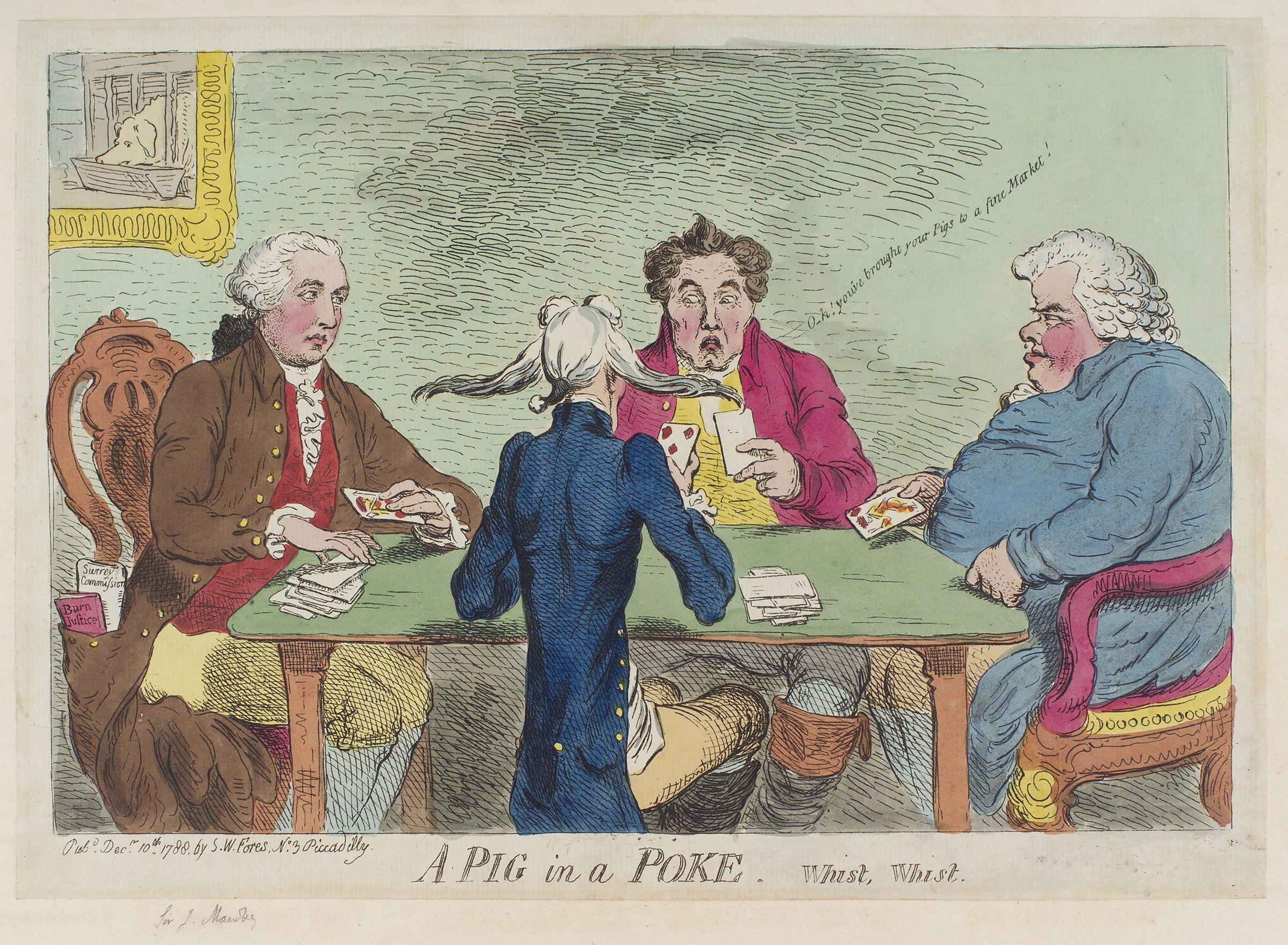
Solo Whist has a rich history dating back to the early 19th century, originating in the Low Countries. It was introduced to London in 1852 by a family of Dutch Jews, quickly gaining popularity within the city's Jewish community. Originally known as Solo Whist, it became a favorite pastime in London's sporting clubs, serving as a low-stakes gambling game. Despite the rise of Contract Bridge in the early 20th century, Solo Whist continued to be enjoyed in social settings, including homes and pubs, albeit its popularity waned over time.
Dealing
- The cards are thoroughly shuffled by the designated dealer and then cut by the player to the dealer's right.
- Cards are typically dealt in sets, following specific patterns such as 3, 3, 3, 3, 1 or variants like 4333, 3433, 3343, 3334. The final card dealt is placed face up to indicate the trump suit.
- Some players may opt for dealing the cards singly, similar to the method used in Bridge.
Bidding
Bidding begins with the player to the dealer's left and proceeds clockwise. Each player has the option to bid or pass. Bidding continues around the table until the contract is settled or all players pass. If everyone passes or there is a Prop without a Cop, the hands are reshuffled and redealt.
- Prop and Cop: Two players attempt to win eight tricks together, with the first player calling Prop and others invited to call Cop. +/- 2 units each. Both proposer and accepter score.
- Solo: One player attempts to win five tricks alone. +/- 2 units.
- Misere: A player aims to win no tricks. +/- 3 units. There is no trump.
- Abundance: A player endeavors to win nine tricks. +/- 4 units. Proposer names the trump suit.
- Royal Abundance: Similar to Abundance but with the added condition of winning nine tricks in the current trump suit (the turned-up suit). +/- 4 units.
- Misere Ouverte: A player aims to win no tricks, with their hand placed face up after the first trick. +/- 6 units. There is no trump.
- Abundance Declared: A player aims to win all 13 tricks. The bidder names the trump suit and leads first. +/- 8 units.
Gameplay
- The player to the dealer's left leads the first trick, unless it's an Abundance Declared bid, in which case the bidder leads.
- Players must follow suit if possible. Those unable to follow suit may play any card, including a trump card if available.
- The trick is won by the highest trump card played, or if no trumps are played, by the highest card in the led suit.
- Once a player has succeeded or failed in their bid, scores are adjusted accordingly.
- After the completion of a hand, the deal passes to the left, and a new hand begins.
Ending the Game
The game of Solo Whist can conclude under various circumstances:
- Target Score Reached: Players may set a target score (e.g., 500 points) at the beginning of the game. The first player or team to reach or exceed this target score wins.
- Predefined Number of Rounds: Alternatively, players may agree to play a fixed number of rounds or hands. Once all rounds are completed, the game ends, and the player or team with the highest score wins.
- Mutual Agreement: In informal settings, players may opt to end the game by mutual consent. This could occur when players reach a predetermined time limit or simply when all participants decide to conclude the game.
- Discontinuation: The game may also end if players choose to stop playing due to external factors like time constraints or unforeseen events.
Tips & Strategy
Focus on communication with your partner while also considering the potential solo contracts of your opponents. Keep track of the cards played and adapt your strategy accordingly.
Successful players in Solo Whist employ a balance of teamwork and individual skill, adapting their strategies based on the bidding, card distribution, and opponents' tendencies.
Trivia & Fun Facts
Solo Whist is known for its blend of partnership and solo contracts, adding layers of strategy and excitement to each hand.
1. What is another name for Solo Whist? 2. How many tricks must a player attempt to win in an Abundance contract? 3. What is the origin of Solo Whist?
History & Culture
Solo Whist, originating from the Low Countries in the early 19th century, gained popularity in London's Jewish community in the mid-19th century. It was introduced as a low-stakes gambling game in sporting clubs, serving as a faster alternative to traditional Whist.
Solo Whist has cultural significance as a traditional card game enjoyed in social gatherings, clubs, and family settings, particularly in British and European communities.
Variations & House Rules
Variations of Solo Whist include different bidding systems, card dealing methods, and scoring rules.
Players can customize the game by adjusting the target score, bidding conventions, or introducing additional bidding options.