
How to Play
Trappola is a Renaissance Italian 2-player trick-taking game first recorded in Venice by 1524. It uses a 36-card deck (A-K-Q-J-10-9-8-7-2) with a two-phase structure: open draw then closed follow-suit. Aces and the last-trick bonus drive scoring.
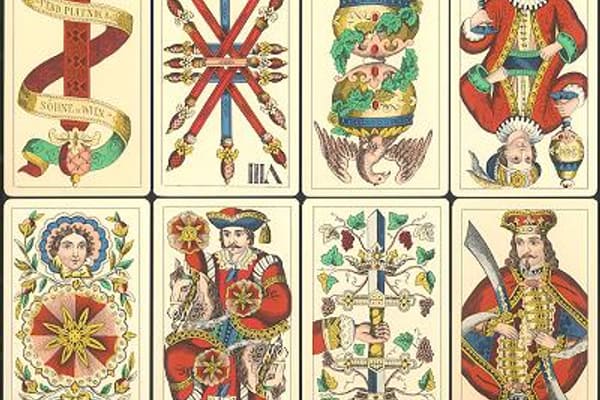
Trappola is a venerable 2-player trick-taking card game that originated in Venice by 1524, making it one of the oldest recorded card games still played in Europe. It uses a distinctive 36-card Trappola deck (or a standard pack stripped to A, K, Cavalier, Jack, 10, 9, 8, 7, 2 in each suit), with the deuce (2) acting as a high-ranking card immediately below the Jack. Each player receives nine cards in batches of three; the next card is turned up to set the trump suit, and players draw from the stock after each trick until it is exhausted. Card points, combined with a 6-point bonus for winning the last trick, determine the round winner. Trappola was among the most popular card games in Central Europe for four centuries, especially in Bohemia and Austria, before its decline in the mid-20th century; Piatnik's 1988 historical re-issue revived the game for collectors and hobbyists. It is the ancestor of several important Central European card traditions including Mariage / Schnapsen and features the earliest documented Ace-above-King rank order.
Quick Reference
- 2 players; 36-card deck (A, K, Q/Cavalier, J, 10, 9, 8, 7, 2).
- Deal 9 cards each in batches of 3; turn up next card to set trump.
- Optional: declare triples, quads, or sequences held in hand.
- Non-dealer leads; play any card.
- Open phase (stock non-empty): no follow-suit obligation.
- Closed phase (stock empty): must follow suit; must overtrump if void.
- Trick winner draws first from the stock, then the loser.
- A = 6, K = 5, Q/Cavalier = 4, J = 3, 2 = 2, 10-9-8-7 = 0.
- Last trick bonus: 6 points.
- Schneider (0 tricks): +6 to opponent. Schwarz (0 tricks, 0 points): +12.
Players
Trappola is primarily a 2-player game, played head-to-head. A 4-player partnership variant (often called Trappola Quattro) exists: two teams of two partners sit across the table; rules are identical except deals are 9 cards to each player and play proceeds clockwise. The base 2-player game is always referred to as classic Trappola and is what the rules below describe.
Card Deck
A 36-card Trappola deck or a standard 52-card French-suited deck with the 3s, 4s, 5s, and 6s removed. The nine ranks per suit are, high to low: Ace (highest), King, Cavalier (Queen in French decks), Jack, 10, 9, 8, 7, 2. The 2 is unusual: it is the fifth-ranking card in its suit, ranked just below the Jack and above the 7. The Ace-above-King rank order is one of the earliest recorded in any card game. Suit emblems in the traditional Trappola deck are Swords, Cups, Coins, and Clubs (Italian); French suits are equivalent.
Objective
Across one or more deals, be the first player (or partnership) to reach the agreed target of 30, 60, or 100 points. Each deal is worth a variable number of points based on captured cards, declarations, and the last-trick bonus.
Setup and Deal
- Shuffle the 36-card Trappola deck thoroughly. The non-dealer cuts.
- Deal 9 cards to each player, face-down, in three batches of 3 cards, alternating starting with the non-dealer.
- Turn up the next card of the 18-card stock and place it half-concealed under the stock. Its suit is the trump suit for this deal. The exposed trump remains in play and will be drawn normally later.
- Players examine their hand and may make declarations of held combinations before play (optional variant; see below). Declarations score immediately on success.
- The non-dealer leads the first trick.
Gameplay
- On your turn, play one card face-up to the trick area. The trick consists of the lead card and the response.
- Leading: The trick leader may play any card from their hand.
- Responding (during the open draw phase, stock still has cards): The responder may play any card of any suit. Following suit is not required during the draw phase; either player may trump freely or discard.
- Responding (during the closed phase, stock empty): The responder must follow suit if possible, and must trump if void of the led suit. If they hold neither the led suit nor a trump, they may play any card.
- Trick resolution: A trump card beats any non-trump card. If both cards are trumps, the higher trump wins; if both are of the led suit, the higher led-suit card wins; if the response is off-suit and non-trump, the leader always wins the trick.
- Draw after the trick: During the open draw phase, both players draw from the stock to refill their hands to 9 cards. The trick winner draws first; the loser draws second. When the last cards of the stock are drawn, the turned-up trump indicator is the final card taken; from then on, the game is in the closed phase (no more drawing, strict follow-suit rules apply).
- Winning the last trick: The trick winner scores a 6-point bonus for taking the final trick of the deal, in addition to the card-point values captured.
- Collecting captured cards: Both players stack their won tricks face-down in front of them. At deal end, both total the card-points and declaration values in their tricks pile.
Declarations (optional)
- Before the first card is led (or in some variants, at your first turn to lead), you may declare any of the following combinations held in hand after the deal. Declarations score immediately if not challenged and verified by showing.
- Three Aces: 6 points. Four Aces: 12 points.
- Three Kings: 5 points. Four Kings: 10 points.
- Three Cavaliers (Queens): 4 points. Four: 8 points.
- Three Jacks: 3 points. Four: 6 points.
- Sequence in a suit (A-K-Q or K-Q-J consecutively): 3 points per sequence; 4-card sequences score 6.
- Players may choose not to declare. Declarations bind you to the holding; if an opponent captures a member of a declared set later, the declarer loses that portion of the declared score (some variants). Agree before play.
Scoring
- Card values captured in tricks: Ace = 6 points, King = 5, Cavalier/Queen = 4, Jack = 3, 2 = 2, 10 = 0, 9 = 0, 8 = 0, 7 = 0. The 10-9-8-7 are 'blank' cards that help win tricks but score nothing on their own.
- Last trick bonus: 6 points to whoever wins the final trick of the deal.
- Declarations: Added to the declarer's score as per the declaration rules above.
- Total deal points: Sum of card values won plus last-trick bonus plus declarations. The deal winner is whoever scored more; the margin (or a fixed 1 or 2 points per deal win) is added to the match total.
- No-trick penalty (schneider): A player who wins zero tricks is said to be 'schneider'; their opponent scores a bonus of 6 points for the deal. A player who wins zero tricks and captures zero points is 'schwarz'; the opponent scores a bonus of 12 points.
Winning
Play multiple deals until one player or partnership reaches the agreed target (typically 30 points for a short match, 60 for a standard match, or 100 for a long match). If both sides cross the target in the same deal, the higher total wins; if exactly tied, one tie-breaker deal settles the match.
Common Variations
- Czech Trappola (Taroky / Trapulka): Uses slightly different point values (Ace = 5, King = 4, and so on) and mandates declarations as part of the deal.
- Austrian Trappola: Includes an exchange phase where both players may swap up to three cards with the stock before the first lead; the exchange tightens the draw phase.
- 4-player partnership Trappola: Two teams of two, 9 cards each, follow-suit rules apply throughout (no open draw phase). Partner signals are allowed.
- Trappola mit Talon: The stock is called the 'talon' and forms the basis for exchange. Common in older German-language rule books.
- Blind Trappola: Skip the declarations and play only with card points and last-trick bonus. Reduces memory load; good for beginners.
- No-2 Trappola: Remove all four 2s (32-card variant) for a sharper game where points concentrate in A-K-Q-J only.
Tips and Strategy
- Count the stock. With 18 cards in the stock, there are 9 full draw cycles. Once the stock is down to 2 cards, you know the last draw is imminent; play the final tricks assuming strict follow-suit will soon apply.
- Hold trump Aces and Kings for the closed phase. In the open draw phase, opponents can freely discard trumps if they have them. After the stock is gone, they must follow suit; that is when your high trumps become unblockable.
- The 2 is a sneaky 2 points. Many beginners ignore it because it sits below the Jack, but four 2s captured in tricks equal one Ace's worth of points. Sweep them when you can.
- Win the last trick if possible. The 6-point bonus is worth an Ace; a strong trump saved for the final trick often wins the deal.
- Declare big combinations immediately. A declared triple of Aces scores 6 points before a single card is played, and gives you confidence to lead those Aces aggressively.
- Track captures, not just card-points. Three Kings captured across the deal could be worth 15 points; if you already have two in your pile, aggressively play trump Kings to drag the third out of your opponent's hand.
Glossary
- Trappola deck: The specialised 36-card Italian pack with ranks A, K, C (Cavalier / Queen), J, 10, 9, 8, 7, 2 in each suit.
- Cavalier: The third-highest court card in the Trappola pack (equivalent to the Queen in French-suited decks).
- Open draw phase: The first phase of play, while the stock contains cards; no follow-suit obligation.
- Closed phase: The second phase, once the stock is exhausted; strict follow-suit and overtrump rules apply.
- Talon: The face-down stock from which players draw after each trick.
- Trump indicator: The exposed card beneath the stock that sets the trump suit.
- Declaration: An announced combination held in hand (triples, quads, or sequences) that scores extra points.
- Schneider: Winning zero tricks in a deal; the opponent scores a bonus of 6 points.
- Schwarz: Winning zero tricks and zero card-points; bonus doubles to 12 points.
Tips & Strategy
Count the stock and plan for the phase transition. Hold at least one high trump back for the closed phase when strict follow-suit rules activate; that card is often unstoppable. Declare combinations at once to lock in free points before the first lead.
The signature strategic puzzle of Trappola is the phase transition. Early in the deal, both players draw from the stock and have no follow-suit obligation, which lets you play any card at any time; the moment the stock runs out, follow-suit becomes mandatory, and any high trump you held in reserve becomes nearly unbeatable. Expert play is built around counting the stock, timing the transition, and loading trumps into your closed-phase hand.
Trivia & Fun Facts
Trappola is the earliest recorded card game where the Ace ranks above the King; this rank order was a 16th-century innovation and eventually became the dominant convention in Western card games. The unusual high-ranking 2 (deuce) is a relic of that innovation; when card-makers decided the Ace outranks the King, they simultaneously promoted the 2 to a quasi-court position.
-
01In Trappola, which two card ranks are worth the most individual points when captured in tricks?Answer Aces (6 points each) and Kings (5 points each); all four Aces in your captures equal a 24-point haul.
History & Culture
Trappola first appeared in Venice by 1524 and spread rapidly across Central Europe, reaching Germany, Austria, Bohemia, and beyond. It was the single most important game of the Italian Renaissance card tradition and introduced the Ace-above-King rank order that later became standard in many European games. Piatnik produced Trappola cards continuously until 1944 and reissued them historically accurate in 1988.
Trappola defined four centuries of Central European card-playing culture, spreading from Venice to Bohemia, Austria, and the German lands. Its specialised deck influenced the development of Tarock, Tarot, and Schafkopf families. Modern historical-game circles treat a Trappola match as the closest living link to 16th-century Italian card play.
Variations & House Rules
Czech Trappola modifies point values and mandates declarations. Austrian Trappola adds a card-exchange phase. 4-player partnership Trappola uses identical deals but always enforces follow-suit. No-2 Trappola removes the odd 2-ranking for a simpler pack.
For a short introduction, play to 30 points with only card-points and last-trick (no declarations); for a full traditional match, play to 100 points with full declarations, schneider, and schwarz penalties. Use the authentic Piatnik historical pack to recreate a genuine Renaissance experience; rules are identical.


