Get the full experience in CardRules+
300+ games with text-to-speech, game night planner, quick reference cards, and offline access.
Download on Google Play- 2 players with a standard 52-card deck.
- Deal 10 cards each; flip one card to start the discard pile.
- Draw one card from the draw pile or discard pile.
- Organize cards into sets (same rank) and runs (same suit, sequential).
- Discard one card to end your turn.
- Knock when deadwood is 10 or fewer; go Gin with zero deadwood.
- Knocker scores the difference in deadwood if theirs is lower.
- Undercut: if opponent's deadwood is equal or lower, they get 25 bonus + difference.
- Going Gin: 25 bonus + opponent's full deadwood count.
- First to 100 points wins the game.
Rules
Gin Rummy is a classic card game renowned for its blend of strategy and skill. Players aim to form sets and runs of cards in their hand, ultimately striving to be the first to empty their hand or minimize their remaining points.
Objective
The objective of Gin Rummy is to score fewer points than your opponent by forming sets (three or four cards of the same rank) and runs (three or more sequential cards of the same suit).
- The game continues until one player reaches the agreed-upon point threshold, typically 100 points or another predetermined value.
- The player with the lower total score at the end of the game is declared the winner.
Setup
- Shuffle the deck thoroughly.
- Determine the dealer for the first hand.
- Deal 10 cards to each player, one at a time, placing the remaining deck face-down to form the draw pile. The top card from the draw pile is flipped over to start the discard pile.
Gameplay
- Drawing and Discarding: Players take turns, starting with the non-dealer, drawing a card from the draw pile or the discard pile. After drawing, players must discard one card to the discard pile.
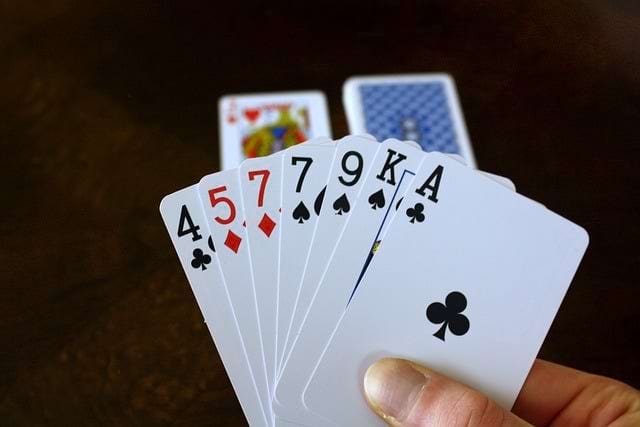
- Forming Sets and Runs: Players aim to create valid sets or runs in their hand. A valid set consists of three or four cards of the same rank. A valid run consists of three or more sequential cards of the same suit. Aces are always low only (A-2-3 is valid, but Q-K-A is not).
- Knocking: When a player believes they can form valid sets and runs with deadwood totaling 10 points or fewer, they may knock to end the round. A player draws a card first, then knocks by laying down their hand and discarding their final card. After knocking, the player arranges their hand into valid sets and runs, leaving any deadwood unmatched.
- Scoring: The player who knocks reveals their hand, and both players arrange their cards into sets and runs. Unmatched cards in each player's hand count as deadwood. Face cards (Jacks, Queens, and Kings) carry a value of 10 points each, while Aces are worth 1 point, and numbered cards are equal to their face value. The opponent may "lay off" their unmatched cards on the knocker's melds to reduce their own deadwood. If the knocking player's deadwood count is lower than their opponent's, they score the difference. If the opponent's deadwood is equal to or lower than the knocker's, it's an "undercut" — the opponent scores the difference plus a 25-point bonus. Going Gin: If a player has zero deadwood (all 10 cards in melds), they "go Gin" and score a 25-point bonus plus the opponent's entire deadwood count. The opponent cannot lay off cards against a Gin hand.
- End of Round: After scoring, the round ends, and players' scores are updated. A new round begins with the next dealer, and players receive new hands.
Tips and Strategies
- Organize Your Hand: Arrange your cards as soon as possible to identify potential sets and runs. Discard cards strategically to minimize deadwood and improve your hand's overall composition.
- Pay Attention to Discards: Observe the cards your opponent is discarding to gauge their hand and adjust your strategy accordingly.
- Know When to Knock: Assess your hand carefully before knocking to ensure your deadwood count is lower than or equal to your opponent's. Be wary of knocking too early, as it may give your opponent an opportunity to improve their hand.
- Be Mindful of the Draw and Discard Piles: Keep track of the cards drawn and discarded to anticipate which cards are available and which ones your opponent may need.
- Adapt Your Strategy: Flexibility is key in Gin Rummy. Be prepared to adjust your strategy based on the cards you receive and the actions of your opponent.
Variations
There are several variations of Gin Rummy, including Oklahoma Gin, Hollywood Gin, and Straight Gin, each with its own set of rules and nuances.
Tips & Strategy
Pay attention to the cards discarded by opponents. Discard cards strategically to mislead your opponents and improve your own hand.
Timing is crucial in Gin Rummy. Know when to knock and when to hold onto cards to maximize your chances of forming winning melds.
Trivia & Fun Facts
Gin Rummy is said to have been invented by Elwood T. Baker and his son C. Graham Baker in 1909. It has been a favorite pastime for many notable personalities, including celebrities and politicians.
In Gin Rummy, what is the term for a hand where all cards form valid sets and runs, with no unmatched cards?
History & Culture
Gin Rummy originated in the early 20th century and gained popularity as a variant of Rummy. It has since become one of the most widely played forms of Rummy.
Gin Rummy has cultural significance in many regions and is often played in social settings and tournaments. It has been featured in various forms of popular culture, including literature and film.
Variations & House Rules
Gin Rummy has variations such as Oklahoma Gin and Hollywood Gin. These variants introduce additional rules and scoring mechanisms to the game.
Experiment with different scoring systems or introduce house rules to add variety to your Gin Rummy games.