Get the full experience in CardRules+
300+ games with text-to-speech, game night planner, quick reference cards, and offline access.
Download on Google Play- Use a standard 52-card deck (no Jokers).
- Deal 13 cards face-down to each of 2-4 players.
- Arrange cards into: front (3 cards), middle (5 cards), back (5 cards).
- Back must be strongest, middle next, front weakest.
- All players reveal simultaneously and compare corresponding hands.
- Win points for each hand you beat an opponent's matching hand.
- Fouling (wrong hand order) means you lose all three hands.
- Bonus points for special hands like flushes or full houses.
Rules
Chinese Poker is a card game that originated in Asia. It is typically played with four players, each receiving 13 cards from a standard 52-card deck. The game is renowned for its simplicity and strategic depth, making it a favorite among casual and competitive players alike.
Chinese Poker is also known as Pusoy or Russian Poker.
Objective
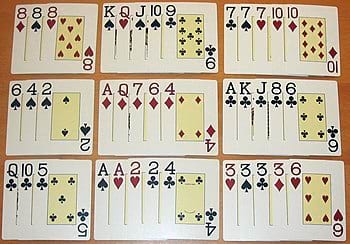
The objective of Chinese Poker is to arrange your 13 cards into three poker hands: a front hand of three cards, a middle hand of five cards, and a back hand of five cards. The goal is to create the highest-ranking hands possible, beating your opponents' hands to earn points.
Setup
- Players: Chinese Poker is ideally played with four players, but variations exist for two or three players.
- Deck: Use a standard 52-card deck with jokers removed.
- Dealing: The dealer shuffles the deck thoroughly and deals 13 cards face-down to each player.
Hand Formation
- Players arrange their 13 cards into three separate hands: a front hand of three cards (weakest), a middle hand of five cards, and a back hand of five cards (strongest).
- The back hand must be the strongest, followed by the middle hand. The front hand must be the weakest. Violating this order is called a 'foul' and the player loses all three hands.
Scoring
- Hands are scored based on standard poker hand rankings, with each player's front hand compared against opponents' front hands, the middle hand against middle hands, and the back hand against back hands.
- Winning a hand against an opponent earns points based on the strength of the winning hand.
- Various scoring systems exist, but commonly, points are awarded for winning individual hands and for achieving certain bonus combinations, such as a flush or a full house across all three hands.
Comparison
After all players have arranged their hands, comparisons are made between corresponding hands of each player. For example, each player's front hand is compared against the front hands of all other players, and points are awarded accordingly.
Endgame
The game typically consists of multiple rounds, with players tallying points at the end of each round. The player with the highest total score at the end of the predetermined number of rounds wins the game.
Special Rules and Variations
- Open Face Chinese Poker (OFC): OFC is a popular variant where players gradually reveal their hands as they are dealt cards, allowing for strategic decisions based on the information available. OFC introduces additional rules and scoring systems, such as royalties for specific hands and penalties for fouling.
- Fantasyland: In Open Face Chinese Poker, achieving QQ (pair of Queens) or better in the front hand allows a player to enter Fantasyland in the next round. Fantasyland grants the player the advantage of seeing all 13 cards at once, providing an opportunity to arrange optimal hands.
- Variant Scoring Systems: Different groups may use custom scoring systems, awarding points differently for various hand strengths and bonus combinations.
- Three-Player and Two-Player Variants: In games with fewer than four players, adjustments are made to the number of cards dealt and the scoring system to maintain balance and fairness.
Tips for Success
- Hand Management: Strategically organize your cards into strong hands, prioritizing the formation of a powerful top hand while ensuring the bottom and middle hands are strong enough to compete.
- Risk Assessment: Evaluate the potential of your hand and the hands of opponents, adjusting your strategy based on the cards revealed and the scoring system in use.
- Positioning: Consider your position at the table and the actions of other players, using this information to make informed decisions and gain an advantage.
Tips & Strategy
To excel in Chinese Poker, focus on hand management, risk assessment, and positional play. Adapt your strategy based on the variant being played and the actions of your opponents.
Strategic thinking is paramount in Chinese Poker, where players must balance risk and reward, anticipate opponents' moves, and capitalize on opportunities to build winning hands.
Trivia & Fun Facts
Did you know? Chinese Poker is sometimes called 'Russian Poker' due to its popularity in Russia.
What is the significance of Fantasyland in Chinese Poker variants? How does Open Face Chinese Poker differ from traditional Chinese Poker?
History & Culture
Chinese Poker has roots in traditional poker and has evolved over time into various regional and variant forms. It continues to be popular in both casual and competitive settings.
Chinese Poker holds cultural significance in regions where it is played, serving as both a social pastime and a competitive endeavor that fosters camaraderie and strategic thinking.
Variations & House Rules
Explore different variants of Chinese Poker, including Open Face Chinese Poker (OFC) and Fantasyland variants, each offering unique gameplay mechanics and challenges.
Customize your Chinese Poker games by experimenting with different scoring systems, variant rules, and house rules. Encourage creativity and strategic thinking among players.